



-
 Written By:
Amber Asher, MSW, LSW
Written By:
Amber Asher, MSW, LSW -
 Edited By:
Phyllis Rodriguez, PMHNP-BC
Edited By:
Phyllis Rodriguez, PMHNP-BC
-
 Clinically Reviewed By:
Dr. Ash Bhatt, MD, MRO
Clinically Reviewed By:
Dr. Ash Bhatt, MD, MRO
Key Takeaways
- Trazodone is FDA-approved only for major depressive disorder, its use for anxiety is off-label, and one of the only controlled trials to test it against a benzodiazepine for generalized anxiety disorder used doses far higher than the 50 mg or 100 mg most people search for.
- Feeling calmer on trazodone usually means you’re finally sleeping, not that your anxiety disorder is being treated. This distinction matters if you’re deciding whether to stay on it long-term or ask about something else.
- Anxiety that appears after drinking or after you stop can be alcohol withdrawal, not a standalone anxiety disorder, and withdrawal can escalate to seizures, which can not be prevented by using trazodone.
If you’ve been prescribed trazodone, or you’re wondering whether it’s worth asking your doctor about, you likely have one specific question: does this medication actually treat anxiety, or does it just make you drowsy enough that the anxiety feels quieter?
In this article, we’ll break down what trazodone is FDA-approved to do, how 50 mg compares to 100 mg, whether it can stop a panic attack in the moment, and why anxiety that shows up around drinking or stopping alcohol needs a different kind of attention entirely.
Does Trazodone Help With Anxiety?
Trazodone can reduce anxiety symptoms in some people, but it isn’t FDA-approved for anxiety, and the evidence supporting it is considerably thinner than for medications built specifically for anxiety disorders. The FDA approved trazodone in 1981 for major depressive disorder, while, insomnia, anxiety, PTSD-related sleep disturbance, falls outside that approval, and hence it’s off-label prescribing.
That distinction shapes how much weight the evidence deserves. A randomized, placebo-controlled trial published in 1993 compared trazodone, diazepam, and placebo across 230 people with generalized anxiety disorder over eight weeks and found meaningful improvement with trazodone, though the researchers themselves noted the results needed replication and used flexible, considerably higher doses than the 50 mg or 100 mg commonly discussed for sleep. Till now, it remains one of the only trials of its kind, and no research supports trazodone for panic disorder or agoraphobia.
Off-label prescribing at this scale isn’t rare, but it’s worth understanding how common it actually is. Roughly 85% of the 24 million trazodone prescriptions filled in the U.S. in 2019, about 20 million prescriptions were for off-label uses, primarily insomnia, according to a Medical Expenditure Panel Survey analysis. Doctors often reach for it when anxiety and insomnia occur together, using it to handle the sleep piece while a separate medication or therapy handles the anxiety itself.
How Does Trazodone Affect the Brain?
Trazodone works mainly by blocking serotonin 2A receptors and inhibiting serotonin reuptake, while also blocking histamine and alpha-1 adrenergic receptors, a combination that produces sedation more reliably than it produces sustained anxiety relief.
Dose matters here more than most people realize:
- 25–100 mg: Sedation-dominant. This is the range used for sleep, and where most anxiety-related searches (“50mg,” “100mg”) land.
- 150–600 mg: The antidepressant range, requiring broader serotonin reuptake inhibition, but most people don’t tolerate these doses well due to drowsiness and low blood pressure on standing.
This is different from how anxiety-specific medications work. SSRIs and SNRIs recalibrate mood and anxiety pathways over weeks of consistent use. Benzodiazepines act directly on GABA receptors for rapid calming. Trazodone does neither particularly well, it calms the nervous system enough for sleep, not the anxiety response itself.
Why Is Trazodone Sometimes Used When Someone Has Anxiety?
Trazodone is sometimes prescribed for anxiety because anxiety and insomnia frequently feed each other, The cycle usually looks like this:
- Anxious thoughts intensify at night, making it harder to fall or stay asleep
- Poor sleep increases next-day irritability, physical tension, and emotional reactivity
- That heightened reactivity makes the following night’s sleep even harder
- The cycle repeats and compounds over time
Addressing the sleep piece can have genuine value here, and research has found trazodone improves several sleep measures, though sleep-medicine guidelines have also flagged limitations in that evidence and don’t recommend it as a routine chronic-insomnia treatment.
| Clinical Insight from Dr. Ash Bhatt: Sleep-medicine guidelines from the American Academy of Sleep Medicine actually recommend against using trazodone as a routine treatment for chronic insomnia, precisely because the sedation it produces doesn’t reliably translate into durable sleep-architecture improvement. In practice, I see patients feel better within days but plateau within a few weeks, that plateau is often the moment I check whether we’re still treating sleep, or whether the anxiety underneath needs its own diagnosis and its own treatment. |
If someone feels noticeably calmer the day after sleeping well on trazodone, that improvement is real, but it doesn’t tell you why it happened. It could reflect better sleep, a broader antidepressant effect, reduced nighttime arousal, or several of these at once, which is exactly why helping someone sleep is not the same as treating their anxiety disorder.
Will 50 mg of Trazodone Help With Anxiety?
At 50 mg, trazodone is more likely to produce mild sedation and improved sleep onset than any direct daytime anxiety reduction. This dose sits at the low end of the sedating range, where trazodone’s off-label sleep effects are strongest — and notably, well below the mean dose used in the 1993 GAD trial that actually demonstrated anxiolytic effects.
Whether 50 mg “helps” depends on several factors specific to you:
- The reason it was prescribed, anxiety-related insomnia responds differently than daytime panic or constant worry
- Other medications you’re taking, particularly other serotonergic drugs
- Alcohol or other sedative use, which changes how the dose feels
- Individual sensitivity to sedation and dizziness
- Body weight and metabolism, which affect how the dose is processed
These factors are exactly why two people on the same 50 mg dose can have completely different experiences.
Will 100 mg of Trazodone Help With Anxiety?
At 100 mg, sometimes searched as “100mg of trazadone,” trazodone produces stronger sedation than 50 mg, but that increase reflects deeper sedation, not a proportional jump in anxiety relief. Doubling the dose doesn’t double the anxiety benefit, because trazodone’s dose-response curve for sedation isn’t the same curve as its relationship to anxiety symptoms.
A higher dose also raises the odds of side effects like morning grogginess and dizziness on standing, which can indirectly worsen anxiety in people already sensitive to physical sensations, one reason dose changes need a prescriber’s input rather than trial and error at home.
| 50 mg | 100 mg | |
| Primary effect | Mild to moderate sedation | Stronger sedation |
| Anxiety-specific evidence | Limited (below GAD-trial dose range) | Limited |
| Best suited for | Anxiety tied to trouble falling asleep | More persistent insomnia alongside anxiety |
| Side effect likelihood | Lower | Higher (grogginess, orthostatic dizziness) |
| Does more = better anxiety relief? | No | No |
| Dose changes | Should be guided by a prescriber | Should be guided by a prescriber |
If someone takes trazodone, sleeps well, and wakes up less anxious, it’s tempting to assume a higher dose means even more relief. That assumption overlooks the likelier explanation: the original benefit came from sleep, not from the medication treating anxiety directly, which is why dose increases should always go through a prescriber rather than trial and error.
Can Trazodone Stop an Anxiety Attack?
Trazodone should not be used as an on-demand rescue medication during a panic or anxiety attack. A panic attack typically peaks within about ten minutes and resolves within twenty to thirty, while trazodone takes considerably longer than that to produce noticeable sedation after an oral dose, the timelines simply don’t line up.
By the time trazodone would start working, most panic attacks have already run their course. It’s also worth separating the two conditions clearly:
- Ongoing anxiety – The kind that colors your whole day, building gradually
- A panic attack – A sudden surge of physical and psychological symptoms: racing heart, shortness of breath, trembling, chest discomfort, or a sense of impending doom
Research on trazodone specifically for panic disorder is limited and mixed, with some older reports suggesting modest benefit and others raising tolerability concerns. If you’ve reached for trazodone hoping it would interrupt a panic episode in progress, raise that with your prescriber rather than repeating it, recurrent panic attacks are better addressed with treatments built for rapid or targeted relief, including cognitive behavioral therapy and, when appropriate, medications with faster-acting mechanisms.
How Long Does Trazodone Take to Work for Anxiety?
Trazodone’s sedating effects typically begin within thirty minutes to two hours, but that timeline has almost nothing to do with when or whether anxiety itself improves. Confusing the two is one of the most common misreadings patients bring into appointments.
Within hours: Drowsiness, sedation or reduced alertness sets in, driven by trazodone’s immediate receptor-blocking action.
Days to weeks: Sleep patterns begin to stabilize with continued use.
Several weeks: Any broader improvement in anxiety or mood, if it occurs, typically builds gradually through the sleep-improvement pathway, not as a direct anxiolytic effect.
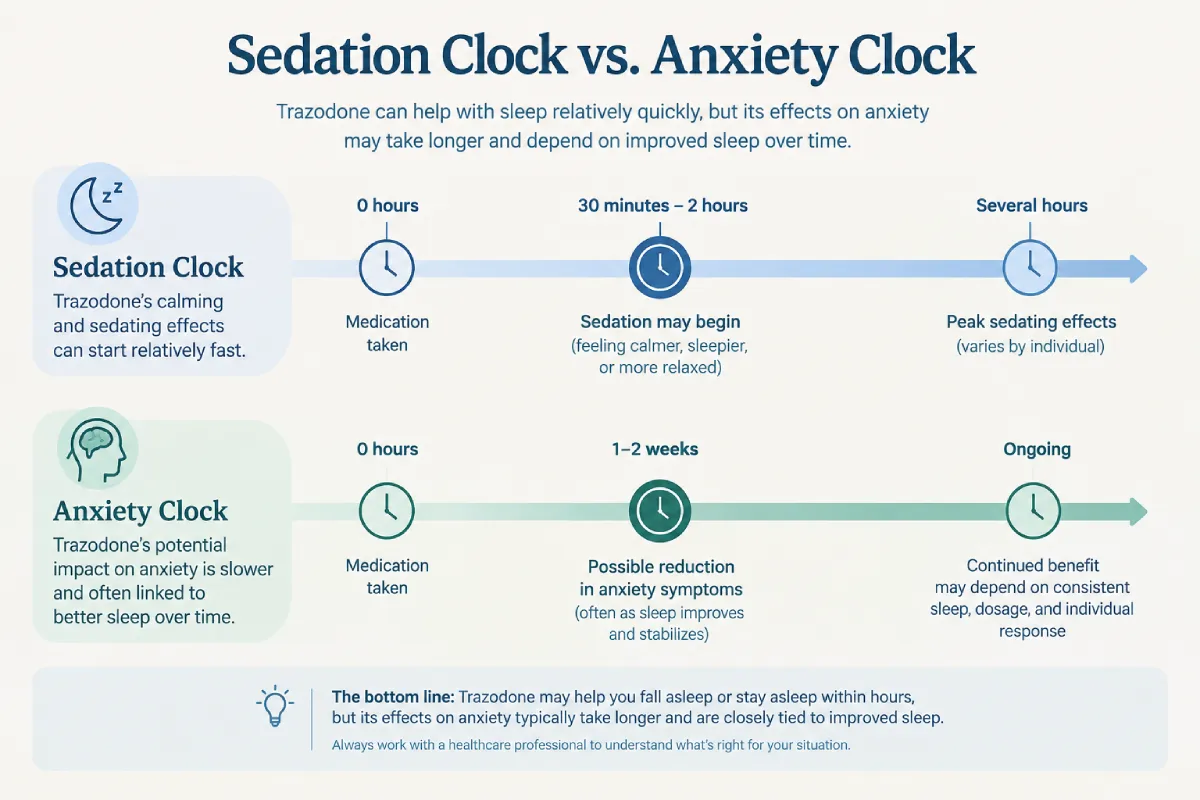
Feeling drowsy within the first hour but noticing no anxiety shift after two weeks isn’t a sign something is wrong, it’s the expected pattern. The reverse is also true: someone who says trazodone “worked immediately” for their anxiety is likely describing sedation and relief from finally sleeping, not a fast-acting anxiety treatment.
What Are the Side Effects of Trazodone?
Trazodone’s side effect profile is generally mild at lower doses, but several effects are worth knowing before you start, since some directly shape how anxiety feels day to day.
- Daytime drowsiness and fatigue – The most commonly reported effect, and one that can linger into the next morning at higher doses.
- Dizziness or lightheadedness when standing – From trazodone’s effect on blood pressure regulation.
- Dry mouth, headache, and nausea – Common, usually mild, and often fade over the first couple of weeks.
- Blurred vision or trouble concentrating – Can feel unsettling if you’re already anxious about your health.
- Priapism – A rare but serious, prolonged and painful erection in men requiring emergency care.
- Serotonin syndrome – A rare but serious risk when trazodone is combined with other serotonergic medications, marked by agitation, rapid heart rate, and muscle rigidity.
Trazodone also carries an FDA boxed warning for increased risk of suicidal thoughts and behavior in children, adolescents, and young adults, a warning shared across most antidepressants, but one worth knowing regardless of why it was prescribed to you.
For a full breakdown of warning signs and what constitutes a medical emergency, our guide to trazodone overdose symptoms covers exactly what to watch for.
Can You Take Trazodone With Alcohol?
Combining trazodone with alcohol isn’t safe, both substances depress the central nervous system, and together they amplify sedation, impair coordination, and increase the risk of dangerously slowed breathing. A trazodone prescription is not a green light to keep drinking as usual.
The current prescribing information specifically warns that trazodone can enhance the effects of alcohol and other CNS depressants. That’s a particular concern if alcohol is already being used to manage anxiety, since the pattern often looks like this: anxiety leads to drinking for relief, drinking disrupts sleep, disrupted sleep worsens anxiety, and trazodone gets added for the sleep piece, while the drinking continues underneath it all.
Adding trazodone into that loop doesn’t break it; it just makes it harder to tell what’s actually causing the sedation, dizziness, or mood changes someone is experiencing.
What If Anxiety Happens After Drinking or After Stopping Alcohol?
Anxiety after drinking, or after you stop, doesn’t automatically mean you have a standalone anxiety disorder, it can reflect alcohol’s direct effects on brain chemistry or withdrawal, and each explanation calls for a different response. Alcohol initially suppresses the same GABA and glutamate systems involved in anxiety regulation; as it wears off, that suppression reverses, sometimes producing the rebound anxiety informally called “hangxiety.”
This pattern is more common than most people expect. In one survey by The Recovery Village, 44% of respondents reported using alcohol specifically to cope with mental health symptoms like anxiety, and anxiety disorders and alcohol use disorder frequently develop together because alcohol is easy to access and can seem to relieve anxiety in the short term. However, heavy, repeated drinking and withdrawal cycles tend to worsen both conditions over time.
| Clinical Insight from Dr. Ash Bhatt: One detail that surprises most patients: alcohol withdrawal anxiety and generalized anxiety disorder can produce nearly identical symptoms, racing thoughts, restlessness, a sense of dread, but withdrawal follows a predictable timeline tied to your last drink, typically peaking within 24 to 72 hours, while an anxiety disorder doesn’t. I use that timeline as a diagnostic clue. If someone’s anxiety tracks tightly with when they last drank, I treat withdrawal risk first and do not prescribe an anxiety medication. |
When drinking stops after a period of heavy or regular use, that rebound can escalate into full alcohol withdrawal, which frequently includes:
- Anxiety and restlessness
- Tremor and sweating
- Elevated heart rate and blood pressure
- Insomnia
- In more severe cases, seizures or delirium tremens
This is exactly where trazodone becomes a poor stand-in for real evaluation. It might sedate someone enough to sleep through a rough night, but it does nothing to identify or manage the withdrawal process happening underneath.
Is Trazodone a Treatment for Alcohol Withdrawal?
Trazodone is not a treatment for alcohol withdrawal and should never substitute for medically supervised withdrawal management. Withdrawal can progress to seizures and delirium tremens, and it requires monitoring and medications specifically chosen to manage that risk.
Here’s why trazodone falls short for this purpose:
- It sedates, but it doesn’t address the physiological withdrawal process itself
- Masking a symptom like poor sleep isn’t the same as managing what’s causing it
- It provides no protection against the more serious complications of withdrawal, including seizures
Anyone stopping regular or heavy alcohol use should be evaluated for withdrawal risk before symptoms escalate. If alcohol withdrawal or detox is part of your situation, our guide to medically supervised alcohol detox in Los Angeles explains what that evaluation and monitoring process actually involves.
When Should Anxiety Be Evaluated Instead of Simply Treating the Symptom?
Anxiety deserves a full clinical evaluation, rather than symptom management alone, when it’s persistent, worsening, tied to alcohol use, or accompanied by physical or medication-related concerns you can’t fully explain. Trazodone can quiet symptoms temporarily, but it doesn’t replace an accurate diagnosis.
Evaluation is worth seeking when you notice:
- Anxiety that persists or worsens despite consistently better sleep
- Anxiety that appears specifically after drinking, or during the days after stopping alcohol
- Reliance on trazodone, alcohol, or both to get through anxious moments
- New or worsening side effects that make daily functioning harder
- A pattern of increasing the dose on your own to get the same effect
- Co-occurring symptoms like depression, panic attacks, or intrusive thoughts
The numbers here make a strong case for not waiting: between 18% and 28% of the U.S. general population experiences an anxiety disorder in a given year, and within that group, 33% to 45% also have a co-existing substance use disorder. Treating one side of that picture without addressing the other often leaves symptoms unresolved.
If you’re in the Los Angeles area, our anxiety treatment program in Los Angeles is built around exactly that kind of integrated assessment, so anxiety, sleep problems, and alcohol use are evaluated together instead of one at a time. For an immediate mental health crisis, the 988 Suicide & Crisis Lifeline is available by call or text, and SAMHSA’s National Helpline offers free, confidential treatment referrals 24/7.