




-
 Written By:
Joseph Remaley
Written By:
Joseph Remaley -
 Edited By:
Phyllis Rodriguez, PMHNP-BC
Edited By:
Phyllis Rodriguez, PMHNP-BC
-
 Clinically Reviewed By:
Dr. Ash Bhatt, MD, MRO
Clinically Reviewed By:
Dr. Ash Bhatt, MD, MRO
Key Takeaways
- Depression can alleviate the substance use more likely, and it is also one of the mediums that is the result of depression. And since alcohol and drugs alter brain chemistry directly, quitting alone can leave the depression untouched or even worse.
- The cycle is the real danger, where depression leads to substance use, substance use brings relief, relief turns into dependence, and dependence deepens the depression. Rather than just ending one point of this cycle, it is important to break this loop.
- Treating addiction without depression, or depression without addiction, is why so many treatment attempts are not working in favor. Which is why both conditions have to be treated in parallel, by the same team, otherwise the untreated half can bring the other one back.
Depression and substance abuse show up together so often that clinicians call it “co-occurring disorders, or dual diagnosis”. None of the cases is rare, but the combination of both the diseases are present in many people. According to the 2023 National Survey on Drug Use and Health, 35% of adults aged 18 and over in the U.S. who have another mental disorder also have a substance use disorder, and more than one in four adults living with serious mental health problems also has a substance use problem.
This article explores how depression and substance abuse feed each other and what the warning signs are, and why treating one alone hardly ever results in a sustainable recovery. You might be reading this because you see yourself or someone you love in the text, that recognition is already the hardest step you have taken.
What Is the Connection Between Depression and Substance Abuse?
Depression and substance most often exist together where one condition often sets the stage for the other, and once both are present, they tend to reinforce each other in ways that make each harder to shake on its own.
Clinicians call this pattern a co-occurring disorder, or dual diagnosis. Fundamentally, this word indicates that a person is suffering not only a mental disorder but also a substance abuse problem and these two conditions are affecting the developments in both directions.
- Depression can make substances feel like relief, even temporary relief that costs more than it gives back
- Substance use can alter brain chemistry in ways that create or deepen depressive symptoms
- Genetics, trauma, and chronic stress can raise the risk for both conditions independently
Because these conditions interact so closely, treating them together through dual diagnosis treatment, rather than one after the other, is essential for a recovery that actually holds.
Does Depression Lead to Substance Abuse?
For many people, substance use starts as an attempt to manage pain they don’t have another name for yet. This is often described as the self-medication theory, and it shows up constantly in clinical intake conversations.
Some research suggests that people with mental illness may use drugs or alcohol as a form of self-medication, reaching for relief from symptoms they haven’t yet connected to a diagnosis. That pattern isn’t rare: according to the 2024 National Survey on Drug Use and Health, 8.2% of U.S. adults, or roughly 21.4 million people, experienced a past-year major depressive episode, a population large enough that even a modest overlap with substance use translates into millions of people self-medicating at any given time.
The most common substances used are:
- Alcohol Addiction: Alcohol in any form is the first support people look out for, because it’s legal, accessible, and initially sedating.
- Opioids: These drugs can create a sense of physical and emotional relief and a person who has depression can feel more appeal towards opioids.
- Benzodiazepines: These types help in quiets racing, anxious thoughts that frequently get along with depressive thoughts.
- Marijuana: It is commonly framed as “natural” relaxation, even though heavy use can worsen mood over time.
- Stimulants: This may be used to counter the fatigue and low motivation that depression causes
The relief these substances offer is almost always short-lived but as tolerance builds, the same amount stops working, and the underlying depression becomes worse than before.
Clinical Perspective from Dr. Ash Bhatt:
Patients usually report that substance use helps them ‘relieve the pressure’. But that’s not actually what happens, in fact due to daily use the brain chemistry of both reward and stress systems alters a lot. Over time, it becomes harder to experience pleasure naturally, the depression symptoms worsens, and the amount of the substance required to get the same effect rises eventually.
Can Substance Abuse Cause or Worsen Depression?
This connection exists in both ways, and drug abuse directly causes it, mostly with long-term or heavy use.
Alcohol and many drugs disrupt the brain’s natural chemistry, especially the systems that regulate mood, motivation, and reward. With a prolonged period, the brain loses the ability to generate these chemicals naturally so the person feels indifferent and hopeless even when substance is out of the system.
Withdrawal makes the situation more complicated, as quite a lot of substances bring on depressive signs during withdrawal which can be confused with the signs of clinical depression whereas the correct solutions or approach is to treat the two situations as totally different from each other.
| Withdrawal-Related Low Mood | Clinical Depression | |
| Timing | Begins shortly after substance use stops | Can occur with or without substance use |
| Duration | Typically improves within days to a few weeks | Persists for two weeks or longer, often much longer |
| Root cause | Brain chemistry rebalancing after the substance is removed | A distinct mental health condition requiring its own treatment |
| Response to sobriety | Gradually lifts as the body stabilizes | Often remains unchanged, or unchanged, by sobriety alone |
| Treatment needed | Medical support through detox | Ongoing therapy and, often, medication management |
A clinician can help determine which one a person is actually experiencing, and that distinction shapes everything about the treatment plan that follows.
- Persistent low mood or emptiness lasting well beyond a typical withdrawal window
- Growing isolation from friends, family, and activities once enjoyed
- Financial strain caused by the cost of sustaining substance use
- Damaged relationships and a shrinking support system
- Loss of motivation or interest that doesn’t lift once withdrawal symptoms subside
Why Depression and Substance Abuse Often Create a Dangerous Cycle
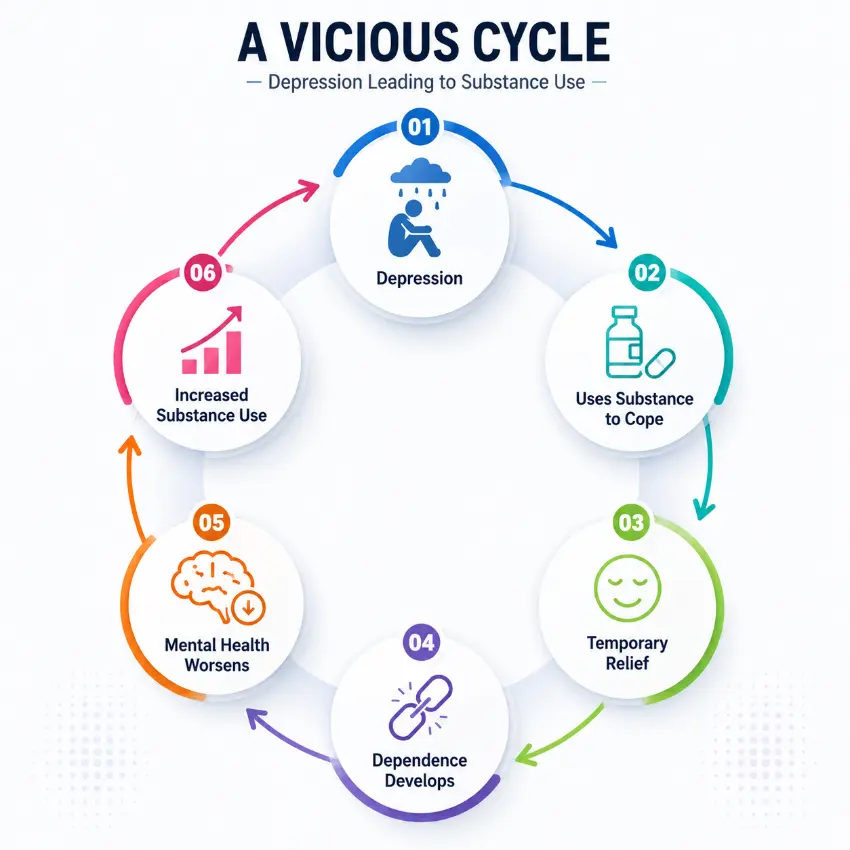
Once this loop starts, each pass tends to deepen both conditions rather than resolve either one. A person doesn’t usually notice the shift from coping to dependence until they’re several turns into the cycle, which is exactly why early intervention matters so much.
Signs You May Be Struggling With Both Depression and Substance Abuse
Recognizing the signs of co-occurring depression and substance abuse can take time, since symptoms of one condition can look like symptoms of the other. Paying attention to patterns across below categories can help clarify the picture.
- Emotional signs
- Persistent sadness or a sense of emptiness that doesn’t lift
- Feelings of hopelessness about the future
- Increased irritability or a shorter fuse than usual
- Loss of interest in activities that used to bring enjoyment
- Behavioral signs
- Drinking or using drugs specifically to manage stress or emotional pain
- Withdrawing from friends, family, or social plans
- Declining performance or attendance at work or school
- Secretive behavior around how much or how often substances are used
- Physical signs
- Noticeable changes in sleep, either sleeping far more or far less
- Appetite changes, including unintentional weight loss or gain
- Persistent fatigue that rest doesn’t seem to resolve
- Low energy that interferes with daily responsibilities
Dr. Ash Bhatt Says:
Another indicator I look for is when the person starts saying something like, “It’s only when I get my drinks or take my drugs that I feel really normal.” At this stage, alcohol or drugs have already become an integral part of everyday brain functioning. This kind of change in a person’s behavior is usually related to the later stages of a substance use disorder and is a clear sign that the individual should seek professional help at the earliest possible moment.
Risk Factors for Co-Occurring Depression and Substance Abuse
Certain conditions tend to increase the likelihood of developing depression with a substance use disorder. Though, having one or more of these risk factors is not a guarantee that these problems will occur. Identifying your personal risk profile can help you spot the warning signs and address them sooner, before a coping strategy progresses to dependence.
- Family history of depression, anxiety, or addiction: Although genetics don’t determine outcomes, they do shape how a person’s brain responds to stress and to substances, making some people more vulnerable to substance use.
- A personal history of trauma or PTSD: Usually, trauma that has not healed continues to cause the same inner wound, and Because of this, both disorders become a means of escaping this pain. This way, in such instances, these two diseases are closely connected.
- Chronic, unmanaged stress: Sustained stress keeps the body’s cortisol and stress-response systems activated for extended periods, wearing down the same neurochemical systems involved in mood regulation.
- Existing anxiety disorders: There is a common overlap between anxiety and depression, and both disorders as separate issues can be the cause of turning to drugs or alcohol for temporary relief.
- Chronic pain conditions: A chronic condition will generally lead to regular consumption of prescribed medicines. The cumulative impact of the physical and emotional aspects of chronic pain is a recognized depression risk factor.
- Major life changes: Examples include loss, divorce, or job instability, which can result in depressive moods being stirred up and routines that protect against drug abuse being taken away or lost.
- A previous history of addiction: Even after a period of sobriety, since prior substance use can leave lasting changes in the brain’s reward system.
Anxiety in particular deserves a closer look here. Substance use disorders show high comorbidity with several other psychiatric conditions, including PTSD, ADHD, depression, and anxiety, which points to shared underlying neurobiological and environmental mechanisms rather than a simple cause-and-effect relationship. In any case, it will not be sufficient to interpret such comorbidities as simply a case of the one disorder being the cause and the other being the effect. Rather, they come from the same root.
Why Treating Only One Condition Often Doesn’t Work
This is one of the most important things to understand if you’re weighing treatment options for yourself or someone you love. Because it’s also one of the most common mistakes in how depression and substance abuse get treated.
Without taking into account the depression which a person experiences due to addiction and treating it separately from the addiction itself, the original pain remains completely untouched. A person who goes through detox gets clean, maintains sobriety for weeks or months, can still be carrying the very same level of sadness, hopelessness, or emptiness that was driving them to use substances initially. In other words, that underlying pain is a highly accurate predictor of the relapse if the pain is not treated alongside the addiction because staying sober only is not enough to remove the reason someone was using.
In case of depression, when it is treated without addressing active substance use, therapy and medication have to compete against a substance that’s actively disrupting brain chemistry.
- Treating addiction without depression increases relapse risk substantially, since the underlying pain remains unresolved
- Treating depression without addressing substance use limits how much progress therapy or medication can realistically achieve
- Integrated care allows both conditions to be assessed and treated by the same coordinated team, rather than two providers working without full context of the other diagnosis
- Coordinated treatment planning means medications, therapy modalities, and timelines are chosen with both conditions in mind from day one, not adjusted after the fact
This is exactly the gap that dual diagnosis treatment exists to close: treating the whole person, with both conditions addressed in parallel, rather than picking one to fix first and hoping the other resolves on its own.
Treatment Options for Depression and Substance Abuse
When it comes to effectively treating someone with both a substance abuse and a depression condition, multiple treatment techniques are usually employed simultaneously, as per the severity of each disorder.
For those with significant physical dependence, treatment often begins with luxury medical detox. After all, it’s a medically supervised and safe way to get rid of the toxins from our body (withdrawal) that pave the way for the mental health interventions.
Once that’s done, inpatient treatment is the next step, In particular for people who require constant support and guidance through the early recovery period when, for instance, mood symptoms and drug cravings are at the top of their list of concerns.
Actually, most of the long-term improvements come from the dual diagnosis treatment itself, where the problems of depression and substance use are handled at the same time rather than one after another. It usually consists of:
- Individual therapy: This provides a setting or space to work through the underlying causes of both conditions
- Cognitive Behavioral Therapy (CBT): This is a method of therapy that focuses on identifying and changing negative thoughts that can contribute to depression and drug abuse
- Dialectical Behavior Therapy (DBT): This approach teaches how to deal with overwhelming feelings without falling back on substances
- Group therapy: It is one of the therapy sessions that gives a sense of being together with a group, having the experience who had to fight the same battle
- Medication management, which can address depressive symptoms and, in some cases, help reduce cravings at the same time
- Family therapy: It helps heal the broken bonds and relationships between family members because of these medical conditions
- Aftercare planning, supporting long-term stability once formal treatment ends
Medication choices matter more than people expect, such as bupropion is approved for treating depression as well as nicotine dependence.
When Should You Seek Professional Help?
Certain signs indicate that it’s time to reach out for professional support rather than continuing to manage things alone. Waiting for symptoms to resolve on their own often allows both conditions to deepen.
- Depressive symptoms lasting more than two weeks without improvement
- Any thoughts of suicide or self-harm
- Substance use continues to increase despite attempts to cut back
- Repeated failed attempts to stop using it on your own
- Withdrawal symptoms when substance use is reduced or stopped
- A noticeable decline in work performance or personal relationships
If you or someone you know is having thoughts of suicide, please treat it as an emergency and contact the 988 Suicide & Crisis Lifeline immediately by calling or texting 988. Support is available right now, and reaching out is not a sign of weakness.
How Legacy Healing Los Angeles Can Help
At Legacy Healing Los Angeles, we approach depression and substance abuse as connected conditions that deserve connected care, not two separate problems to be treated on separate timelines.
- Comprehensive assessment covering both mental health and substance use history
- A true dual diagnosis approach where both conditions are treated by the same coordinated team
- Personalized treatment plans built around each patient’s specific symptoms and history
- Evidence-based therapies, including CBT, DBT, and medication management where appropriate
- A continuum of care that supports patients from detox through aftercare planning
If any of this feels familiar, reaching out for an assessment is a reasonable next step, not a commitment to anything more than a conversation.
Conclusion
Depression and substance abuse are rarely two isolated struggles. More often, they’re deeply intertwined, each one capable of triggering or intensifying the other in a cycle that’s difficult to break without support.
The most effective path forward treats both conditions together, rather than addressing one and hoping the other resolves on its own. If you recognize these signs in yourself or someone you love, professional support can help interrupt the cycle before it deepens further.
Reaching out isn’t a small step, and it isn’t one you have to take alone. Our team is here to talk through what treatment could look like for your specific situation, whenever you’re ready.