



-
 Written By:
Amber Asher, MSW, LSW
Written By:
Amber Asher, MSW, LSW -
 Edited By:
Phyllis Rodriguez, PMHNP-BC
Edited By:
Phyllis Rodriguez, PMHNP-BC
-
 Clinically Reviewed By:
Dr. Ash Bhatt, MD, MRO
Clinically Reviewed By:
Dr. Ash Bhatt, MD, MRO
- Taper timeline is determined by how long you have taken Xanax. It is suggested at least 2 weeks after 2 to 8 weeks of use, and 6 to 18 months after more than a year.
- Xanax withdrawal can start within 24 hours of your last dose because the drug is short-acting. The riskiest window is usually days 5 to 14, so I want you supervised during that period.
- Taper, detox, and rehab are three different things with three different timelines. Detox stabilizes you in the first days, the taper can run for months, and rehab treats the addiction and anxiety.
There is no fixed number of weeks that applies to everyone who tapers off Xanax. The length depends on your dose, how long you have taken it, and how your body responds to each reduction. Xanax (alprazolam) is a short-acting benzodiazepine, and physical dependence can develop even when you take it exactly as prescribed.
Stopping suddenly or cutting the dose too fast can cause serious withdrawal. The 2025 joint clinical guideline, developed by the American Society of Addiction Medicine with nine other medical societies, advises against abruptly stopping benzodiazepines in people who are likely to be physically dependent.
In this article, we will cover how long a Xanax taper takes, what a benzo withdrawal timeline looks like week by week, and how long benzo detox and Xanax rehab last. We will also cover residential treatment, cost, and insurance.
How Long Does It Take To Taper Off Xanax?
The length of a Xanax taper depends mainly on how long you have been taking it. The Oregon Health Authority’s tapering guidance recommends these minimum taper lengths:
- 2 to 8 weeks of use: at least 2 weeks, and slower for high daily doses or alprazolam
- 8 weeks to 6 months of use: at least 4 weeks
- 6 months to 1 year of use: at least 8 weeks
- More than 1 year of use: 6 to 18 months
Longer use needs a longer taper because your body has had more time to adjust to the drug. A person who has taken Xanax daily for several years should expect a taper that lasts a year or more.
A slow taper does not mean treatment is failing. Clinicians often pause or slow a reduction when symptoms get worse, and they continue once the symptoms settle.
The taper timeline and the rehab timeline are two separate measurements. The taper covers the medication reduction. Rehab covers the addiction treatment, therapy, and mental health care that happen around it.
Clinical insight, Dr. Ash Bhatt: Using the Oregon ranges above, I place most long-term Xanax patients in the 6 to 18 month group, and I say so at the first visit. Patients who expect a 4-week taper often think they are failing at week 8, when they are actually on schedule. I also plan slower reductions in the second half of the taper, because that is where symptoms tend to return.
Why A Xanax Taper Cannot Be Rushed
Regular Xanax use leads to physical dependence. American Addiction Centers reports that dependence can develop after 3 to 6 weeks of use, even when the medication is taken as directed. It also reports that around 40% of people who use a benzodiazepine for 6 months or more have moderate to severe withdrawal when they stop.
Withdrawal can include anxiety, insomnia, sweating, tremor, and agitation. Severe withdrawal can cause seizures and delirium, which is why unsupervised, abrupt stopping is dangerous. The goal of a taper is to lower your medication exposure while keeping withdrawal as mild as possible.
Physical dependence and addiction are different. Dependence means your body has adjusted to Xanax and reacts when the dose drops. Addiction, also called benzodiazepine use disorder, involves problematic use and loss of control. You can have dependence without addiction, and both need medical care during a taper.
What Determines Your Xanax Taper Schedule
There is no universal Xanax taper schedule, and clinicians do not give you a day-by-day chart to follow alone. The schedule comes from an assessment, and then it changes as your body responds. The joint guideline, recommends first reductions of 5% to 10% and never more than 25% every 2 weeks.
A clinician builds a benzo taper schedule around these factors:
- Current dose and how long you’ve taken it. Higher, longer-term use generally means a longer, more cautious taper.
- Frequency of use. Daily use creates a different withdrawal picture than occasional or as-needed use.
- Withdrawal history. A rough experience with a past attempt to stop usually means the next attempt goes slower.
- Other substances involved, particularly alcohol, opioids, or other sedatives.
- Underlying anxiety or other psychiatric conditions that Xanax may have been treating.
- How you respond to each reduction. The schedule shifts based on symptoms, not a printed calendar.
The Oregon guidance adds that many patients switch to diazepam before tapering, because its slow elimination gives a smoother drop in blood levels than short-acting alprazolam.
The steps for how to taper off Xanax safely follow three stages. Before the taper, the clinician reviews your medication history, dose, and goals. During it, they reduce the dose gradually, monitor withdrawal, and adjust the pace. After it, they watch for returning symptoms and set up ongoing support. You can talk to a treatment professional about whether a supervised taper or a higher level of care fits your situation.
A Benzo Withdrawal Timeline: What Happens Week by Week
Withdrawal varies from person to person, so treat this as a general pattern. American Addiction Centers reports that Xanax withdrawal can begin within 24 hours of the last dose, and that acute withdrawal lasts 5 to 28 days after stopping.
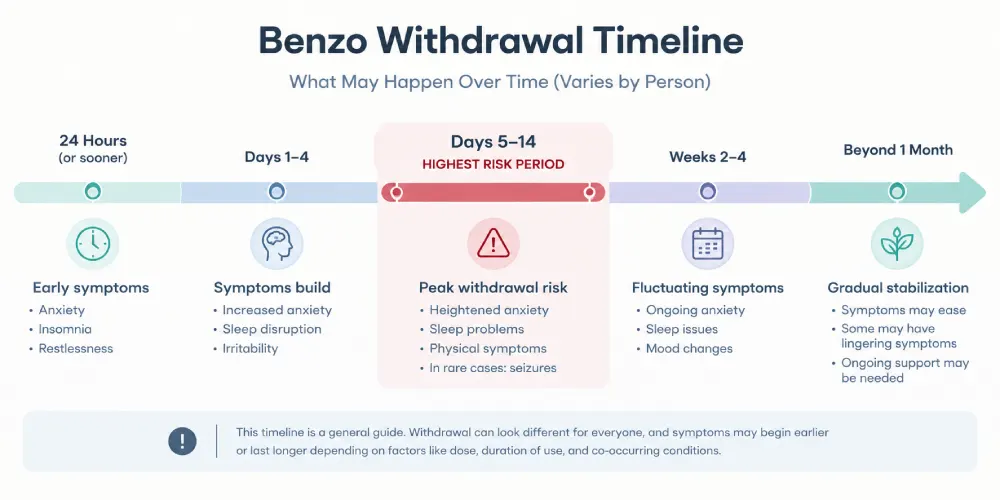
- First 24 to 48 hours: Anxiety, restlessness, and trouble sleeping often show up early, sometimes catching people off guard given how quickly Xanax leaves the system.
- Days 1 through 5: Symptoms can intensify, sweating, tremor, nausea, and heightened sensitivity to light or sound are common during this stretch.
- Days 5 through 14: This is generally the highest-risk window. This period can include confusion, insomnia, and in more severe cases, seizures, which is the core reason medical supervision matters during this stretch specifically.
- Weeks 2 through 4: Many people start to stabilize, though anxiety and sleep disruption can still show up in waves rather than improving in a straight line.
- Beyond the first month: Some people feel largely settled. Others experience what’s sometimes called protracted withdrawal, lingering anxiety, low mood, or cognitive fog that can persist for months.
Symptoms do not improve in a straight line. Symptoms that last past the first month need a clinical evaluation, because they may have another cause.
Clinical insight from Dr. Ash Bhatt: Because symptoms rise and fall, a patient can feel fine for three days and then have a bad night. A bad night is not a reason to raise the dose. I hold the current dose until symptoms settle, and then we continue the taper.
How Long Benzo Detox Take?
Detox covers the acute withdrawal phase, which American Addiction Centers puts at 5 to 28 days after the last dose. A supervised taper cannot be rushed because a clinician needs time to watch each reduction. The guideline says to pause or slow the taper when symptoms appear.
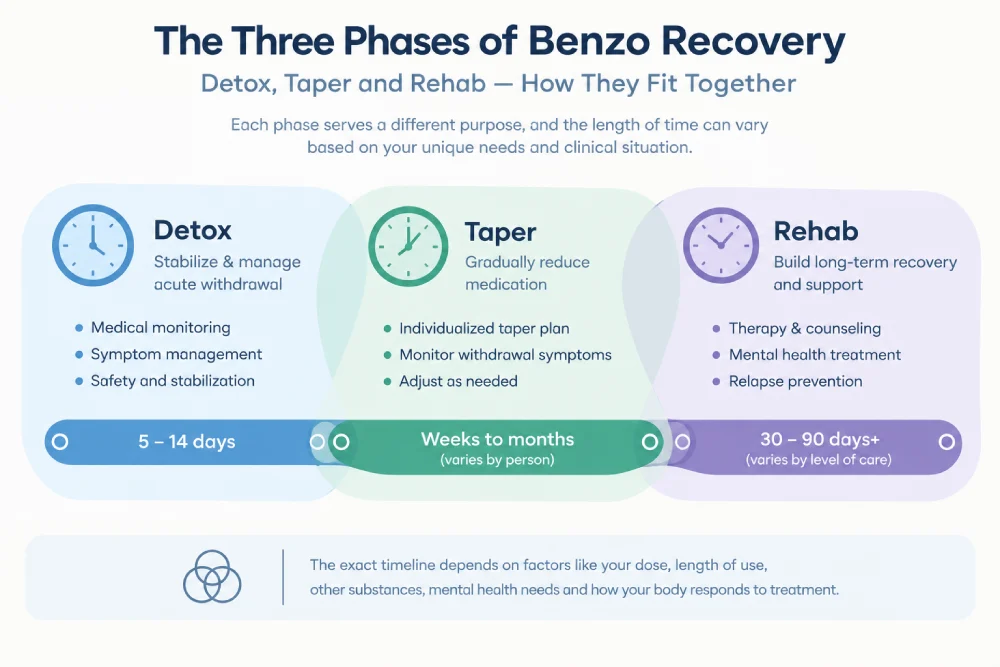
The full process usually moves through four stages:
- Detox: This process stabilizes you and manages acute withdrawal risk.
- Taper: This one gradually reduces benzodiazepine exposure, often for months.
- Rehab: It helps treats the addiction, behaviors, mental health, and relapse risk.
- Aftercare: This one help to maintain recovery and manages any underlying condition.
Detox is one step in the process and is not a full treatment plan.
What Makes A Xanax Taper or Rehab Take Longer
A few factors reliably extend both taper length and overall treatment duration:
- Long-term use: About half of patients dispensed oral benzodiazepines receive them for 2 months or longer, according to FDA data reported by the American Pharmacists Association. More time on the drug means more dependence to unwind.
- Alcohol use with Xanax: Both depress the central nervous system, and it is recommended to avoid alcohol during a taper.
- Opioid use with Xanax: The American College of Medical Toxicology notes that overdose risk rises when benzodiazepines are combined with opioids, so these patients need closer monitoring.
- Anxiety disorders: Stopping Xanax does not treat the condition it was prescribed for, and cognitive behavioral therapy helps during a taper, particularly for panic disorder.
- Previous attempts to stop: Repeated difficulty suggests that a higher level of support is appropriate.
Residential Treatment for Benzodiazepine Addiction: When it’s Needed
Most benzodiazepine tapering happens in outpatient care, and the guideline says so directly. Residential care becomes appropriate when outpatient care cannot manage the risk. The Detox.com summary lists these situations:
- A history of withdrawal seizures or delirium
- Dependence on alcohol or opioids alongside benzodiazepines
- Unstable medical or psychiatric conditions
- A previous taper that went badly
An unstable home environment is another reason to consider it. Residential treatment gives you 24-hour structure, clinical monitoring, therapy, psychiatric support, medication management, relapse-prevention work, and discharge planning. Residential programs are commonly built around 30, 60, or 90-day stays, and the taper can continue after discharge.
How Long Is Xanax Rehab?
Xanax rehab has no set length. The duration depends on the level of care you need, how complicated your withdrawal is, how severe your substance use is, whether you have a co-occurring mental health condition, and how you respond to treatment.
The levels of care include:
- Medical detox
- Residential treatment
- Partial hospitalization
- Intensive outpatient
- Outpatient care
People often move from more intensive levels to less intensive ones as they stabilize. The length of your taper and the length of your rehab are two different measurements. You can continue a medically supervised taper while you attend another level of behavioral health treatment.
Finding A Benzo Taper Doctor Near You
When you search for a benzo taper doctor near me, look for a clinician who has experience with benzodiazepine tapering. They should review your full medication and substance history, monitor your withdrawal, and adjust the taper to your symptoms. They should also assess anxiety or other conditions and coordinate with addiction treatment when use has become problematic.
If you want medically supervised Xanax tapering in Los Angeles, At Legacy Healing we offer assessment, addiction treatment, and dual-diagnosis care. Our team can help you decide which level of care fits your situation.
Cost of Medically Supervised Benzo Tapering, and Insurance Questions
The cost depends on whether you receive outpatient or residential care, how many clinical visits you need, and how much medical monitoring and psychiatric care is involved. Therapy, treatment length, and whether the provider is in-network also change the total.
Insurance coverage depends on your plan, medical necessity, level of care, deductible, and prior authorization rules. Ask your insurer:
- Is benzodiazepine withdrawal treatment covered?
- Is residential treatment covered?
- Is detox covered?
- Is psychiatric care covered?
- Is the treatment center in-network?
- Is prior authorization required?
- What out-of-pocket costs should I expect?
What Happens After You Finish Tapering
The last dose is the end of the medication reduction, and it is the start of a different phase of care. Your body is still adjusting, and the reasons you took Xanax in the first place are still there. Most people need support for both after the taper.
Here is what usually happens in the months after the last dose:
- Monitoring for lingering symptoms. The joint clinical guideline, as summarized by Detox.com, says monitoring should continue after the final dose because of protracted withdrawal. Around 1 in 4 chronic benzodiazepine users have symptoms such as anxiety and depression that can last up to a year or longer.
- Treatment for the original condition. If Xanax was managing anxiety, panic, or insomnia, those symptoms can return once the medication is gone. The Oregon guidance notes that cognitive behavioral therapy helps during and after a taper, particularly for people with panic disorder.
- Relapse prevention. People are more likely to go back to Xanax, or to another substance, when anxiety returns and they have no other way to cope. It is also advised against replacing benzodiazepines with alcohol, cannabis, or other substances.
- Ongoing behavioral health support. Detox alone is typically not enough for long-term recovery. Therapy, counseling, and regular check-ins help you keep the progress you made during the taper.
If you have finished a taper, or you are getting close, you should not have to manage the next phase alone. Legacy Healing in Los Angeles offers assessment, addiction treatment, and dual-diagnosis care for people who need help with both benzodiazepine use and the anxiety or mental health condition behind it.