



-
 Written By:
Amber Asher, MSW, LSW
Written By:
Amber Asher, MSW, LSW -
 Edited By:
Phyllis Rodriguez, PMHNP-BC
Edited By:
Phyllis Rodriguez, PMHNP-BC
-
 Clinically Reviewed By:
Dr. Ash Bhatt, MD, MRO
Clinically Reviewed By:
Dr. Ash Bhatt, MD, MRO
Key Takeaways
- Alcohol doesn’t just add sedation on top of Xanax, it means that alcohol slows down the very liver enzyme that breaks down alprazolam from your system, so drug accumulates to higher levels than your prescription was intended.
- Xanax is a benzodiazepine that acts quickly, by the time you know where you are, you may be too impaired to notice the damage. In CDC data, alcohol was involved in nearly three-quarters of fatal overdoses where a benzodiazepine was the only drug class involved.
- Even if you’ve developed alcohol tolerance, do not believe that it will safeguard you. Alcohol and Xanax cross-tolerance can help to mask the degree of your actual impairment, only until the consequences arrive uninvited.
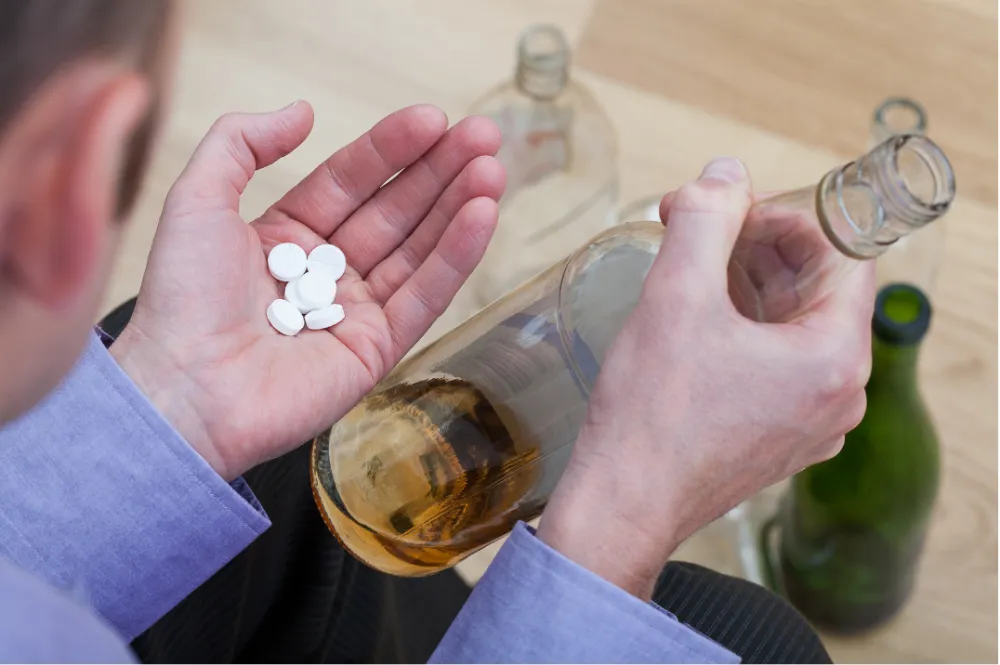
Mixing Xanax and alcohol is dangerous because alcohol interferes with how your liver breaks down alprazolam, causing the drug to accumulate in your bloodstream at higher concentrations than intended, on top of layering two central nervous system depressants at once. This is a specific pharmacological interaction, and it’s part of why this particular combination shows up so often in emergency room data.
In this article, we’ll explain the actual mechanism behind that danger, what it does to your alertness, memory, and breathing, how to tell dependence apart from addiction, and when this pattern needs more than a conversation with your prescriber.
This is both a medication-safety issue and, for some people, an early signal of a substance-use pattern worth examining. The FDA has issued a boxed warning, its most serious safety designation, specifically about combining benzodiazepines with alcohol, and CDC surveillance data backs up why that warning exists.
Why Xanax and Alcohol Can Be Dangerous Together
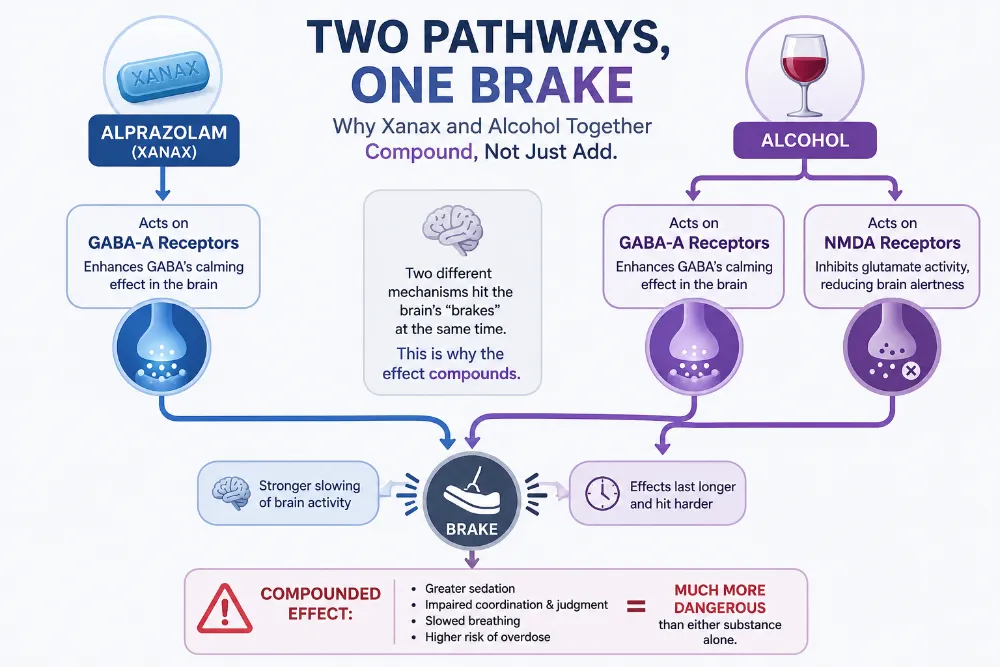
When alprazolam is taken, it binds to GABA-A receptors thereby slowing down the nerve activity in the brain; that is the calming effect. Alcohol acts on those same GABA-A receptors, but it also interferes with a separate system, the NMDA receptors, which normally help keep the brain alert. Because Xanax and alcohol hit the brain’s brakes through two different mechanisms at once, the resulting combination is not just adding effects but compounding them.
There’s a second layer most people never hear about: alcohol inhibits the CYP3A4 liver enzyme, which is the primary pathway your body uses to metabolize alprazolam. When that enzyme is suppressed, Xanax doesn’t clear from your bloodstream at its usual rate; it accumulates. This specific mechanism is one reason why combination of alprozam and alcohol ranks high-risk not only in comparison with other benzodiazepine plus alcohol pairings but as one of the most dangerous combinations of drugs with alcohol.
There’s also a timing problem specific to alprazolam. It’s a short-acting, high-potency benzodiazepine, meaning it reaches peak concentration in the blood faster than longer-acting benzodiazepines like diazepam or clonazepam. That rapid onset, combined with alcohol’s own fast absorption, can create a gap between how impaired someone actually is and how impaired they feel, because the very faculties needed to recognize “I’ve had too much” are the ones being dulled first.
When Xanax and alcohol interact, people can experience:
- Increased sedation that comes on faster and lasts longer than expected
- Impaired coordination, including stumbling or slowed reflexes
- Reduced alertness and slower reaction times
- Memory gaps or blackout periods
- A level of impairment that feels disproportionate to how much of either substance was actually consumed
- In serious cases, dangerously slowed breathing
Dr. Ash Bhatt’s Clinical Perspective: What I want people to understand is that this isn’t a matter of self-control or “knowing your limit.” The mechanism at work here is metabolic, in which your liver enzyme is being suppressed while the drug is still active. That’s a pharmacology problem, and it’s why I don’t accept “I only had two drinks” as a marker of safety when Xanax is involved.
How Xanax and Alcohol Can Affect the Body
The combined effects of Xanax and alcohol show up across several systems at once, not just as generalized drowsiness.
1. Alertness and Coordination
Reaction time, muscle coordination, and balance all rely on rapid signaling between the brain and body. Both substances slow that signaling, and the combined slowdown often shows up as ataxia, a loss of coordinated movement that goes beyond typical drunkenness. Someone might seem only mildly affected by alcohol alone, then become noticeably unsteady, slow to respond, or prone to falls once Xanax is factored in.
2. Memory and Judgment
Xanax alone can cause anterograde amnesia, difficulty forming new memories after taking the drug, because of how it affects the hippocampus. Alcohol independently impairs the same memory system. Together, they produce what’s sometimes called a synergistic amnestic effect: people can remain conscious, appear to function, and even carry on conversations, while forming little to no lasting memory of that window of time. Judgment is affected in parallel, which is often why decisions made during that window don’t reflect what the person would normally choose.
3. Breathing and Emergency Concerns
This is the mechanism behind most fatalities. Both alcohol and Xanax suppress the brainstem’s respiratory centers, the neural circuitry that keeps you breathing automatically, without conscious effort. When combined, that suppression can progress to clinically significant respiratory depression. According to CDC surveillance data analyzing overdose deaths involving only a single drug class, alcohol was a contributing factor in 72.1% of benzodiazepine-only fatalities, a figure that reflects how often this specific combination, rather than the benzodiazepine alone, is what turns dangerous.
Does Taking Xanax as Prescribed Mean You Have an Addiction?
No, and this distinction matters clinically, not just semantically.
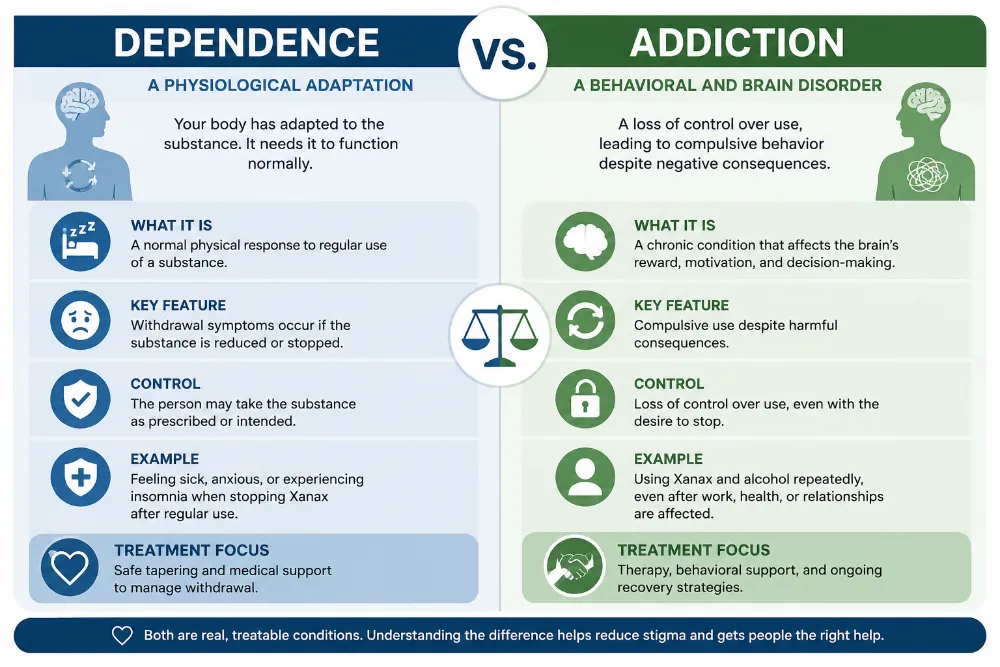
Physical dependence develops as a predictable, expected physiological adaptation in anyone who takes a benzodiazepine consistently, even exactly as prescribed. Your brain adjusts to the presence of the drug, which is why stopping abruptly can trigger withdrawal. The FDA is explicit that alprazolam can produce clinically significant physical dependence, and that abrupt discontinuation or a rapid dose reduction can precipitate withdrawal reactions serious enough to be life-threatening, including seizures.
Addiction is a separate clinical picture: compulsive use, loss of control over the amount or frequency, and continued use despite clear negative consequences. Someone can be fully dependent on Xanax, taking it exactly as directed, with zero features of addiction.
Dr. Ash Bhatt’s Clinical Perspective: I see patients panic after their prescriber mentions dependence like it’s the same conversation as addiction. It isn’t. What I actually watch for is whether the medication still fits into a person’s life the way it did when we started, or whether it’s started reshaping their decisions. That distinction, not the presence of dependence itself, is what tells me whether we need to change course.
Signs Xanax Use May Be Becoming a Larger Problem
Not everyone who mixes Xanax and alcohol once has a substance use disorder, and it isn’t useful to diagnose yourself or someone else from a single incident. That said, certain patterns are worth paying attention to over time.
Some patterns that may suggest Xanax use is shifting from medical to problematic include:
- Taking Xanax more frequently or in larger amounts than prescribed
- Using alcohol specifically to intensify or “boost” the effect of a dose
- Noticing that the same dose no longer produces the same effect it once did (a sign of tolerance)
- Feeling preoccupied with having the medication available, or anxious when supply runs low
- Repeated attempts to cut back that haven’t held
- Continuing the pattern despite it causing friction at work, at home, or in relationships
One pattern deserves specific attention: cross-tolerance. Regular alcohol use can dull how strongly someone perceives Xanax’s effects, and vice versa. That doesn’t mean the interaction has become safer; the underlying respiratory and CNS risks are unchanged. It means the body’s early warning signals have gotten quieter, which can lead someone to use more of one or both substances to get the effect they’re used to.
When Xanax and Alcohol Become Part of the Same Pattern
In some situations, this partnership is not sudden but gradual instead. Say someone has been prescribed Xanax for anxiety and notices that a glass of wine later in the day helps them relax even more. As they continue, they might not realize the gradual increase of alcohol consumption plus the medication. Eventually, the two products will be considered as part of the person’s routine in dealing with stress rather than just a fleeting connection at some point.
As the person relies more heavily on both Xanax or alcohol together, the focus is not so much on Xanax or alcohol as separate entities anymore, but rather on a pattern that combines both of them. Most often, just targeting one substance while ignoring the other does not even touch the problem that actually causes this substance dependence.
If Xanax use has become part of a larger pattern, Xanax addiction treatment and alcohol addiction treatment are typically most effective when they’re coordinated rather than handled separately, since stopping one substance can affect withdrawal risk from the other.
What Professional Treatment Can Address
Treatment for combined Xanax and alcohol use starts with a comprehensive evaluation, not a one-size-fits-all program. A thorough intake assessment for combined Xanax and alcohol use typically covers:
- Full substance-use history, including how long, how much, and how often each substance has been used
- Other medications currently being taken
- Physical health conditions that could affect withdrawal or treatment
- Mental health history, including anxiety, depression, or trauma that may have influenced use
- Withdrawal risk from both benzodiazepines and alcohol, which can differ significantly
- Prior treatment experiences, including what has and hasn’t worked before
- Family and social circumstances that support or complicate recovery
Not everyone in this situation needs residential care. Someone with a shorter history and no other complicating factors may be appropriately supported through outpatient care with medical monitoring. Someone with a longer history, higher doses, or additional health complications may need a more structured level of care. That’s precisely why the assessment comes before the plan. Prescription medication addiction treatment programs are built around this kind of individualized evaluation rather than a single default path.
Dr. Ash Bhatt’s Clinical Perspective: Rather than just “how much are you drinking”, we need to look at how the substances are being used together in one’s lifestyle. Someone having a drink a week but however taking Xanax daily presents with a completely different risk pattern when compared to someone who might be drinking heavily at occasional prescription. The management must be based on that unique drug-use configuration, and not on the same general outline.
When to Seek Immediate Medical Help
Some symptoms after combining Xanax and alcohol require emergency medical attention right away, not a wait-and-see approach. Call 911 or go to the nearest emergency room if you or someone you’re with experiences:
- Difficulty breathing, or breathing that becomes slow, shallow, or irregular
- Extreme difficulty staying awake or being roused
- Blue-tinged lips or fingertips
- Unresponsiveness or loss of consciousness
- Seizures
These symptoms can indicate severe central nervous system depression, which can be fatal without prompt treatment. It’s always safer to seek emergency care and be wrong than to wait and hope symptoms pass on their own.