




-
 Written By:
Amber Asher, MSW, LSW
Written By:
Amber Asher, MSW, LSW -
 Edited By:
Phyllis Rodriguez, PMHNP-BC
Edited By:
Phyllis Rodriguez, PMHNP-BC
-
 Clinically Reviewed By:
Dr. Ash Bhatt, MD, MRO
Clinically Reviewed By:
Dr. Ash Bhatt, MD, MRO
Key takeaways from Dr. Ash Bhatt
- A verified benefits check tells you what your plan reports, and nothing more. Coverage for a specific level of care is only settled after my team’s clinical assessment and, when required, the insurer’s authorization.
- The insurer approves the level of care our clinicians can document as medically necessary, so honest details about withdrawal history, medications, and past treatment attempts directly shape what gets approved.
- With a PPO, an out-of-network label still leaves room for coverage at a higher cost share. Ask for the out-of-network deductible, coinsurance, and your estimated out-of-pocket total before you commit to an admission date.
You have your insurance card ready, and the rehab has checked your benefits. Then comes the question many families are not prepared for: what happens now?
Insurance verification is usually the beginning of the admissions process, and it is rarely the end. The next steps often include a clinical assessment, a level-of-care recommendation, prior authorization, financial planning, and admission coordination. In this article, we walk through each step in order. We also cover what verification does not guarantee, how PPO and out-of-network benefits change your costs, where private-pay rehab fits, and how same-day admission comes together.
SAMHSA’s 2024 National Survey on Drug Use and Health found that 48.4 million people aged 12 or older had a substance use disorder in the past year. About 1 in 5 of the people who needed treatment received it. Knowing the sequence ahead of time helps you avoid losing days to steps you did not expect.
First, What Does “Insurance Verified” Actually Mean?
When an admissions team verifies your insurance, it contacts your insurer or reviews your plan details to see what the policy reports for substance use treatment. The team typically establishes whether the policy is active and whether substance use treatment is a covered benefit. It also looks at which levels of care may be covered, the network status, your deductible, copay or coinsurance, and any authorization or extra clinical information the insurer wants.
The result is an estimate that guides planning, and the insurer has not agreed to pay for anything yet. A verified benefit can still change for several reasons:
- The insurer may require prior authorization before the stay begins.
- The insurer may approve a lower level of care or fewer days than the treatment team requests.
- Your deductible and out-of-pocket totals can shift as claims from other providers are processed.
- The insurer decides on payment when it processes the actual claim, which happens after treatment starts.
Preauthorization is an insurer’s decision that a service is medically necessary. However, it is not a promise the plan will cover the cost. In fact, it is advised that people ask their insurer what treatment is covered and at what rate, what the copay or coinsurance is, and how many days or appointments are covered each year.
The law works in your favor here. HealthCare.gov states that all Marketplace plans cover mental health and substance abuse services as essential health benefits. The Mental Health Parity and Addiction Equity Act requires plans that offer these benefits to provide them at the same level as medical and surgical care. The exact benefits still depend on your plan and your state.
What Does Rehab Check During Insurance Verification?
Luxury rehab insurance verification follows the same logic as any other verification, with a few extra questions about out-of-network coverage, since many private facilities sit outside insurer networks. Here is what gets checked and why each item matters:
- Eligibility. The team confirms the policy is active, notes the effective dates, and identifies the policyholder, because a lapsed or recently changed policy affects every step after it.
- Network status. The team finds out whether the facility is in-network or whether the plan pays out-of-network benefits, since that decides which cost-sharing numbers apply.
- Level of care. The team checks whether the plan lists benefits for detox, residential treatment, PHP, and IOP, so the coverage matches what an assessment may recommend.
- Cost sharing. The team identifies your deductible, copay, and coinsurance, and how much of each you have already met this year.
- Authorization requirements. The team asks whether the insurer requires prior authorization and what clinical information it wants.
- Benefit limitations. The team looks for day limits, exclusions, and utilization-review requirements that could shorten a stay.
Luxury programs and what insurance evaluates
Insurance decisions center on treatment, and a luxury label does not change that. Eligible services may include assessments, therapy, medication management, and other medically necessary care, while premium rooms and other nonclinical amenities may be excluded or billed separately.
Ask the facility for a written estimate that separates expected clinical charges from possible noncovered costs. Amenities may also not count toward your plan’s out-of-pocket maximum, so that limit may not cap your total bill. Our insurance coverage guide covers this in more detail.
How Long Does Verification Take?
The initial benefits check can be quick, but the full process can take longer if the insurer requires clinical documentation or prior authorization. At Legacy Healing, our online verification form returns initial results in under two minutes, and we usually confirm insurance within the hour. That result covers the first step only.
Several things can add time after that first result:
- The insurer needs a call back or additional details from the policyholder.
- The clinical assessment has not happened yet.
- The insurer requires prior authorization and needs time to review the clinical documentation.
Ask the admissions team which of these apply to your plan, and ask for a realistic timeline in hours or days. Our insurance coverage page explains what an initial result includes.
What Happens After the Benefits Check?
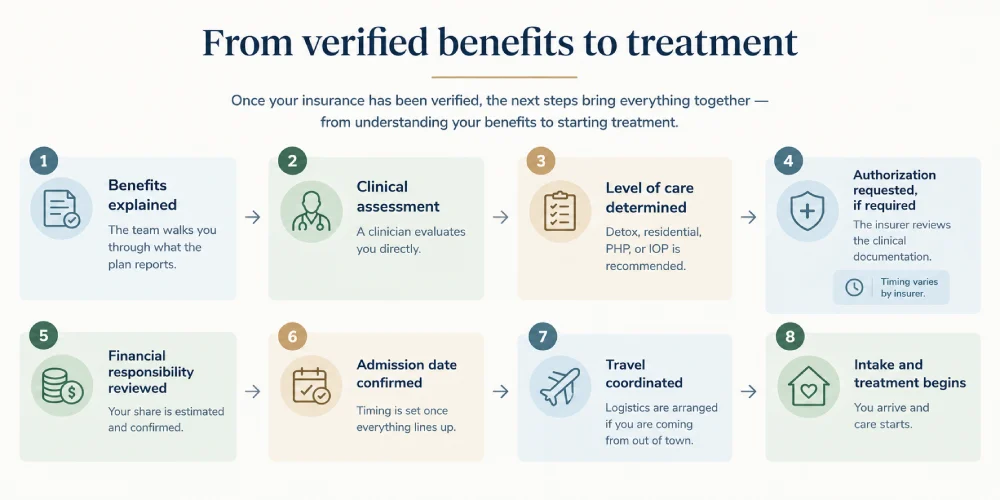
Verification answers whether your plan has benefits, and every decision that follows depends on who acts next. The process usually runs in this order: insurance verified, benefits explained, clinical assessment, level of care determined, authorization requested if required, financial responsibility reviewed, admission date confirmed, travel coordinated, intake, and treatment begins.
The stages are not all handled by the same people. The admissions team handles the benefits conversation and the paperwork, clinicians decide the level of care, and the insurer decides authorization and payment. Delays usually come from the stages that depend on someone outside the facility, such as an insurer reviewing clinical documentation or a policyholder returning a call.
How the Admissions Team Explains Your Benefits
Right after verification, the admissions team should walk you through what it found in plain language. A statement like “you’re covered” does not tell you enough to plan around, so the conversation should answer these questions:
- What does the plan appear to cover? The answer should name the levels of care and the number of days, because a plan can cover a benefit in principle and still cap it.
- Is the facility in-network, or is it being accessed through out-of-network benefits? This decides which deductible and coinsurance apply.
- What may you owe? Ask for a range instead of a single figure, since the final amount can depend on the authorization decision.
- Is a deductible involved? Find out how much of it you have already met this year.
- Is coinsurance involved? Ask for the percentage and what it is calculated on.
- Is authorization required? Ask who submits it and how long the insurer usually takes.
- Are there limitations the family should know about, such as day limits or exclusions?
Numbers make this easier to follow. Suppose your plan’s allowed amount for a service is $1,000 and your coinsurance is 20% after the deductible is met. You would owe $200 for that service, and the plan would pay the rest. These figures are hypothetical, and your own policy will differ.
Keep your insurance card, the policyholder’s name and date of birth, and your plan’s member services number within reach for this conversation. Ask the admissions team to send the estimate in writing, along with a note of which parts could change after the clinical review. Network status changes the numbers enough that it needs its own section, and that comes next.
PPO and Out-of-Network Benefits: What Happens If the Rehab Is Out of Network?
A PPO is a plan where you pay less inside the network and can use outside providers for an additional cost. So out-of-network does not automatically mean uncovered. The extra cost usually appears as a separate deductible and a higher coinsurance percentage.
A hypothetical plan might charge 20% coinsurance in-network and 40% out-of-network, which changes your share considerably on a residential stay. These are the questions that produce a usable answer:
- Does the plan include out-of-network substance use treatment benefits?
- Is the out-of-network deductible separate from the in-network one, and how much have you met?
- What coinsurance percentage applies after the deductible?
- What is the allowed amount for the service?
- Is prior authorization required for out-of-network care?
- How does the plan handle the facility’s claim?
- What portion could remain your responsibility?
The last two questions matter most. Coinsurance is calculated on the allowed amount, and if the facility’s charge is higher, the difference can be billed to you, also known as balance billing. Ask for a written estimate that includes that gap. Our PPO insurance page covers how this applies to substance use treatment.
Next Comes the Clinical Assessment
Insurance and clinical placement are two different decisions. Insurance can indicate that benefits are available, and it does not determine whether detox, residential treatment, PHP, or another level of care is clinically appropriate. A clinician makes that call after evaluating you directly.
The evaluation usually covers:
- Which substances you use, how much, how often, and when you last used
- Any past withdrawal experiences, including seizures, hallucinations, or severe symptoms
- Current medications and medical conditions
- Mental health symptoms and any earlier treatment
- How stable your home environment is for outpatient care
Clinicians commonly organize this assessment around the ASAM Criteria, a widely used set of standards for placement, continued service, and transfer of patients with addiction. It covers six areas: withdrawal risk, medical status, psychiatric needs, readiness to change, relapse risk, and recovery environment.
Insurers often review the same picture, using ASAM or criteria built on it, sometimes under names such as InterQual or MCG. Payer practices vary, so ask which criteria your insurer applies. The recovery environment matters too, because someone without a stable home may need residential care for that reason alone.
The result is a level-of-care recommendation. In general terms, the options look like this:
- Detox is medically managed withdrawal, and some people need it before any other program.
- Residential treatment means living at the facility while you receive daily clinical care.
- PHP (partial hospitalization) involves several hours of treatment most days while you live elsewhere.
- IOP (intensive outpatient) involves fewer weekly hours and suits people with a stable home environment.
At Legacy Healing, the sequence is a private clinical evaluation, a level-of-care recommendation, insurance and financial planning, and then treatment coordination. Some people need medically supervised detox before residential treatment, and the evaluation is where that gets decided. The recommendation also goes into any authorization request, which keeps the clinical picture and the insurance process connected.
Does Insurance Verification Mean You Are Approved for Rehab?
No. Verification, authorization, and payment are separate events, and each has its own decision-maker:
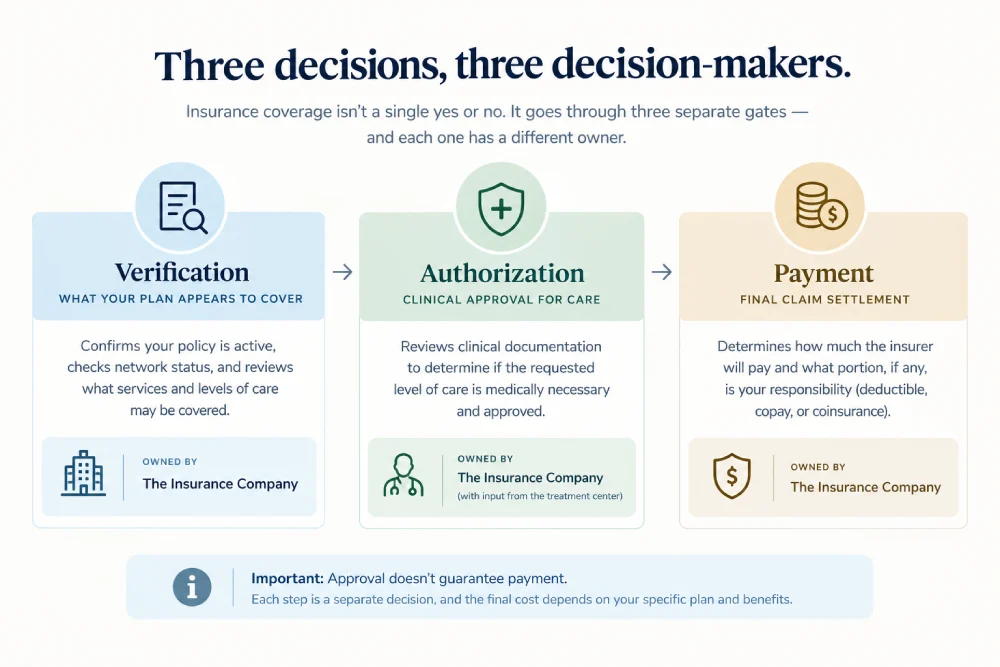
Verification does not equal authorization, and authorization does not equal guaranteed payment. In fact, preauthorization is not a promise the plan will cover the cost.
A plan can list residential benefits while the insurer’s reviewers approve a shorter stay. Treat the early estimate as a starting point for the conversation, and wait for the later stages before you count on a final out-of-pocket figure.
What Is Pre-Authorization and Who Handles It?
Some insurers require approval before certain services begin. The treatment center usually sends clinical information that supports the requested level of care, and the insurer’s reviewers decide whether it meets their medical necessity criteria.
That information typically comes from your assessment and includes substance use history, withdrawal risk, medical and mental health conditions, and prior treatment attempts. It also explains why a lower level of care would not be safe or effective for you. The reviewer compares it with the plan’s criteria and returns a decision.
Our Carelon process is one example. When prior authorization is required, our team works with Carelon and submits clinical documentation, and we handle continued-stay reviews when additional authorization is needed.
An authorization may approve only a specific level of care or a set number of days. Continued coverage can require clinical updates, which is why the insurer checks in as treatment continues.
The general path runs from verification to an authorization request, then insurer clinical review, then an authorization decision. Not every insurer follows exactly the same workflow, so ask which steps apply to your plan.
If the insurer denies or shortens a request, ask for the reason in writing and find out whether your plan offers an appeal process. The treatment team can help you understand your options, so a first decision does not leave you guessing.
What If Insurance Doesn’t Cover the Entire Cost?
Coverage rarely arrives as a simple yes or no, so it helps to know what happens under each outcome:
- Insurance covers the planned care. The process moves on to financial clearance and admission planning.
- Insurance provides partial coverage. The team goes over your estimated responsibility and the payment options available.
- You prefer not to use insurance. Private-pay rehab may be an option.
- The plan has no usable benefits. The team discusses private pay or alternative placement options.
How private-pay rehab works alongside insurance
Private pay describes how you pay, and residential treatment describes the level of care. The two are separate, so a person can attend residential treatment under either one. Skipping insurance removes the authorization step, but the assessment, bed availability, and transport still apply.
Some insurance plans reimburse part of a private-pay stay, depending on the facility’s credentials or network status and the plan’s terms. Confirm the details with both the facility and your insurer before enrolling. People choose private pay for several reasons, including high out-of-network costs, limited benefits, or a wish to keep insurance out of the picture where that is feasible.
Cost varies with length of stay, level of care, location, amenities, therapies, staffing, and aftercare. Ask any facility these questions before you commit:
- Is the facility licensed or accredited, for example by the Joint Commission or CARF?
- Are detox, private rooms, or specialized therapies billed separately?
- What credentials do the clinical staff hold?
- Does the program treat co-occurring mental health conditions in-house?
- How is aftercare handled?
At Legacy Healing, we offer private-pay options alongside insurance, and our financial team provides a cost breakdown before treatment begins. Our private-pay rehab guide explains what to expect.
Privacy questions deserve a careful answer. SAMHSA states that health information under private insurance is protected and cannot be shared with your employer. Private pay changes who receives the bill, and it does not guarantee confidentiality on its own, so ask any facility how it handles your information under each payment option.
When Can You Be Admitted After Insurance Verification?
Admission does not happen immediately after verification. Same-day admission may be possible when the clinical assessment, financial arrangements, authorization requirements, bed availability, and travel logistics are all aligned. When any one of those is pending, the date moves.
Same-day admission depends on four decisions:
- Clinical fit. The program must be able to manage your substance use, medical history, mental health, and withdrawal risk.
- Bed availability. A suitable bed must be open when admission is approved, which matters in a small setting like our six-bed residence.
- Safe transport. You must be stable enough to travel, with an escort when indicated.
- Financial clearance. Insurance benefits must be verified or private-pay arrangements confirmed before arrival.
Even when everyone is ready, placement can be delayed by a clinical concern, a full bed, unsafe transport, or incomplete clearance. The admissions team should tell you what is unresolved and what the safest next step is.
A short call goes faster when you have this ready:
- The substances used, approximate amounts, last use, and any past withdrawal complications
- Current medications, diagnoses, and allergies
- A photo ID, the insurance card, and the policyholder’s details
Legacy Healing LA offers same-day admission when it is clinically appropriate, and our luxury detox program can admit the same day after a quick assessment. Our same-day rehab admission page explains how that works. The path runs from verified benefits to assessment, then clearance, then admission coordination, and then same-day arrival when appropriate.
What Happens on Admission Day?
Admission day is where the process leaves insurance behind and treatment begins. Arrival at our Los Angeles facility is discreet and takes place in a private setting. The day usually follows this order:
- We confirm your identification and insurance card.
- You complete the admissions paperwork.
- A nurse and medical provider complete your medical intake.
- Our clinical team reviews your assessment, medications, and any withdrawal symptoms.
- Detox or residential care begins, with medical supervision when detox is needed.
Medication-assisted treatment is part of the plan when it is clinically appropriate. Same-day entry is the beginning of care, and the clinical team may recommend continued residential treatment, therapy, medication management, and a step-down plan after stabilization. Our privacy promise explains how we handle confidentiality.
Bring a photo ID, approved medications in their original containers, basic clothing, and essential contact information. Leave large amounts of cash, valuables, alcohol-containing products, and unapproved medications at home, and wait for program-specific guidance before you leave.
Family and work logistics are easier to handle before you arrive. Decide who needs to know where you are and arrange leave from work. Ask what the facility’s policies are on phone contact and updates.
What If You’re Traveling to Los Angeles for Treatment?
Our admissions team can help coordinate travel and arrival logistics, including for people traveling from outside California. Our travel assistance includes flight booking, airport pickup, and concierge coordination.
The path runs from verified benefits to a confirmed clinical fit, then an established admission time, then travel arrangements, arrival in Los Angeles, intake, and detox or residential care. Here are the practical points to settle with the team:
- Confirm the admission date and arrival time before you book a flight.
- Choose a refundable fare where you can, because authorization decisions and bed availability can move the date.
- Ask about arrival transportation, so you are not navigating a new city while in withdrawal.
- Discuss transport only after the team confirms that travel is clinically appropriate for you.
When the Emergency Room Comes First
Withdrawal from alcohol and benzodiazepines can become life-threatening, and a benefits check is not a substitute for emergency care. Call 911 or go to the nearest emergency room for any of these:
- A suspected overdose, or difficulty waking the person
- Trouble breathing or chest pain
- A seizure
- Severe confusion or hallucinations
- Immediate risk of self-harm
Do not drive a severely impaired or medically unstable person a long distance to treatment. Once the crisis is stabilized, the admissions team can discuss next steps, and safety takes priority over a same-day placement.