




-
 Written By:
Amber Asher, MSW, LSW
-
 Edited By:
Phyllis Rodriguez, PMHNP-BC
-
 Clinically Reviewed By:
Dr. Ash Bhatt, MD, MRO
If weekly therapy is no longer enough but you do not need to live in a treatment center, a partial hospitalization program (PHP) or an intensive outpatient program (IOP) is most likely the level of care you are looking at. Both let you sleep at home or in a recovery residence while you attend treatment during the week.
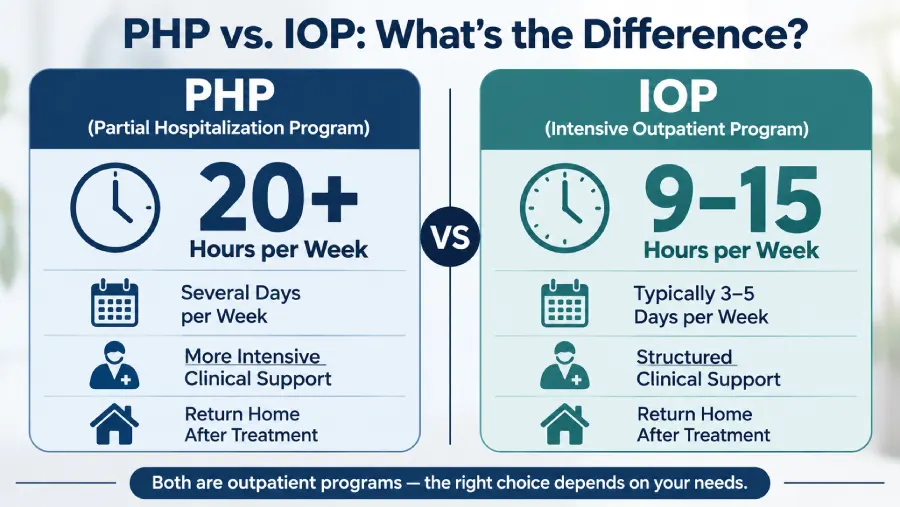
PHP is the more intensive of the two, with at least 20 hours of treatment a week and our medical and psychiatric team close by. IOP runs 9 to 19 hours a week and leaves more room for work, school, and family. This guide explains how the two compare, what a typical day looks like at our Los Angeles outpatient center, how we decide which one fits you, and when residential treatment is the safer choice.
Key Takeaways
- A PHP week of 20 or more hours is close to a part-time job. An IOP week of 9 to 19 hours leaves more room for work or school.
- Both programs are outpatient, so you sleep outside the facility every night. An unsafe home can justify residential care even when symptoms are mild.
- Heavy daily drinking or daily benzodiazepine use can cause dangerous withdrawal, so medical detox comes before PHP or IOP.
- Most people start at the level their assessment supports and move down as they stabilize. The first placement is a starting point and can change.
- Both levels include individual therapy, group therapy, family involvement, and care for co-occurring mental health conditions.
What Is The Difference Between PHP And IOP?
The main difference is intensity. PHP involves more hours of treatment each week and more frequent contact with clinicians, while IOP involves fewer hours and gives you more time to manage work, family, and daily life between sessions.
Both programs treat the same core problems and use many of the same therapies. What changes is how much structure you receive and how much of your week treatment takes up.
What Is A Partial Hospitalization Program (PHP)?
A partial hospitalization program is a higher-intensity form of outpatient treatment. You attend programming for a large part of the day on most days of the week, and the schedule usually includes group therapy, individual sessions, and recovery education.
PHP is still outpatient care. You return home or to supportive housing outside of program hours, so it does not provide 24-hour supervision. It suits people who need frequent clinical contact and can stay safe during the hours they are away from the program.
What Is An Intensive Outpatient Program (IOP)?
An intensive outpatient program gives you structured treatment on scheduled days, with fewer hours than PHP. Sessions typically include group therapy, individual therapy, and work on recovery skills, and the rest of your week is free for work, family, and recovery activities such as support meetings.
If you want program-specific details, our intensive outpatient program page covers how IOP works at our center.
PHP vs IOP: How Do The Programs Compare?
The table below compares the two programs side by side. Hours and days are general benchmarks that vary by provider and treatment plan, and they are not fixed rules.
| Feature | PHP | IOP |
| Treatment intensity | Higher | Moderate |
| General weekly hours | About 20 or more | About 9 to 19 |
| Days and session length | Most days, with long sessions | Several days, with shorter sessions |
| Clinical contact | Frequent | Regular, less frequent |
| Where you sleep | Home or supportive housing | Home or supportive housing |
| Flexibility for work and family | Limited | Greater, though it varies by schedule |
| Common goals | Stabilize, build coping skills, and prepare for step-down | Practice recovery skills in daily life and prevent relapse |
Living Arrangements And Daily Life
Neither program includes an overnight stay, so where you sleep matters. Evenings are often when cravings, stress, and conflict build up, and a home where people drink or use drugs can work against treatment even when the program itself is strong.
If your home is not a safe or supportive place, tell us during your assessment. We can talk through your options with you, which may include a higher level of care.
How Do Daily Schedules Differ Between PHP And IOP?
Schedules vary by provider, treatment plan, and clinical needs. The examples below show the general pattern, followed by how our Los Angeles outpatient center in Van Nuys runs each program.
What Does A Typical PHP Day Look Like?
A PHP day usually combines group therapy, individual sessions, and recovery education, with psychiatric or medical appointments added when they are indicated. You leave when programming ends and return the next scheduled day.
At our center, PHP groups run Monday through Saturday, from 9 a.m. to 12 p.m. and again from 12:30 p.m. to 3:30 p.m., with a daily community meeting. Your individual plan sets which days and sessions apply to you.
What Does A Typical IOP Schedule Look Like?
An IOP week usually has scheduled group sessions on several days, with individual therapy added to the plan. The hours outside sessions are yours to use for work, school, family, and practicing what you are learning.
Our IOP runs about four hours a day, three to five days a week, and we offer evening sessions for people who work during the day. Groups have 7 to 12 people. Whether IOP fits around a full-time job depends on your schedule, so we look at it with you during assessment.
Who May Be A Better Fit For PHP?
PHP may be a better fit if you need more frequent structure and clinical contact than a lower-intensity schedule provides, and you can stay safe at home or in supportive housing between sessions. A clinician decides this after an assessment, and these are examples of who it may suit.
- People stepping down from residential treatment who still need a full day of structure
- People whose depression, anxiety, or trauma symptoms make recovery harder and need closer monitoring
- People whose medications need frequent review
- People who have tried a lower level of care and need more support
Clinical Insight From Dr. Ash Bhatt: The second point on that list is the one I see most often. When a mental health condition goes untreated, it keeps pushing a person back toward drinking or using, so I would rather treat both together in PHP than send someone home to manage the symptoms alone.
Who May Be A Better Fit For IOP?
IOP may be a better fit if you are medically and psychiatrically stable enough for outpatient care, can stay safe outside of sessions, have a reasonably supportive home, and need more structure than weekly therapy offers. It is not simply a program for mild addiction, and many people with serious substance use disorders do well in it.
- People finishing PHP or residential treatment who are ready for fewer hours
- People with a stable, substance-free place to live
- People with work, school, or family duties that cannot be paused
- People who can take their medications as prescribed and get to sessions reliably
What Treatment Includes At Both Levels
PHP and IOP use the same core treatments, and the main difference is how many hours of each you receive. At our center, both levels include the following.
- Individual therapy, where you work one-on-one with a therapist on triggers, goals, and coping skills.
- Group therapy, where a small group practices relapse prevention and learns from each other.
- Family involvement, including family therapy sessions so the people at home understand your plan.
- Psychiatric care and medication management for conditions that often come with addiction, such as depression, anxiety, or trauma.
- Treatment for substance use and mental health at the same time, because many people have both.
What Do Clinicians Consider When Recommending PHP Or IOP?
Clinicians match you to a level of care by looking at your whole situation, not at a single score or at how severe your addiction seems. We use a national framework called the ASAM Criteria as a guide, and it looks at six areas of your health and life.
- Withdrawal and medication needs: whether stopping is safe without medical support and whether medications for addiction treatment would help.
- Physical health: conditions that need monitoring, such as liver disease, diabetes, or pregnancy.
- Mental health and thinking: depression, anxiety, trauma symptoms, or thoughts of self-harm.
- Risk of continued use: how likely use is to continue or return without close support.
- Recovery environment: your housing, relationships, and whether people around you use substances.
- Readiness and barriers: how ready you feel, and what could make it hard to attend, such as work, childcare, or transportation.
This is not a checklist for diagnosing yourself. A qualified clinician weighs these areas together, which is why two people with the same substance use can end up in different programs. The same idea runs through NIDA’s research-based treatment principles, which say no single treatment works for everyone and that plans should be reviewed and changed as needs change.
Clinical Insight From Dr. Ash Bhatt: The first area on that list, withdrawal risk, is the one I check before anything else. If you drink heavily every day or take benzodiazepines daily, stopping suddenly can cause seizures. You would need medical detox before PHP or IOP, and I will tell you that even if you want to start outpatient today.
You do not need to work out your own score before you call. Our team will walk through these areas with you in plain conversation and explain why we are recommending one level over another.
Can You Move From PHP To IOP As Your Recovery Progresses?
Yes. Many people begin in PHP, move to IOP when their symptoms and cravings settle, and then step down to standard outpatient care. Others begin in IOP and move up to PHP when they need more support.
A change in level should follow your progress and your needs, not a fixed timeline or an automatic graduation date. When we review your plan, we look at how steady your symptoms are, how often cravings come up, whether your home has stayed safe, and how you are handling work and relationships.
Stepping down usually means fewer hours, and it does not mean less support, because your therapy, medication care, and family involvement continue at the new level. Our guide to step-down care in the continuum of care shows how the levels connect.
Can You Work While Attending PHP Or IOP?
Many people can keep working during IOP, and most people cannot keep a full-time job during PHP. The reason is time. PHP takes 20 or more hours a week, which leaves little room for a standard work schedule, while IOP takes fewer hours and evening sessions can fall outside a workday.
If you work, a few steps make treatment easier to fit in.
- Tell our admissions team your work schedule on the first call, before choosing a program.
- Ask whether evening IOP sessions are available and how many days a week you must attend.
- Ask your employer’s HR department what leave or schedule options exist before treatment starts.
- If your assessment recommends PHP, ask whether a short PHP stay followed by evening IOP is possible.
What To Bring And Ask At Your Assessment
An assessment goes better when you arrive with specific information and questions. It helps to have these ready before you call.
- Everything you use, how much, and how often, including alcohol and prescription medications
- Any medical conditions and the medications you take
- Your work or school schedule and who depends on you
- Who lives in your home and whether substances are kept there
Then ask us how many hours a week the recommended level requires, whether evening sessions are available, and what would cause us to change your level.
Explore Outpatient Addiction Treatment At Our Los Angeles Center
Our outpatient center in Van Nuys offers PHP, IOP, and standard outpatient care, Monday through Saturday, 9 a.m. to 3:30 p.m. Both PHP and IOP include individual therapy, group therapy, and family involvement, and we treat substance use and co-occurring mental health conditions together.
You do not need to know which level you need before you call. Start with a conversation, and we will walk through your health, your home, and your schedule, then explain what we recommend and why. If residential care turns out to be the better fit, our team at our Los Angeles center can talk you through that option, including our luxury rehab program.
You can also verify your insurance to see what your plan covers before you decide. A verification explains your benefits and does not guarantee coverage.
Contact us or call (800) 808-4570.