




-
 Written By:
Amber Asher, MSW, LSW
Written By:
Amber Asher, MSW, LSW -
 Edited By:
Phyllis Rodriguez, PMHNP-BC
Edited By:
Phyllis Rodriguez, PMHNP-BC
-
 Clinically Reviewed By:
Dr. Ash Bhatt, MD, MRO
Clinically Reviewed By:
Dr. Ash Bhatt, MD, MRO
Methylphenidate can last a few hours or much of the day, depending on the formulation. Immediate-release versions act over a shorter period, while extended-release products are designed to release the medication more gradually.
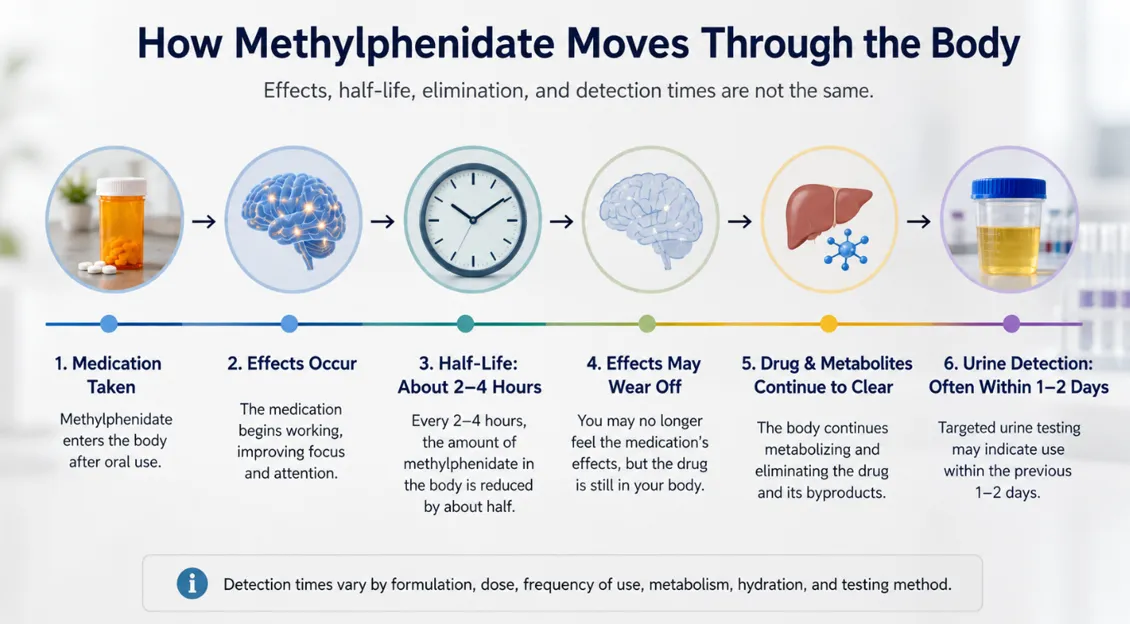
There is also an important difference between how long methylphenidate works and how long it stays in your system. The noticeable effects can wear off while the drug and its metabolites are still being processed and may remain detectable on certain tests.
Methylphenidate Timeline at a Glance
The timeline depends on the formulation and what you are measuring.
| Question | General Timeline |
| When does methylphenidate reach peak levels? | Around 2 hours for immediate-release formulations |
| When does extended-release methylphenidate reach peak levels? | Around 5–6 hours, depending on the formulation |
| What is methylphenidate’s half-life? | About 2–4 hours |
| How long can it be detected in urine? | Targeted testing may indicate use within the previous 1–2 days |
The important distinction is that duration of effect, half-life, and drug-test detection are not the same thing.
How Long Does Methylphenidate Last?
How long methylphenidate lasts depends largely on its formulation.
Immediate-release methylphenidate is designed for shorter periods of medication exposure. Extended-release formulations release methylphenidate over a longer period to provide more sustained coverage.
For example, the FDA states that extended-release products approved as generics for Concerta are intended to release methylphenidate over approximately 10–12 hours.
That does not mean every methylphenidate product lasts 10–12 hours. Different formulations use different release mechanisms.
A higher dose also does not automatically mean longer effects. Knowing that a tablet contains 18 mg, 27 mg, or another strength does not by itself tell you exactly how long it will work. The formulation, release mechanism, prescribed dose, and individual response all matter.
How Long Does Methylphenidate Take to Work?
There is no single onset time that applies to every methylphenidate product.
Mayo Clinic Laboratories reports that methylphenidate reaches peak concentrations at around 2 hours for immediate-release formulations and approximately 5–6 hours for extended-release formulations.
Peak concentration should not be confused with the moment someone first notices an effect.
Three timelines are useful to separate:
- Onset: when effects begin
- Duration: how long the medication’s effects continue
- Elimination: how long the body takes to metabolize and remove the drug
This is why feeling that methylphenidate has “worn off” does not mean it has completely left the body.
How Long Does Extended-Release Methylphenidate Last?
Extended-release methylphenidate is designed to provide longer coverage than immediate-release formulations.
Concerta is one example. FDA information states that Concerta-type extended-release products are intended to release methylphenidate over approximately 10–12 hours.
The current U.S. prescribing information for Concerta also shows that methylphenidate concentrations rise after administration and reach mean peak concentrations at approximately 6–10 hours.
Again, peak concentration and duration of effect are different measurements.
If prescribed methylphenidate consistently seems to wear off sooner than expected, discuss it with the prescribing clinician rather than changing the dose or how the medication is taken without medical guidance.
How Long Does Methylphenidate Stay in Your System?
Methylphenidate has a relatively short half-life.
Mayo Clinic Laboratories reports a methylphenidate half-life of approximately 2–4 hours. Its primary inactive metabolite, ritalinic acid, has a half-life of approximately 3–4 hours.
A half-life is the amount of time it takes for the concentration of a drug in the body to decrease by about half.
It does not mean methylphenidate has completely left the body after one half-life.
The process is closer to:
Dose taken → effects begin → effects wear off → methylphenidate continues to be metabolized → metabolites are eliminated
That distinction becomes particularly important when drug testing is involved.
How Long Does Methylphenidate Stay in Urine?
Targeted urine testing may indicate methylphenidate use within approximately the previous 1–2 days, although this is an estimate rather than a guaranteed detection window.
Most methylphenidate does not leave the body unchanged. It is extensively metabolized into ritalinic acid.
Mayo Clinic Laboratories reports that less than 1% of unchanged methylphenidate appears in urine, while approximately 60%–86% of the dose is excreted as ritalinic acid. This is why targeted laboratory testing may look for the metabolite as well as methylphenidate itself.
Detection can vary based on factors such as:
- The specific test and cutoff used
- Dose and frequency of use
- Individual metabolism
- Other health and medication factors
For this reason, urine detection windows should be treated as general estimates, not a way to predict exactly when a test will be negative.
Does Methylphenidate Show Up on a Drug Test?
Yes, methylphenidate can be detected when an appropriate test is used.
Not every drug panel specifically tests for methylphenidate. Targeted laboratory testing can measure both methylphenidate and ritalinic acid.
For example, Mayo Clinic Laboratories uses liquid chromatography-tandem mass spectrometry (LC-MS/MS), with separate cutoff concentrations for methylphenidate and ritalinic acid.
Methylphenidate is also not the same substance as amphetamine or methamphetamine, even though they are all stimulants.
Anyone taking prescribed methylphenidate who needs a workplace, medical, or other drug test should follow the testing provider’s process for reporting prescription medications rather than relying on a general detection timeline.
What Affects How Long Methylphenidate Lasts?
The same medication may not produce an identical timeline for everyone.
The main factors include:
- Formulation: Immediate-release and extended-release products deliver methylphenidate differently.
- Dose and frequency: How much is taken and how often can affect overall drug exposure.
- Individual response: People can experience different effects and durations from the same medication.
- Health and medications: Individual health factors and other medications may affect how methylphenidate is experienced or processed.
- Testing method: Detection depends on what the laboratory is testing for and the cutoff it uses.
This is why online timelines are best treated as general estimates rather than personal clearance calculators.
Is Methylphenidate the Same as Meth?
No. Methylphenidate is not methamphetamine.
Methylphenidate is a prescription central nervous system stimulant. Concerta and Ritalin are examples of medications containing methylphenidate.
Methamphetamine is a different stimulant drug.
Methylphenidate is also not methadone. Methadone is an opioid medication, whereas methylphenidate is a stimulant.
The names can cause confusion, but these substances are different.
Can Methylphenidate Be Addictive?
Methylphenidate has legitimate medical uses, but it also carries a risk of misuse and addiction.
The FDA requires prescription stimulants to carry updated warnings about misuse, abuse, addiction, and overdose. The FDA specifically identifies methylphenidate products such as Concerta and Ritalin among commonly prescribed stimulants.
Current U.S. prescribing information for Concerta also carries a boxed warning stating that the medication has a high potential for abuse and misuse that can lead to a substance use disorder, including addiction.
Taking methylphenidate as prescribed does not mean someone has an addiction. Concern becomes greater when use starts moving outside the prescribed plan.
Warning signs may include:
- Taking larger doses than prescribed
- Taking the medication more frequently than directed
- Regularly running out early
- Using someone else’s prescription
- Taking methylphenidate for nonmedical effects
- Finding it difficult to control use
- Continuing misuse despite negative consequences
If prescribed methylphenidate no longer seems to work as expected, speak with the prescribing clinician rather than increasing the dose independently.
When Methylphenidate Use Becomes Difficult to Control
Questions about how long methylphenidate lasts are often simply medication questions.
But when use shifts from following a prescription to regularly taking more, seeking nonmedical effects, or struggling to control use, a professional assessment may be appropriate.
Legacy Healing Center Los Angeles provides prescription medication addiction treatment based on each person’s substance use, mental health needs, medical history, and circumstances.
When prescription stimulant misuse occurs alongside anxiety, depression, trauma, or another mental health condition, dual diagnosis treatment can address substance use and co-occurring mental health concerns together.
Sources
Mayo Clinic Laboratories: Methylphenidate and Metabolite, Random, Urine — half-life, metabolism, ritalinic acid, peak concentrations, and urine detection.
S. Food & Drug Administration: Methylphenidate Hydrochloride Extended-Release Tablets — extended-release timing.
DailyMed / U.S. National Library of Medicine: Concerta Prescribing Information — U.S. prescribing information, pharmacokinetics, half-life, and boxed warning. The label was updated in April 2026.
S. Food & Drug Administration: Prescription Stimulant Safety Communication — misuse, addiction, overdose, and safe-use warnings.