




-
 Written By:
Amber Asher, MSW, LSW
Written By:
Amber Asher, MSW, LSW -
 Edited By:
Phyllis Rodriguez, PMHNP-BC
Edited By:
Phyllis Rodriguez, PMHNP-BC
-
 Clinically Reviewed By:
Dr. Ash Bhatt, MD, MRO
Clinically Reviewed By:
Dr. Ash Bhatt, MD, MRO
Key Takeaways
- Patients whose tests are positive on a drug screen days after they assumed Adderall was long gone from their system, let me tell you that detection time and how “normal” you feel are two completely different timelines.
- Nearly 4 million Americans misused prescription stimulants like Adderall last year, and most never took an illicit pill to get there. Taking your own prescription slightly wrong can build the same dependence.
- If you’ve been raising your own dose, running out early, or relying on Adderall just to function normally, that pattern is worth a real conversation, not something to manage quietly on your own.
Adderall typically stays in your system for 2 to 4 days, though this depends heavily on which formulation you took, how your body metabolizes it, your dosage, how often you use it, and which drug test is being used to detect it.
The distinction between IR (immediate-release) and XR (extended-release) matters more than most people realize, since XR releases medication over a longer window and clears the body differently than IR. Metabolism, kidney and liver function, dosage, and frequency of use all shift these timelines further, sometimes significantly.
It’s also worth understanding early on that detection time and effect duration are two different things. Adderall can still show up on a drug test long after its effects have worn off, and repeated or escalating use over time can increase the risk of dependence, which is where professional support becomes relevant.
Quick Answer: Adderall Detection Windows
| Test Type | Detection Window |
| Urine | 2 – 4 days |
| Blood | Up to 24 hours |
| Saliva | 20 – 50 hours |
| Hair | Up to 90 days |
These windows are general estimates. Actual detection time varies based on dosage, formulation, frequency of use, metabolism, hydration, and the specific testing method used. This information is educational and not a guarantee of test results.
What Is Adderall?
Amphetamine and dextroamphetamine are the two main components of Adderall, a prescription medication that stimulates the nervous system and increases brain activity of dopamine and norepinephrine. The FDA has given its approval for the use of Adderall in the treatment of attention-deficit/hyperactivity disorder (ADHD) as well as narcolepsy, which is a chronic sleep disorder characterized by daytime sleepiness.
Since misuse and dependence of Adderall are common, the DEA has categorized it as a Schedule II controlled substance, which means that despite its medical use, it is the most closely controlled of all medications. This way, it is on the same shelf with other prescription stimulants and opioids that have a high possibility of being abused.
Misuse of Adderall include a desire to get more focused or academically competitive or simply be aware of oneself at work all day long. SAMHSA‘s 2024 National Survey on Drug Use and Health found that 3.9 million people misused prescription stimulants like Adderall in the past year. Also, starting misusing Adderall does not involve illegal taking of the drug, but rather refers to situations where one exceeds medically recommended doses, frequency of use, or even self-administration without a prescription which is all quite different ways of the misuse of such drugs.
How Long Does Adderall Stay in Your System?
The time you feel the effects of Adderall and the time it is traceable within your body are different. For instance, the positive effects of increased concentration, alertness, and reduced hunger can go away long before the drug itself has completely exited your body.
Immediate-Release (IR) Adderall reaches peak concentration in the blood in roughly 3 hours and produces effects that typically last 4 to 6 hours. The drug is still there, although it is no longer at the height that it was before, so the effects will fade but detectable amounts will be present for a long time.
Extended-Release (XR) Adderall is designed to release medication gradually throughout the day. It reaches peak plasma concentration around 7 hours after ingestion. The general time for effects is 10-12 hours with the possibility of getting the stimulation beyond that as well.
Both forms are removed from the body via the same half-life mechanism that is the reason the drug remains in the body even though you have stopped feeling the drug’s effect.
Adderall Half-Life Explained
A drug’s half-life is the time it takes for your body to eliminate half of the substance from your bloodstream. According to FDA prescribing information, the mean elimination half-life for d-amphetamine is approximately 10 hours in adults, while l-amphetamine has a mean elimination half-life of approximately 13 hours in adults. This holds true across both IR and XR formulations, since both contain the same active compounds.
It generally takes 4 to 5 half-lives for a drug to be considered fully eliminated from the bloodstream. Using the 10-to-13-hour range, that puts full elimination of Adderall at roughly 40 to 65 hours, or about 2 to 3 days, for most adults under average conditions.
This is exactly why someone can test positive on a drug test well after they’ve stopped feeling any effects. The subjective experience of the drug wearing off happens much faster than the actual clearance of the compound from your system, which is a distinction worth understanding if you’re facing an upcoming drug test or trying to gauge your own use.
How Long Does Adderall Stay in Different Drug Tests?
Different testing methods detect Adderall over different windows, based on how the drug distributes through blood, saliva, urine, and hair.
1. Urine Test
Urine testing is the most common method used for prescription stimulants, largely because it offers a longer detection window than blood or saliva. Adderall is generally detectable in urine for 2 to 4 days after last use, though heavier or more frequent use can extend this window.
2. Blood Test
Blood tests capture a much narrower window since amphetamines clear from the bloodstream relatively quickly. Adderall is typically detectable in blood for up to 24 hours after use, making blood testing more useful for confirming recent or current use rather than use from several days prior.
3. Saliva Test
Saliva testing falls between blood and urine in terms of detection length. Adderall is generally detectable in saliva for 20 to 50 hours, and this method is increasingly used because it’s less invasive and harder to tamper with than urine testing.
4. Hair Follicle Test
Hair testing offers by far the longest detection window of any method. Adderall can be detected in hair follicles for up to 90 days after use, since the drug becomes embedded in the hair shaft as it grows. This method is less common for routine testing but is sometimes used in legal, employment, or long-term monitoring contexts.
What Factors Affect How Long Adderall Stays in Your Body?
Detection times are only estimates, and not exact, because a number of contributing personal factors affect how long it takes a person’s body to metabolize and excrete Adderall. With that said, the factors affecting Adderall’s stay in body are:
- Dosage – The higher the dose, the longer it will take to be eliminated as more of the drug is present.
- Frequency of use – Regular or daily use leads to accumulation in the body, extending detection windows well beyond what a single dose would produce.
- Immediate vs. extended release – Due to XR being released gradually it remains in the body over a longer period than IR despite both having similar elimination half lives.
- Age – The rate of metabolism usually decreases with increasing age, so the drug will be present for longer.
- Liver function – Amphetamines are metabolized in the liver so if the liver is not functioning properly then the elimination of the drug can be slower.
- Kidney function – Amphetamines can be partly cleared by the kidney. So abnormal or decreased kidney function may increase the detection period.
- Body composition – Factors like body fat percentage and muscle mass can influence how the drug distributes and clears from the body.
- Metabolism – Individual metabolic rate, which varies based on genetics, diet, and overall health, directly affects elimination speed.
- Hydration (myth clarification) – Drinking a ton of water doesn’t really accelerate the flushing or flushing out of Adderall by your system. It may dilute a urine sample, which can sometimes trigger a retest rather than a clean result, but it doesn’t change how quickly your liver and kidneys actually process the drug.
How Long Do the Effects of Adderall Last?
It’s worth repeating this distinction clearly: how long you feel Adderall’s effects is not the same as how long it stays detectable in your system. The two timelines are related, but they don’t match.
Immediate-Release (IR): Effects generally last 4 to 6 hours, with onset within 30 to 60 minutes of taking the dose. This is why IR is often prescribed in multiple daily doses.
Extended-Release (XR): Effects generally last 10 to 12 hours, covering most of a standard day with a single morning dose. Some people report the effects fading before the full 12-hour window, particularly later in the day.
In both cases, the drug remains measurable in blood, saliva, and urine well after these effect windows close, based on the elimination half-life discussed earlier.
Signs Adderall Is Leaving Your System
Once the stimulation effect of Adderall has dissipated, a group of symptoms generally occurs after that. This is mostly the case when the drug is taken regularly or when the dose is high.
- Fatigue – The energy level drops visibly when the stimulating effects disappear, and some people describe this stage as “feeling completely exhausted.”.
- Sleep changes – Depending whether the last dose is still working or has disappeared entirely, the same person may end up either unable to fall asleep at all or sleeping more than normal, respectively.
- Increased appetite – The appetite-suppressing effect of Adderall is only short-lived, and after a while the hunger returns in a more pronounced way than was experienced before taking the drug.
- Mood changes – Feeling irritated or having low mood since dopamine and norepinephrine levels adjust back toward baseline.
- Difficulty concentrating – Some individuals may notice that the drop in concentrating ability after stopping Adderall is even more noticeable than their regular level of distraction before they started using the medication at all.
These symptoms are common with typical, prescribed use and usually resolve within hours. When they become more intense, prolonged, or start following a pattern, they may indicate the beginning of a withdrawal process rather than simple effect wear-off.
Adderall Withdrawal Timeline
Withdrawal generally develops after regular use, particularly at higher doses, once the medication is stopped or significantly reduced. Not everyone experiences withdrawal the same way, and severity varies based on dosage, duration of use, and individual physiology.
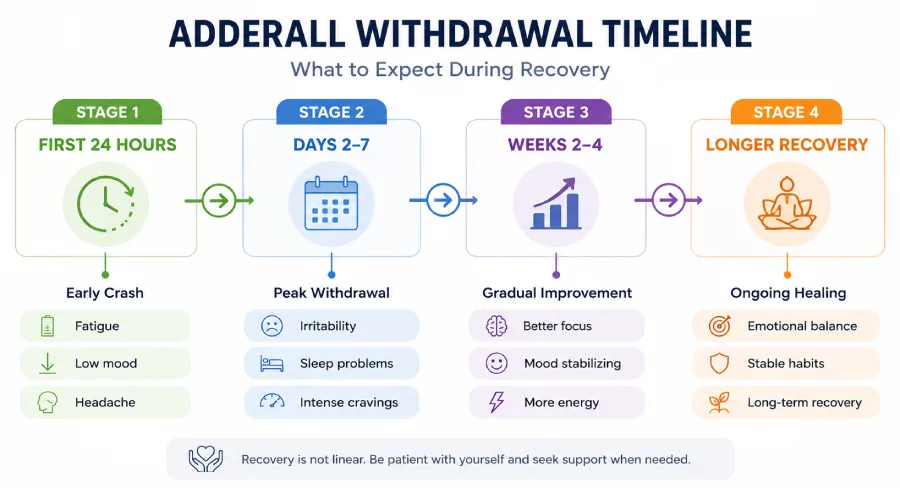
First 24 Hours: Fatigue, increased appetite, and mood changes typically begin as the drug clears the bloodstream, often described as a “crash.”
Days 2–7: Symptoms commonly peak during this window, including depressed mood, irritability, disrupted sleep, and intense cravings.
Weeks 2–4: Physical symptoms generally taper, though some psychological symptoms, such as low motivation, difficulty concentrating, mood instability can persist longer after heavier or prolonged use.
Longer Recovery: For some individuals, especially those with a longer history of misuse, subtler symptoms like anhedonia (reduced ability to feel pleasure) and fatigue can linger for weeks beyond the acute withdrawal period as brain chemistry gradually normalizes.
Clinical Perspective from Dr. Ash Bhatt:
I will be direct about Adderall on one thing and that is it should never be stopped abruptly without medical guidance, especially after regular or long-term use. Because sudden stopping can trigger a more intense crash, including significant depressive symptoms.
When Does Adderall Use Become an Addiction?
Adderall use can shift from appropriate medical use into misuse and eventually addiction, often gradually enough that it’s difficult to notice from the inside. Watch for these patterns:
- Taking higher doses than prescribed, or more frequently than directed, to achieve the same effect.
- Running out early or consistently finishing a prescription before the refill date.
- Cravings, a strong urge to take Adderall, particularly during periods when it’s not available.
- Doctor shopping, which means seeking multiple prescribers to obtain more medication than a single doctor would prescribe.
- Using Adderall without a prescription, including medication obtained from friends or family.
- Declining work or school performance, because dependence can eventually undermine the very focus and productivity it was meant to enhance.
Any combination of these patterns is worth taking seriously, regardless of how the medication was originally obtained or intended.
When Should You Seek Professional Help?
Certain signs indicate it’s time to involve a professional rather than trying to manage the situation independently.
- Withdrawal symptoms that feel severe, prolonged, or include significant depression or hopelessness.
- Mental health concerns – Adderall misuse can worsen underlying anxiety, depression, or trigger symptoms in people with no prior history.
- Polysubstance use – Using Adderall alongside alcohol, other stimulants, or sedatives to manage its effects or come down, which significantly increases health risks.
- Relapse risk – Previous attempts to cut back or stop that didn’t hold, or a pattern of returning to higher doses after periods of reduced use.
Dr. Ash Bhatt’s Clinical Perspective:
The patients I see with prescription stimulant dependence rarely started out looking for a “high.” Most started with a legitimate prescription or a genuine need to keep up with demanding work or school responsibilities. That’s exactly why professional support matters here — this isn’t about willpower, it’s about the neurochemical reality of how stimulant dependence develops, and that requires clinical treatment, not just discipline.
If any of this resonates, Legacy Healing LA’s prescription medication treatment program is built specifically to address stimulant dependence with medical and clinical support.
How Legacy Healing LA Helps Treat Prescription Stimulant Addiction
Recovering from Adderall dependence works best with a coordinated, medically informed approach rather than trying to stop on your own.
- Medical detox referrals – When appropriate, medical detox provides supervised support through the withdrawal process, helping manage symptoms safely under clinical observation.
- Residential treatment – A structured environment that removes access to the substance and daily triggers, allowing full focus on recovery.
- Individual therapy – One-on-one sessions to address the underlying reasons behind stimulant use, whether that’s academic or work pressure, an untreated mental health condition, or a pattern of self-medication.
- Cognitive Behavioral Therapy (CBT) – It helps identify and change the thought patterns that drive compulsive use and supports the development of healthier coping strategies.
- Dual diagnosis treatment – A treatment used when stimulant misuse frequently overlaps with anxiety, depression, or ADHD itself; treating both the substance use and any underlying mental health condition together produces better, more lasting outcomes.
- Aftercare – Ongoing support after residential treatment ends, helping maintain progress and reduce relapse risk during the transition back to daily life.
- Family support – This is important since stimulant addiction affects relationships and household dynamics, family involvement is built into the treatment process where appropriate.
If cost or coverage is a concern, our team can help you verify your insurance before starting treatment, and our admissions team is available to walk you through what the first step actually looks like.