



-
 Written By:
Amber Asher, MSW, LSW
Written By:
Amber Asher, MSW, LSW -
 Edited By:
Phyllis Rodriguez, PMHNP-BC
Edited By:
Phyllis Rodriguez, PMHNP-BC
-
 Clinically Reviewed By:
Dr. Ash Bhatt, MD, MRO
Clinically Reviewed By:
Dr. Ash Bhatt, MD, MRO
Key Takeaways
- The FDA’s own data on meloxicam shows only one in five people who develop serious stomach bleeding on an NSAID actually feel it coming. If you’ve had “just one drink” and felt fine, that’s not proof you’re in the clear.
- Someone on meloxicam for months, having a drink or two on weekends, assuming their body would “tell them” if something was wrong. The FDA data says otherwise, and that gap between feeling fine and being fine is exactly where the danger lives.
- If a drink has become your answer to the pain meloxicam is supposed to be treating, that’s worth a real conversation with me or another clinician, not something to quietly manage by cutting back “when you remember to.”
If you’re taking meloxicam for arthritis, back pain, or another inflammatory condition and wondering whether a glass of wine with dinner is off the table, the direct answer is: no, you shouldn’t drink alcohol while taking meloxicam. The combination raises your risk of stomach bleeding, ulcers, liver stress, and kidney damage, and the danger doesn’t scale down just because you’re only having one drink.
In this article, we’ll walk through exactly why meloxicam and alcohol don’t mix, who faces the highest risk, the warning signs that mean you need medical care right away, and what it means if reaching for alcohol around your medication has started to feel like more than an occasional choice.
Can You Drink Alcohol While Taking Meloxicam?
Healthcare providers advise against combining meloxicam and alcohol because both substances irritate the stomach lining independently, and together, that irritation compounds rather than simply adds up. Meloxicam is a nonsteroidal anti-inflammatory drug (NSAID), and according to the FDA’s prescribing information for meloxicam, alcohol use is specifically listed as one of the factors that increases the risk of serious gastrointestinal bleeding in patients taking NSAIDs.
There’s no version of “one drink is fine” backed by clinical guidance here. Even a single drink introduces the same interaction mechanism as three or four, just at a smaller scale, and your individual risk factors (age, liver health, prior ulcer history) matter more than the drink count itself.
Why Mixing Meloxicam and Alcohol Can Be Dangerous
Meloxicam and alcohol don’t just add separate risks side by side, they overlap on the exact same organs, which is what makes this combination more dangerous than either substance alone.
1. Increased Risk of Stomach Bleeding
Meloxicam already thins the protective mucus layer that shields your stomach wall, and alcohol irritates that same lining directly. Together, they raise the odds of gastrointestinal bleeding that can occur without any early warning signs.
2. Higher Risk of Stomach Ulcers
Repeated exposure to both substances can wear down stomach tissue enough to form open sores. The FDA notes that patients with a prior history of peptic ulcer disease or GI bleeding face a more than 10-fold increased risk of a GI bleed when using NSAIDs, and alcohol use adds further risk on top of that baseline.
3. Liver Stress
Your liver processes both meloxicam and alcohol, and asking it to metabolize both at once increases the workload on an organ that’s already doing double duty.
4. Kidney Damage
NSAIDs reduce blood flow to the kidneys, and alcohol can cause dehydration that further strains kidney function. Combined, this raises the risk of acute kidney injury, particularly in people with existing kidney conditions.
5. Increased Dizziness and Drowsiness
Alcohol’s sedative effects can intensify any dizziness meloxicam already causes, which raises fall risk, especially for older adults.
Quick Risk Comparison
| Risk Area | Meloxicam Alone | Meloxicam + Alcohol |
| GI bleeding | Elevated | Significantly higher |
| Stomach ulcers | Possible with long-term use | Higher, faster onset |
| Liver stress | Mild in most patients | Compounded metabolic load |
| Kidney strain | Present, dose-dependent | Increased, especially with dehydration |
| Dizziness/drowsiness | Occasional | More frequent and intense |
How Alcohol Changes the Way Meloxicam Affects Your Body
Meloxicam works by blocking enzymes called COX-1 and COX-2, which reduces inflammation and pain but also lowers the production of protective compounds that normally shield your stomach lining. That’s the trade-off built into every NSAID, including meloxicam.
Alcohol independently irritates the digestive tract and increases stomach acid production, which on its own can already cause irritation. When your stomach lining is already less protected because of meloxicam, alcohol’s irritating effect lands on tissue with fewer defenses.
This is why bleeding risk increases rather than just general stomach discomfort. The two substances aren’t just each causing separate problems, they’re attacking the same protective barrier from different directions at the same time.
Clinical Insights from Dr. Ash Bhatt:
One detail that surprises a lot of patients: the FDA’s meloxicam label states plainly that only one in five people who develop a serious upper GI event on an NSAID actually experience symptoms beforehand. Four out of five don’t get a warning sign. That’s part of why this specific interaction is treated so seriously in clinical guidance, regardless of how someone feels after drinking.
Who Faces the Greatest Risk?
Some people face greater danger from this combination than others, and it’s worth knowing where you fall on that list.
Higher-Risk Groups
- Adults over 65 – Metabolism slows with age, so alcohol and meloxicam both stay active in the body longer.
- People with a history of stomach ulcers – Prior GI damage means the stomach lining has less resilience to begin with.
- Heavy or frequent drinkers – Regular alcohol use compounds the GI and liver risks with every combined dose.
- People with liver disease – A liver already under strain has less capacity to process meloxicam safely.
- People with kidney disease – Reduced kidney function means both substances clear more slowly, extending exposure.
- People with high blood pressure – NSAIDs can raise blood pressure independently, and alcohol can compound that effect.
- People taking blood thinners – Combining blood thinners, meloxicam, and alcohol multiplies bleeding risk substantially.
- People on multiple prescription medications – More medications generally means more potential interaction points, and alcohol adds another variable into that mix.
Dr. Ash Bhatt’s Clinical Perspective:
The patients I worry about most aren’t the ones who drink heavily; they’re the ones over 65 who have one glass of wine a night out of habit and don’t realize their body is processing both meloxicam and alcohol far more slowly than it did at 40. That slower clearance is exactly what turns a “safe” nightly habit into a real risk.
Signs You Should Seek Medical Care Immediately
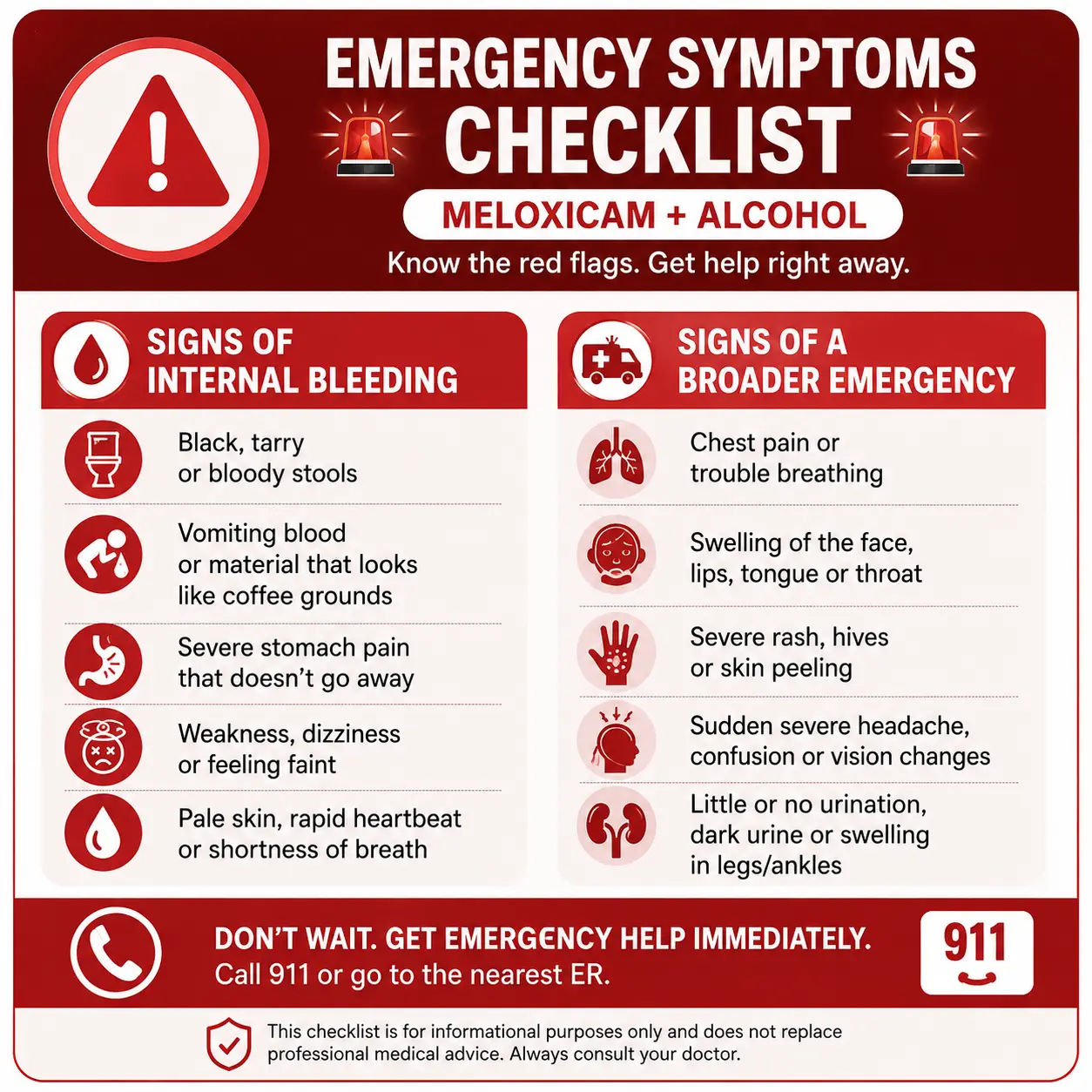
The FDA’s own data shows most people don’t get a warning before serious GI bleeding starts. That means waiting to “see how you feel” isn’t a safe strategy once any of these signs show up and you must seek emergency care right away if you notice:
1. Signs of Internal Bleeding
These point specifically to bleeding in your stomach or intestines, and they don’t need to be severe to be serious.
- Black or tarry stools – This is digested blood, and it means bleeding has already been happening for some time.
- Vomiting blood or material that looks like coffee grounds – Coffee-ground vomit is partially digested blood and is never something to wait out.
- Severe or persistent stomach pain – Pain that doesn’t ease up, especially paired with nausea, warrants same-day evaluation.
2. Signs of a Broader Emergency
These can indicate the bleeding has progressed far enough to affect your whole body, or that a different serious reaction is underway.
- Fainting or sudden lightheadedness – This can signal significant blood loss or a dangerous drop in blood pressure.
- Chest pain – NSAIDs carry their own cardiovascular risk, and chest pain should always be treated as an emergency, not assumed to be indigestion.
- Difficulty breathing – This can point to a severe allergic reaction or a cardiovascular event, both of which need immediate attention.
- Sudden confusion – In the context of possible blood loss or liver strain, confusion is a red flag, not a symptom to sleep off.
If you notice any of these after combining meloxicam and alcohol, don’t wait for a follow-up appointment, go to an emergency room or call 911. These symptoms describe active medical emergencies, not side effects to monitor at home.
Can You Ever Drink Alcohol While Taking Meloxicam?
Occasional social drinking still carries risk, and there’s no verified safe threshold where the interaction stops applying. Some people go months without a noticeable issue, while others experience GI symptoms after a single combined instance, and there’s no way to predict in advance which category you fall into.
Timing doesn’t neutralize the risk either. Meloxicam has an elimination half-life of roughly 15 to 20 hours, so it typically takes about three to four days after your last dose to clear it from your body, meaning a few hours between a dose and a drink doesn’t meaningfully reduce the overlap.
The safest approach is always to follow your prescribing clinician’s specific guidance, since they can weigh your personal health history against the general warning. What you should never do is adjust your meloxicam dose, skip it, or double up later, just to “make room” for drinking. That approach introduces new risks around pain control and medication consistency without actually solving the interaction problem.
Common Myths About Meloxicam and Alcohol
Because this interaction doesn’t always cause an immediate, obvious reaction, a handful of misconceptions have taken hold that end up putting people at more risk, not less. Here are the ones worth correcting directly.
1. “I only had one drink.”
One drink still introduces the same interaction mechanism as several. It may lower the odds compared to heavy drinking, but it doesn’t eliminate the risk, and the FDA’s warning doesn’t carry a quantity threshold.
2. “I’ve mixed them before without problems.”
GI bleeding and ulcers can develop silently before symptoms appear, and a clean track record isn’t a reliable predictor of future safety, since risk tends to build with repeated exposure over time.
3. “Beer is safer than liquor.“
The type of alcohol doesn’t change the interaction. What matters is the amount of ethanol consumed, not the beverage it came in, so a beer and a shot of liquor carry the same relative risk if they contain similar alcohol content.
4. “Taking meloxicam with food eliminates the risk.”
Food can reduce stomach irritation somewhat, but it doesn’t cancel out the combined effect of alcohol and an NSAID on your GI lining. It softens one variable, not the whole interaction.
When Mixing Alcohol and Prescription Medications Becomes a Pattern
For some people, drinking around a prescription isn’t a one-off decision, it becomes a repeated coping strategy. That shift often starts small and is worth paying attention to before it becomes routine.
Signs the Habit Is Shifting Into a Pattern
- Self-medicating pain – Reaching for a drink on nights when the pain meloxicam is treating feels worse than usual.
- Using alcohol to “come down” faster – Choosing alcohol over waiting for the medication because it feels like it works quicker.
- Ignoring an explicit warning – Continuing to drink after being told not to, because nothing bad happened the first few times.
- Drinking to manage stress – Using alcohol to cope with stress or discomfort rather than addressing what’s driving it.
If any part of this sounds like your own routine, it’s worth naming it out loud to a clinician rather than managing it quietly. At Legacy Healing LA, our prescription medication treatment program works specifically with situations where medication use and alcohol use have started to overlap in ways that carry real, ongoing health risks.
When to Seek Professional Help
Certain patterns point toward needing more structured support rather than trying to manage the situation alone.
Signs It’s Time to Reach Out To A Professional If:
- You’ve tried to cut back on drinking around your medication and found it harder than expected.
- You’ve had more than one risky combination despite knowing the warning.
- You’ve noticed cravings or restlessness when you go without alcohol.
- Anxiety, depression, or another mental health condition seems tied to why the drinking started.
What tends to separate a manageable slip from a pattern that needs support is whether it’s a repeated, harder-to-stop cycle. If that’s where you are, professional evaluation gets you an honest read on both the physical risk and the alcohol use itself, rather than guessing at it on your own.
How Legacy Healing LA Supports Recovery
If any part of the above sounds like your own routine, here’s what support can actually look like, depending on where you’re starting from.
What Treatment Can Include
- Alcohol addiction treatment – Our alcohol addiction treatment program is built around your specific drinking history rather than a one-size-fits-all timeline.
- Dual diagnosis care – When alcohol use is tangled up with anxiety, depression, or another condition, our dual diagnosis care treats both together instead of one and hoping the other resolves on its own.
- Medically supervised detox – When stopping alone doesn’t feel realistic or safe, supervised detox provides that first stabilizing step under clinical observation.
- Behavioral therapy – Addresses the underlying reasons alcohol became part of how you managed pain or stress in the first place.
- Aftercare planning – Carries progress forward once formal treatment ends, so support doesn’t stop at discharge.
You don’t need to have it fully figured out before reaching out. Our team can help you verify your insurance with no pressure attached, and our admissions team can walk you through what a first conversation looks like.