




-
 Written By:
Alex Herrera
Written By:
Alex Herrera
-
 Edited By:
Phyllis Rodriguez, PMHNP-BC
Edited By:
Phyllis Rodriguez, PMHNP-BC
-
 Clinically Reviewed By:
Dr. Ash Bhatt, MD, MRO
Clinically Reviewed By:
Dr. Ash Bhatt, MD, MRO
There is a version of addiction that does not look like addiction from the outside. The meetings still happen. The decisions still get made. The calendar stays full. But somewhere behind the performance, a CEO is managing something that is quietly costing them more than they realize: their clarity, their health, and eventually, their company. This article is for executives who have been asking questions they have not said out loud yet. For CEOs who need clinical stabilization, medically supervised withdrawal can provide a private, appropriate starting point before ongoing treatment. It covers what addiction recovery for CEOs actually looks like, why high performers wait longer than they should, and how treatment can happen without dismantling everything they have built.
Key Takeaways:
|
Why CEOs Often Wait Too Long to Seek Treatment
Addiction recovery for CEOs is complicated because of a particular kind of fear, one that is deeply connected to identity and control. Most executives hold back because of four fears that feel entirely rational from where they are standing:
- Fear of losing control: A CEO’s authority is built on appearing capable and decisive at all times. Entering treatment can feel like relinquishing that, even temporarily.
- Fear of reputation damage: In many industries, addiction is still treated as a character flaw rather than a medical condition, and executives know their name is searchable.
- Fear of stepping away from leadership: Who covers decisions? What signals does it send to investors, employees, or the board?
- Fear of business disruption: For founders, especially, the company and the self are deeply fused. Stepping back feels like stepping out permanently.
According to SAMHSA’s National Survey on Drug Use and Health, past-month illicit drug use among managers was the third-highest rate of all occupations surveyed, while the overall rate of past-month heavy alcohol use among full-time workers was 8.7 percent. That number is almost certainly lower than reality, because the same professional position that puts executives at risk also gives them the resources and cover to hide it longer. 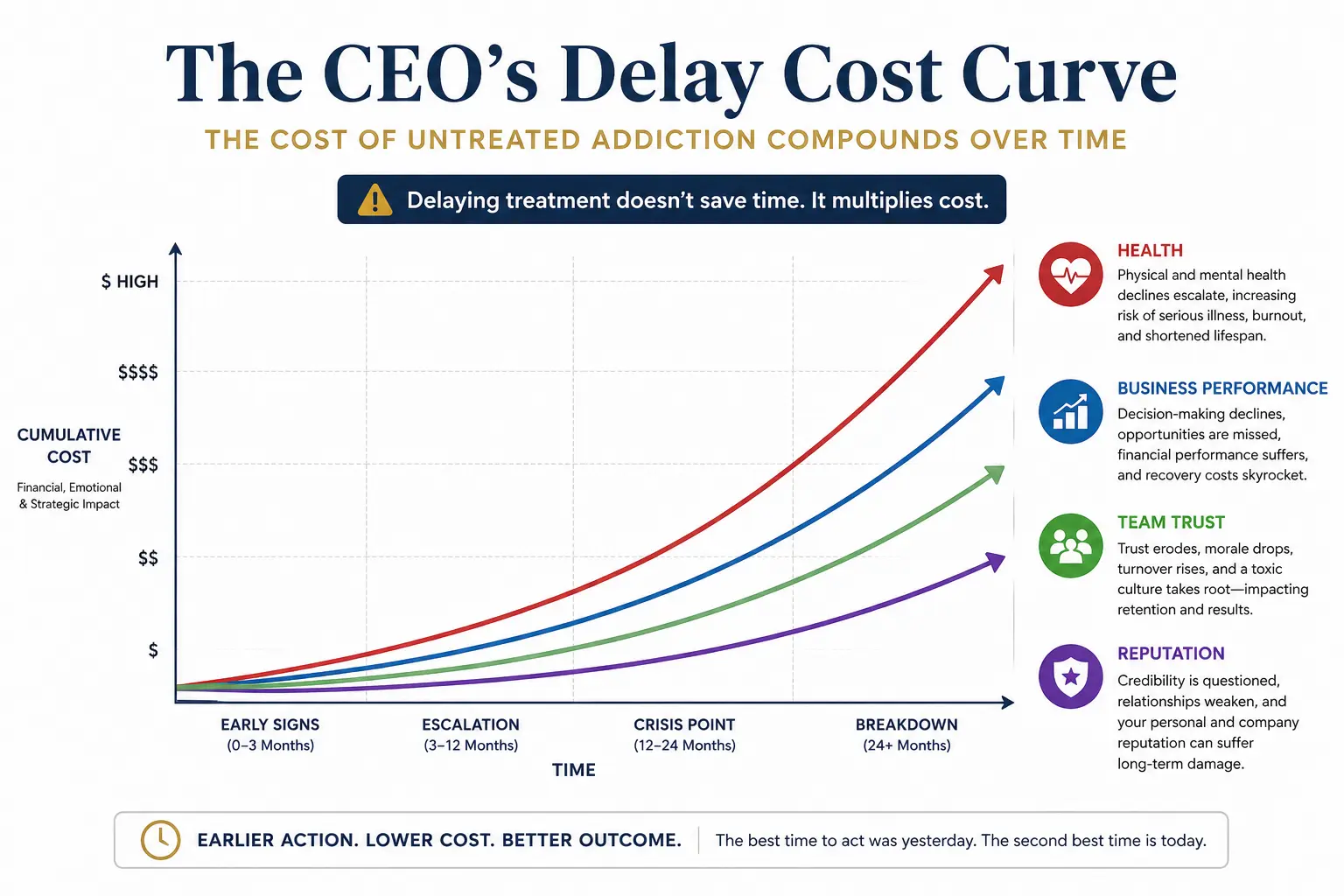
The Hidden Business Risks of Delaying Treatment
The conversation about executive addiction is often framed around personal health. Whereas, the direct effects are visible in leadership performance, long before a crisis becomes visible.
- Decision-Making Suffers
Chronic substance use degrades the prefrontal cortex, the part of the brain responsible for judgment, risk evaluation, and long-term thinking. A CEO operating under this neurological strain is not making the same quality of decisions they made three years ago. No one may have named it yet, but the pattern is already there.
- Leadership Presence Changes
People notice before they say anything. Direct reports begin routing sensitive conversations around the CEO. Board members start double-checking information independently. The erosion of presence is usually the first visible signal, and it precedes any formal performance concern by months.
- Burnout Intensifies
Substance use borrows against future capacity. The temporary relief you get from substance use compounds into cumulative fatigue, and managing the cycle of use and recovery from use gradually consumes more and more of the week.
- Team Trust Declines
Unpredictable moods, inconsistent communication, and altered reactions affect organizational culture in ways that are difficult to reverse. The trust that got damaged at the leadership level requires sustained and deliberate effort to rebuild, and that effort cannot happen while the underlying problem is still active.
- Long-Term Business Value Is Affected
For publicly traded companies, a CEO’s conduct and health are material. For private businesses and founder-led companies, the owner’s clarity directly determines company trajectory. The cost of delaying CEO addiction treatment gets accumulates in missed strategy, relationship damage, and measurable performance decline.
Clinical Perspective From Dr. Ash Bhatt“I have sat across from some of the most accomplished people in business. What I consistently see is that the leadership decline starts long before anyone says anything directly. The CEO is often the last to understand that their performance has changed because everyone around them is still deferring to their authority. By the time it becomes a boardroom conversation, months or years of quiet deterioration have already happened. This is why I emphasize seeking treatment early to protect the thing they have worked hardest to build.” |
How CEOs Receive Treatment Without Walking Away from Their Company
The question most executives ask first is: Can I actually do this without stepping away entirely? The honest answer is yes, if the program is built for it. Executive addiction treatment at Legacy Healing LA is designed around one practical reality: leaders cannot disappear. The best programs build treatment around that constraint rather than ignoring it.
- Business Continuity Planning
Before treatment begins, a good clinical team works with the executive to establish a leadership continuity plan. This is not different from what a CEO would do before a medical procedure; it is simply preparation that protects the organization while they are unavailable for high-level decisions.
- Delegating Leadership Responsibilities
COOs, boards, and senior leadership teams can temporarily absorb operational authority. Defining clear chains of command in advance prevents disruption and protects the executive from the anxiety of feeling disconnected.
- Structured Communication Policies
Most executive programs allow scheduled check-ins with key business contacts, at defined times and through agreed channels. This is not open access; it is a structured window that allows business continuity without derailing the recovery process.
- Executive-Focused Scheduling
Treatment plans for CEOs are often built around flexible scheduling, morning sessions, evening groups, and unstructured time that can accommodate business needs. The goal is recovery that fits into a leadership life, not a program designed for a very different population.
- Confidential Treatment
From intake to discharge, executive programs maintain strict privacy protocols. No public records, no shared facilities with the general population, and no identification in shared spaces. This is a structural feature of the program, not an add-on.
What High-Level Executives Look for in a Recovery Program
When researching luxury rehab for executives, CEOs are looking for comfort; they are assessing whether a program can meet the specific demands of their lives. Here is what a well-designed executive program should include:
- Confidentiality: End-to-end privacy from inquiry to aftercare, with no exposure to public-facing intake processes.
- Personalized Treatment: A clinical plan built around the individual’s history, substances, mental health, and professional pressures, not a standard group curriculum.
- Mental Health Support: According to the National Institute on Drug Abuse, people diagnosed with mood or anxiety disorders are about twice as likely to also have a substance use disorder. For executives, anxiety, burnout, and depression nearly always accompany substance use and must be addressed through dual diagnosis treatment alongside the addiction itself.
- Private Accommodations: Single-occupancy rooms, private dining options, and physical separation from general treatment populations.
- Executive-Level Comfort: Amenities that match the standard of living executives maintain outside treatment, not as indulgence, but because comfort reduces resistance and improves engagement with treatment.
- Travel Coordination: The program arranges private transportation and assists with logistics that might otherwise become barriers to entry.
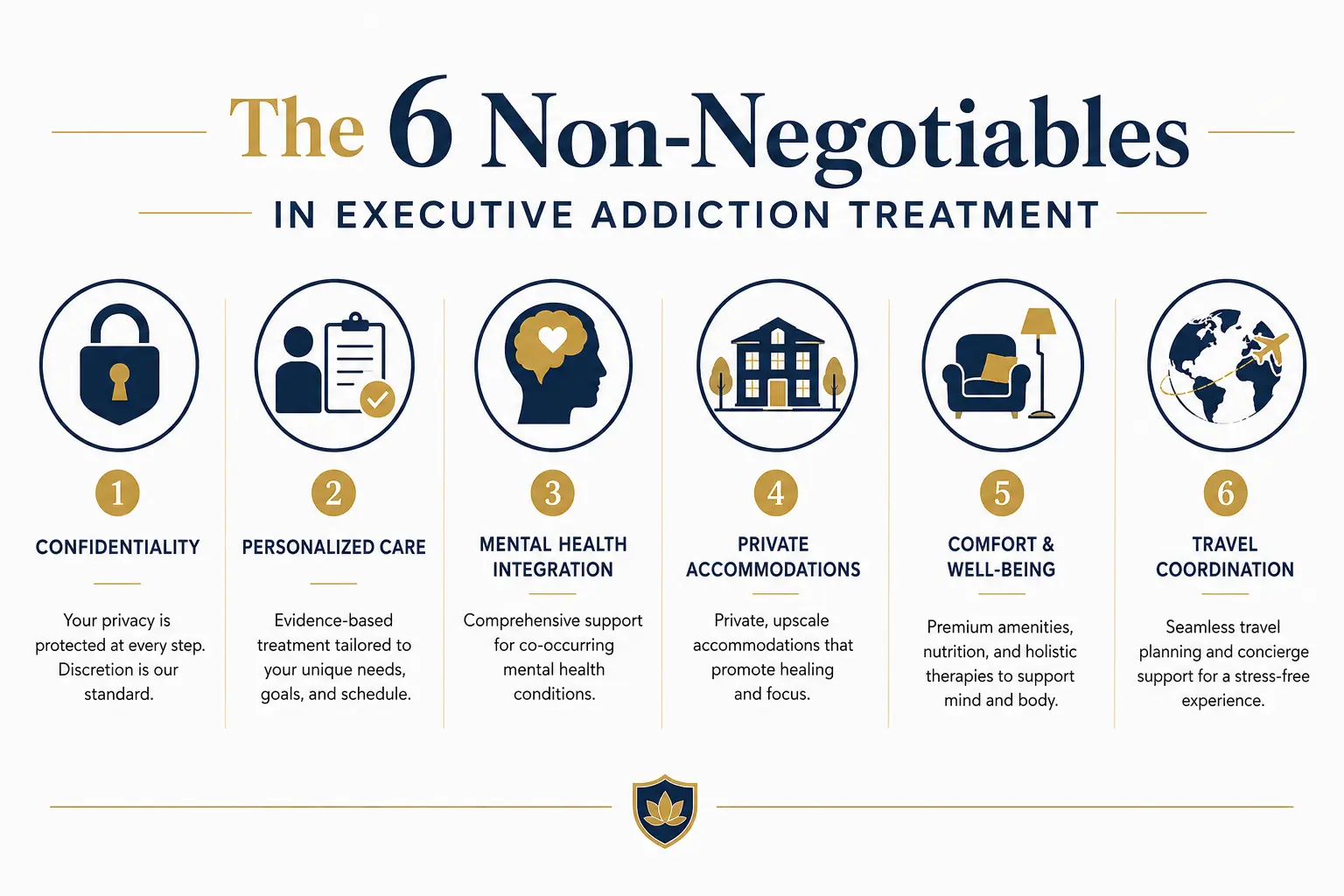 Our luxury treatment program is built around each of these non-negotiables, because executive recovery requires a different level of structure, not just a different level of comfort.
Why Many CEOs Choose Treatment Away from Home
Choosing treatment away from the executive’s home city is not about avoidance. It is about engineering the right conditions for recovery to actually take hold. When a CEO seeks treatment locally, the risk multiplies quickly. Someone from their professional network might recognize them. A colleague might notice a gap in availability. The environment itself, the same city, the same pressures, the same professional identity, makes genuine psychological separation nearly impossible. Traveling for confidential addiction treatment removes those variables entirely. Los Angeles and Beverly Hills have become recognized destinations for executive recovery precisely because they combine clinical excellence with a luxury recovery environment designed for high-profile individuals, far from professional contexts that reinforce the same patterns treatment is trying to interrupt. Distance also creates something that no clinical protocol can manufacture: space. Space from the triggers that built the pattern. Space from the professional roles that maintain it. Space to examine the relationship between high-stakes leadership pressure and substance use, without being inside that pressure while trying to do the work. Legacy Healing LA is located in Los Angeles and provides that separation alongside PHP and IOP programming that is structured to match an executive’s pace and level of care needs.
Clinical Perspective From Dr. Ash Bhatt“I often tell executive patients that choosing to travel for treatment is one of the clearest signs of how seriously they are taking their recovery. The ones who try to manage it while staying embedded in their professional environment rarely get the separation they need to do real work. Recovery requires a different context, not just different behavior inside the same context. When someone is willing to step into an unfamiliar environment for their own health, that is the foundation everything else is built on.” |
The Most Effective CEOs Seek Help Before a Crisis Occurs
Addiction recovery for CEOs works best when it is a proactive leadership decision. The executives who protect the most are the ones who apply to their health the same logic they apply to their business: identify the risk early, act before it compounds, and protect the assets that matter most. That means treating recovery as a matter of:
- Strategic decision-making – Understanding that mental clarity is a leadership asset that requires active maintenance, not just performance output
- Risk management – Recognizing that untreated addiction carries legal, reputational, and operational risk that dwarfs the disruption of a quiet, well-planned treatment period
- Protecting family – The personal cost of waiting is almost always paid by the people closest to the executive first, long before the professional consequences arrive
- Protecting health – Addiction is progressive; the window for the most straightforward intervention is earlier than most executives believe
- Protecting business – The company’s stability is a direct function of the leader’s clarity, and that clarity is not infinite under sustained substance use
Strong leaders solve problems before they escalate. Seeking treatment is not stepping away from leadership. It is the most decisive leadership decision available.
Seeking Treatment Is a Leadership Decision
The strongest leaders know when to bring in the right support in finance, in operations, in legal matters, and in health. Addiction recovery for CEOs is not about stepping away from leadership responsibilities. It is about protecting the health, clarity, and resilience required to keep leading effectively. If you are reading this and recognizing something in yourself or someone you know, Legacy Healing LA offers confidential, executive-level addiction treatment built around your professional life, your privacy, and your long-term recovery. Call Legacy Healing LA: 8008084570