




-
 Written By:
Amber Asher, MSW, LSW
-
 Edited By:
Phyllis Rodriguez, PMHNP-BC
-
 Clinically Reviewed By:
Dr. Ash Bhatt, MD, MRO
Relapse prevention is part of recovery from the start. It is the work of knowing what puts you at risk and having a plan for it. Triggers and warning signs look different for every person, and continued treatment and support lower the chance of returning to use.
Know your triggers, watch for early warning signs, keep treatment and support going after rehab, and write a plan you can follow when cravings hit. If use happens again, get safe, tell someone, and have your treatment reassessed quickly. Our Los Angeles team offers residential care, PHP, IOP, and outpatient treatment.
This article explains what relapse is, why it happens, which signs to watch for, how to build a plan, what changes from one substance to another, and what to do after a return to use.
Key Takeaways
- Relapse can happen during recovery, but it is not inevitable, and a good plan lowers the risk.
- A lapse is a brief return to use. A relapse is a return to a problematic pattern. Both deserve attention right away.
- Warning signs show up in emotions, thoughts, and behavior before any use, which gives you time to act.
- Each substance carries different risks. Reduced tolerance makes opioid relapse a real overdose danger, and withdrawal from alcohol and benzodiazepines can be dangerous.
- Repeated relapse usually means the treatment plan needs to change. It does not mean the person cannot recover.
What Is Relapse Prevention?
Relapse prevention is the work of protecting your recovery over time. It combines clinical care, practical skills, and steady support so you’re ready for the moments that put your sobriety at risk. In practice, that means getting to know your personal triggers, noticing the early warning signs that you’re struggling, and building coping skills you can use when cravings hit. It also means staying connected to treatment and the people who support you, and having a plan in place before high-risk situations come up, not after.
You may also hear the term Relapse Prevention (RP) therapy. RP therapy is a specific type of cognitive behavioral therapy (CBT). In it, you work with a clinician to identify the situations most likely to lead to relapse and practice how you’ll respond to them. Think of relapse prevention as the overall goal and RP therapy as one structured, evidence-based way to work toward it.
Why Does Relapse Happen?
Relapse rarely has one cause. These factors usually work together:
- Changes in the brain. Repeated use changes how the brain handles reward, stress, memory, and decisions, which is why cravings can feel automatic long after use stops.
- Unmanaged emotional distress. Stress, grief, anxiety, depression, loneliness, and trauma make cravings harder to handle.
- Familiar environments. Going back to the places, people, and routines tied to past use brings back strong learned associations.
- Too little continuing care. Some people lose therapy, medication management, or recovery support when residential treatment ends.
- Co-occurring mental health conditions. Untreated depression, anxiety, or PTSD makes recovery harder.
- Physical dependence and withdrawal. Withdrawal symptoms and cravings can pull someone back to use, especially in alcohol, opioid, and benzodiazepine recovery.
Blaming a single trigger or a lack of motivation usually misses what actually happened.
What Are the Early Warning Signs of Relapse?
Warning signs fall into three groups. They are possible signals, not a diagnostic checklist, and having one does not mean relapse is coming.
Emotional Warning Signs
These show up in how you feel day to day:
- Growing irritability
- Anxiety or lasting sadness
- Feeling isolated
- Trouble managing stress
- Losing interest in recovery activities
Mental Warning Signs
These show up in how you think about past use:
- Remembering past use as fun
- Believing controlled use might be possible
- Minimizing what addiction cost you
- Thinking about alcohol or drugs constantly
- Justifying contact with people tied to use
Behavioral Warning Signs
These are changes others can often see:
- Skipping therapy sessions
- Avoiding meetings or support contacts
- Going back to high-risk places
- Neglecting sleep and daily routines
- Hiding things from family or your treatment team
What Are the Most Common Relapse Triggers?
A trigger is anything that sets off a craving, and most fall into four broad groups. Emotional triggers are the feelings that can make use seem like a way to cope, such as stress, loneliness, anger, boredom, shame, grief, and anxiety. Environmental triggers are the places and situations tied to past use, like bars, parties, old neighborhoods, routines built around drinking or using, and easy access to drugs.
Social triggers come from the people around you, including peer pressure, relationships centered on substance use, family conflict, and isolation. Physical and psychological triggers come from within the body and mind: poor sleep, chronic pain, withdrawal symptoms, and untreated mental health conditions can all wear down your defenses and make cravings harder to resist.
Here is how that plays out. Someone who used to drink to cope with work stress may get strong cravings after a bad professional setback, even after months of sobriety. The setback is the emotional trigger, the old coping habit is the learned link, and a long sober streak does not cancel either one.
How Does the Relapse Process Develop?
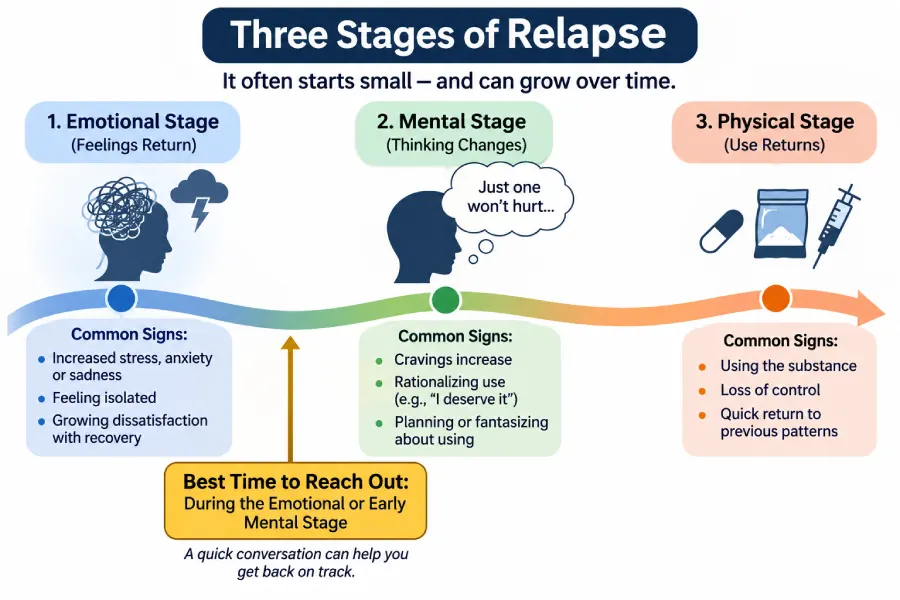
Many clinicians describe relapse in three stages. This is an educational framework, not a universal sequence, and not everyone goes through every stage.
Clinical Insight From Dr. Ash Bhatt
On the emotional stage, I tell patients that the first sign is often small, such as skipping a meeting because they are tired. When that happens twice in a week, call someone and say so. It is much easier to talk about at that point than after a drink.
How to Prevent Alcohol and Drug Relapse
Each of these strategies answers a specific problem:
- Identify your personal triggers. Write down the emotions, people, places, and times of day that raise your risk, so you can plan for them instead of being surprised.
- Build coping skills for cravings. Cravings rise and fade, so delay acting on them. Try urge surfing, which means noticing the craving without acting on it until it passes. Leave the situation, call someone, use grounding or breathing exercises, and practice saying no out loud.
- Keep a daily routine. Regular sleep, meals, and exercise steady your mood and stress, which are the things that drive cravings. A set schedule also fills the empty hours when cravings tend to hit.
- Stay connected. Family, friends, peer groups, sponsors, and your treatment team give you people to call before a craving becomes a decision.
- Continue therapy and medication. Treatment often continues after residential care, and for some substance use disorders, medication plays a major role in staying well.
- Reduce exposure to high-risk places. Set boundaries, skip events built around drinking or use, and clear alcohol or drugs out of your home.
- Treat co-occurring conditions. Untreated anxiety, depression, or trauma keeps pushing people toward old coping habits.
- Stay in touch with professionals. Ask for a reassessment when cravings grow, symptoms return, or your risk factors change.
How to Create a Relapse Prevention Plan
A relapse prevention plan is a written guide you can follow when you cannot think clearly. It should be built for you, ideally with a therapist or treatment provider. A good plan has six parts:
- My personal triggers: the people, situations, emotions, and places that raise my risk.
- My early warning signs: changes in my thoughts, feelings, routines, and recovery habits.
- My coping strategies: what I will do when cravings or distress go up.
- My support contacts: family, trusted friends, my therapist, and recovery contacts, with phone numbers.
- My emergency plan: where I will go and who I will call if I use or suspect an overdose.
- My treatment follow-up: therapy appointments, medication management, and continuing care.
Here is what the plan looks like in practice:
| Situation | Planned Response |
| Work-related stress | Take a break and contact a support person |
| Strong cravings | Leave the triggering place and use a coping strategy |
| Invitation to a party with alcohol | Decline, or arrange a safer alternative |
| Feeling emotionally overwhelmed | Contact a therapist or trusted person |
| Return to substance use | Seek medical assessment and reconnect with treatment |
Review the plan regularly and update it after a job change, a move, a loss, or any craving that caught you off guard.
Clinical Insight From Dr. Ash Bhatt
On the support contacts, specific names beat good intentions. At 2 a.m., a number you can tap is far more useful than a plan to “reach out for support.” I ask patients to save these contacts as favorites before they leave our care.
Relapse Prevention for Different Substances
Each substance has its own withdrawal profile, treatment options, and overdose risk, so one plan does not fit all.
Alcohol Relapse Prevention
Alcohol is everywhere socially, and many people slip at weddings, work dinners, or on stressful evenings alone. Counseling and ongoing support help, and three medications can also help: naltrexone and acamprosate, which reduce cravings, and disulfiram, which causes an unpleasant reaction to alcohol and suits some patients. If you have been drinking heavily and are dependent, talk to a doctor before stopping suddenly, because alcohol withdrawal can be dangerous.
Opioid Relapse Prevention
Cravings and withdrawal drive most opioid relapses, and medications reduce both. Buprenorphine, methadone, and naltrexone are the main options. Keep naloxone at home and tell the people around you where it is.
The biggest danger is lost tolerance. After a period without opioids, a dose you once handled can cause a fatal overdose.
Benzodiazepine Relapse Prevention
Physical dependence on benzodiazepines can develop even when the medication is prescribed, and it is different from addiction. Stopping abruptly can be dangerous, so reductions should be done as a medically supervised taper. Anxiety and rebound symptoms often return during the taper, so psychological support matters. Mixing benzodiazepines with opioids or alcohol raises the risk of serious harm.
Cocaine and Methamphetamine Relapse Prevention
Stimulant relapse is driven mostly by psychological cravings, stress, poor sleep, and the people and places tied to use. No medication is currently FDA-approved for stimulant use disorder, so treatment relies on behavioral approaches. CBT and contingency management have supporting evidence, and continued behavioral support keeps those gains in place.
Cannabis and Other Drugs
Cannabis relapse is often tied to habit, such as using at the same time each evening, and to psychological dependence. Coping skills and therapy address both. For other substances, treatment is built around the specific drug, the person’s history, and their other health needs.
What Is Chronic Relapse? Why Does Someone Keep Relapsing?
When people talk about chronic relapse, they usually mean repeated returns to problematic use after earlier attempts at treatment or recovery. The reasons are usually practical and treatable:
- Treatment that ended too early or was too short to reach the underlying causes
- Untreated depression, anxiety, PTSD, or other mental health conditions
- Ongoing stress from unstable housing, money problems, difficult relationships, or constant exposure to use
- Stopping therapy or medication management without a transition plan
- A treatment approach that did not fit the person’s needs, such as a level of care that was too light
- Repeated withdrawal without treating the substance use disorder itself
That last point matters. Detox clears the body of a substance and manages withdrawal, but it does not change the habits, thinking, and conditions that led to use. On its own, it is not a complete treatment.
Repeated relapse does not mean someone is incapable of recovery. It means the plan needs to be reassessed, and we approach it that way.
How Can Treatment Help Prevent Repeated Relapse?
Professional treatment goes after the specific reasons relapse happens. These are the main approaches.
Cognitive Behavioral Therapy (CBT)
CBT helps you notice thought patterns that lead to use, identify high-risk situations, respond to stress in healthier ways, challenge beliefs such as “one time won’t matter,” and practice coping skills until they feel natural.
Relapse Prevention Therapy
This therapy focuses on high-risk situations, coping responses, managing cravings, and building confidence that you can handle what comes up.
Contingency Management
Contingency management rewards positive steps, such as attending sessions or providing drug-free tests. It has an especially strong record for stimulant use disorder.
Medication-Assisted Treatment and Medication Management
Medication depends on the substance. For alcohol, options include naltrexone, acamprosate, and disulfiram. For opioids, they include buprenorphine, methadone, and naltrexone. These are not interchangeable, and a prescriber chooses based on your health and history.
Dual Diagnosis Treatment
When substance use and a mental health condition exist together, treating both at the same time gives recovery a steadier base than treating one and hoping the other improves.
Family Therapy and Group Support
Family sessions improve communication and accountability. Groups give you peers who recognize what you are going through, and that connection makes isolation harder to fall into.
What Should You Do After a Lapse or Relapse?
A return to use is a setback, and the first hours matter. Take these steps:
- Get safe first. If someone is unconscious, struggling to breathe, having a seizure, or showing overdose signs, call 911 right away.
- Take it seriously. A single episode can carry medical risks, especially when tolerance has dropped.
- Contact a treatment professional. A medical and clinical assessment shows what happened and what care is needed.
- Skip the shame. Self-blame makes people hide, and hiding delays help. Tell someone you trust the truth.
- Reassess the plan. You may need medical detox, medication changes, more frequent therapy, residential care, PHP or IOP, or added mental health support.
- Update your relapse prevention plan. Work out what contributed to the episode and change what needs changing.
If opioids are involved, remember that reduced tolerance can make a previously tolerated dose fatal. Keep naloxone available.
How Does Aftercare Support Long-Term Relapse Prevention?
Support should not stop when residential treatment does. Aftercare can include individual counseling, group therapy, alumni programs, peer recovery groups, sober living where it fits, medication management, family support, and regular updates to your relapse prevention plan.
A structured move from residential care to outpatient treatment keeps support in place while your independence grows. Dropping from daily care to nothing at all is where many people run into trouble.
When Is a Higher Level of Addiction Treatment Needed Again?
Not everyone who has a craving or a lapse needs residential rehab again. The right level depends on your medical stability, how severe your use is, your mental health needs, your home environment, and whether you can stay safe.
- Residential treatment fits people who need a structured, supervised setting and strong support away from their usual environment.
- A partial hospitalization program (PHP) fits people who need intensive daytime treatment but can live outside a facility safely.
- An intensive outpatient program (IOP) fits people who need structured therapy and clinical support while keeping up work, school, or family responsibilities.
Withdrawal that needs medical monitoring may call for medically supervised detox first, which is a separate service. PHP and IOP are not substitutes for emergency care or medically necessary withdrawal management.
Final Thoughts: Staying Sober Takes Practice, and Support Helps
Some people come to us after a slip. Others come because they have relapsed several times and want a different approach. In both cases, we start with a clinical assessment, because the right level of care depends on what is going on for you now.
Our Los Angeles programs include:
- Residential addiction treatment
- PHP and IOP, with IOP running about four hours a day, three to five days a week, with evening sessions available
- Individual and group therapy
- Relapse prevention and coping skills work
- Support for co-occurring mental health conditions
- Continuing care and treatment planning
If you or someone you care about has relapsed more than once, you do not have to work out the next step alone. Our team can help you explore treatment options and understand what level of support may fit.
Contact us or call (800) 808-4570.