




-
 Written By:
Amber Asher, MSW, LSW
Written By:
Amber Asher, MSW, LSW -
 Edited By:
Phyllis Rodriguez, PMHNP-BC
Edited By:
Phyllis Rodriguez, PMHNP-BC
-
 Clinically Reviewed By:
Dr. Ash Bhatt, MD, MRO
Clinically Reviewed By:
Dr. Ash Bhatt, MD, MRO
Key Takeaways
- Benzodiazepine withdrawal can cause seizures and delirium, and the FDA states that withdrawal seizures can be life-threatening.
- Physical dependence can start after several days to weeks of steady use, even when the medicine is taken exactly as prescribed.
- A gradual, supervised taper lowers the risk, and the 2025 joint guideline advises against dose cuts larger than 25% every two weeks.
Yes, a person can die from benzodiazepine withdrawal, although serious complications are not inevitable. The real danger comes from seizures and delirium, which can appear when someone stops a benzodiazepine suddenly or cuts the dose too fast after the body has come to rely on it. You do not have to misuse the drug for this to happen, because dependence can develop in people who take Xanax, Klonopin, Ativan, or Valium exactly as prescribed.
This article covers who is at risk, which symptoms mean emergency help, how long withdrawal can last, and how doctors manage it safely.
Can Benzodiazepine Withdrawal Be Fatal?
Yes, it can, in severe cases. The FDA’s 2020 boxed warning says that stopping benzodiazepines abruptly or lowering the dose too quickly can cause withdrawal reactions, including seizures, and that these can be life-threatening. The American Academy of Family Physicians also lists seizures, psychosis, and death as rare results of stopping suddenly.
Benzodiazepines strengthen GABA, the brain’s main calming signal, and after a few weeks the brain adjusts by turning down its own calming activity and turning up its excitatory activity. If the drug disappears all at once, that excitatory activity has nothing holding it back, and you get tremor, a racing heart, agitation, and sometimes a seizure.
Your own risk depends on several things. The AAFP says the rare severe symptoms show up mainly when someone stops abruptly after taking high doses, meaning more than 10 mg of diazepam-equivalent a day. If you are worried about dependence, please talk with your prescriber before you change anything, because stopping on your own is the riskiest way to do it.
What Are the Symptoms of Benzodiazepine Withdrawal?
Withdrawal looks different from one person to the next, depending on the dose, how long you took the medicine, and which benzodiazepine it was. Most symptoms are uncomfortable but manageable, and a smaller group needs urgent medical care.
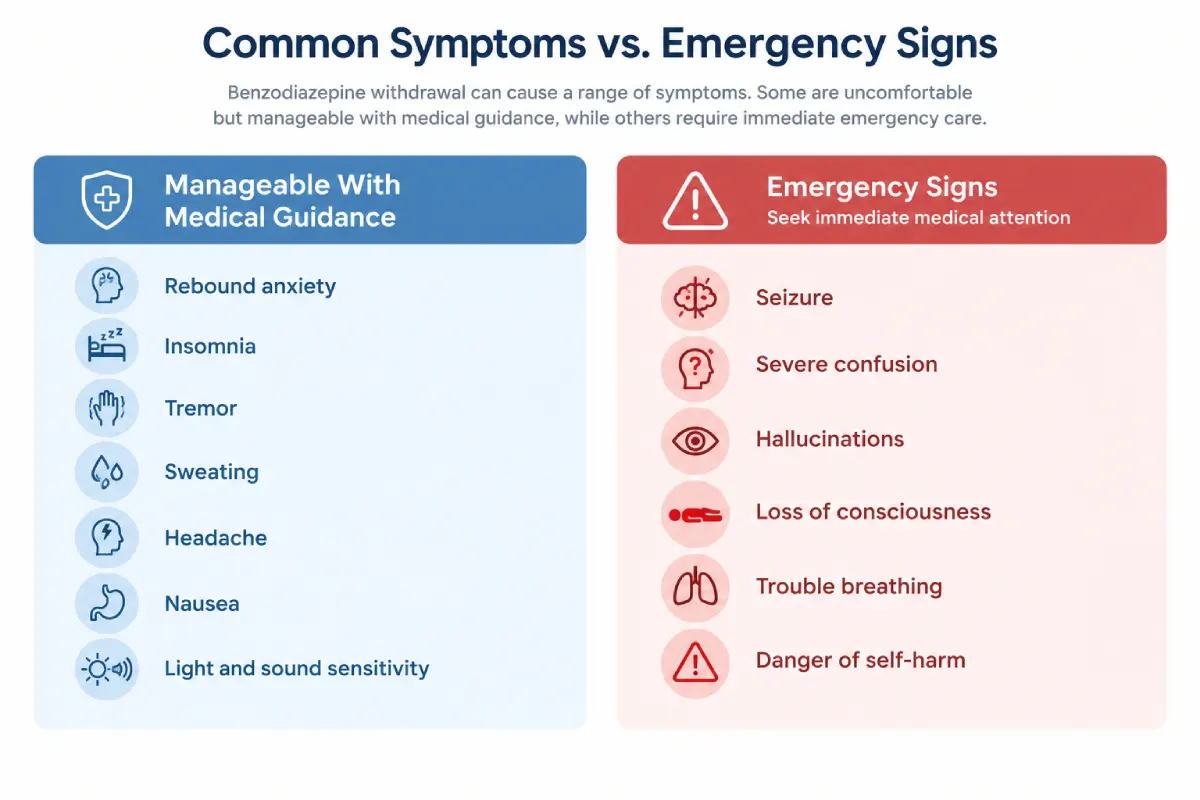
Common Benzodiazepine Withdrawal Symptoms
The AAFP describes rebound symptoms as the first to appear, which means the anxiety and trouble sleeping that the medicine was treating come back, often stronger than before. Milder to moderate symptoms usually follow over the next few days. You might notice:
- Anxiety, irritability, and restlessness
- Insomnia and rebound anxiety
- Tremors, sweating, and muscle tension or aches
- Nausea, headaches, dizziness, and reduced appetite
- Heightened sensitivity to light and sound
Severe Symptoms That Need Urgent Medical Attention
These signs suggest that withdrawal is becoming complicated, and the person needs a clinician or an emergency department right away. Watch for:
- Seizures
- Severe confusion or disorientation, such as not knowing where they are or what day it is
- Hallucinations or psychotic symptoms, such as hearing voices or holding beliefs that are not real
- Severe agitation, or symptoms that worsen quickly over hours
Which Severe Benzodiazepine Withdrawal Complications Can Be Life-Threatening?
A few complications carry most of the medical danger, and each one looks quite different from ordinary withdrawal discomfort.
1. Benzodiazepine Withdrawal Seizures
Seizures are the complication the FDA names in its boxed warning. A typical withdrawal seizure involves loss of consciousness, stiffening, and jerking, and the person can get hurt in a fall or breathe in saliva or vomit.
A seizure that lasts longer than five minutes, or repeated seizures with no recovery in between, is called status epilepticus. It can interfere with breathing and damage the brain, so it needs emergency treatment. Anyone who has a seizure during withdrawal should go to an emergency department even if it stops on its own, because another one can follow.
2. Benzodiazepine Withdrawal Delirium
Delirium is a sudden disturbance of attention and awareness that develops over hours to days and changes through the day. The person may be disoriented, unable to follow a conversation, and drowsy at one moment and agitated the next. Anxiety and insomnia leave a person oriented and aware, and delirium does not. Delirium can also lead to falls, dehydration, and unsafe behavior, and a hospital team needs to check for other causes such as infection or a second withdrawal.
Clinical Insight from Dr. Ash Bhatt: To tell delirium from anxiety, ask the person the date and where they are. I recommend this check because an anxious or sleepless person can answer, and a delirious person usually cannot or gives answers that change within the hour. If that happens, go to an emergency room.
3. Benzodiazepine Hallucinations and Psychosis
Some people experience visual or auditory hallucinations, a crawling sensation on the skin, paranoid beliefs, or severe agitation with loss of contact with reality. Psychosis is among the rare symptoms, seen mainly after abrupt discontinuation at high doses. Hallucinations do not occur in every withdrawal, but when they do, the person needs prompt evaluation. Seeing or hearing something that is not there can be frightening, and a calm, reassuring presence helps while the person is being assessed.
4. Rare Complications of Benzodiazepine Withdrawal
Catatonia, a state of marked change in movement and responsiveness such as being unable to move or speak, has been described in case reports of benzodiazepine withdrawal. A case report shows that something can happen and cannot show how often. Reliable estimates for catatonia and other rare complications do not exist.
How Can Mental Health Conditions Complicate Benzodiazepine Withdrawal?
A mental health condition does not make withdrawal fatal by itself. What it does is make withdrawal harder to read and harder to manage.
Withdrawal Symptoms Versus an Underlying Mental Health Condition
Many people take benzodiazepines for anxiety, panic, or sleep problems, so those same symptoms can return during a taper. A clinician has to decide whether the symptoms come from withdrawal, from the original condition returning, or from both. Withdrawal symptoms often follow dose reductions and fade with time, while a returning condition tends to persist and match the person’s earlier pattern. Perceptual disturbances can also resemble a psychotic disorder.
Because the cause can be unclear, a clinician often adjusts the taper in smaller steps and reviews the person more often, which helps separate a temporary rebound from a condition that needs its own treatment.
Depression, Panic Disorder, PTSD, and Other Co-Occurring Conditions
Because the cause can be unclear, a clinician often adjusts the taper in smaller steps and reviews the person more often. Here is how that plays out with common conditions.
- If you live with depression, sleep loss during a taper can pull your mood down, so your clinician should ask about suicidal thoughts at every visit.
- With panic disorder or PTSD, rebound anxiety and nightmares can look just like your baseline, so earlier symptom records and medication history help set the pace.
- With bipolar or psychotic disorders, lost sleep and agitation can shift mental state quickly, which calls for closer assessment.
How Does Other Substance Use Affect Benzodiazepine Withdrawal Risk?
Withdrawal rarely happens in isolation, and the other substances a person uses change both the risk and the plan.
1. Alcohol and Other Sedatives
Alcohol and benzodiazepines both slow the central nervous system, so their effects add together. SAMHSA’s detoxification guidance states that the combination can lead to coma and respiratory suppression. Alcohol withdrawal is a separate source of seizures and delirium, and when it happens alongside benzodiazepine withdrawal the dangers overlap.
2. Opioids and Other Drugs
Combining benzodiazepines with opioids can cause profound sedation, respiratory depression, coma, and death. Those outcomes are overdose deaths from too much sedation. They are a different event from withdrawal, and this article does not count them as withdrawal deaths.
How Common Are Fatal Complications of Benzodiazepine Withdrawal?
There is no population-wide death rate for benzodiazepine withdrawal, so the numbers below come from one hospital and need to be read with that in mind.
What the Available Research Tells Us
A 2021 retrospective review in the Kansas Journal of Medicine examined records from the University of Kansas Hospital between 2009 and 2016. Of 356 encounters screened, 82 were confirmed as acute benzodiazepine withdrawal.
- 8 patients had seizures (10%), and 3 needed a breathing tube (3.6%).
- No deaths were recorded.
- 31 patients (38%) were also withdrawing from other substances, most often opioids.
- 39 patients (47%) were admitted to the hospital, and 7 went to intensive care.
Why These Statistics Cannot Predict Individual Risk
This was a small review at a single hospital, built from past records and diagnosis codes, and the authors point out that no standard definition exists for diagnosing acute benzodiazepine withdrawal. So the percentages cannot tell any one person their chance of a seizure or a severe complication. And zero deaths among 82 patients does not mean the risk of death is zero.
How Long Can Benzodiazepine Withdrawal Last?
Timing depends mainly on how quickly the specific benzodiazepine leaves the body, and the full course varies widely.
When Withdrawal Symptoms Begin
So the rebound symptoms start within about 1 to 4 days after stopping a short-acting drug such as alprazolam or lorazepam. With a long-acting drug such as diazepam or chlordiazepoxide, they start around 4 to 10 days later. Because long-acting drugs clear slowly, a person may think they have avoided withdrawal when symptoms are only delayed. A person who feels well for a week after stopping a long-acting drug should still watch for symptoms and stay in contact with their prescriber.
How Long Can Symptoms Continue?
The FDA states that withdrawal symptoms may last weeks and as long as 12 months. Physical symptoms such as tremor and sweating usually settle first, while anxiety, poor sleep, and sensory sensitivity can linger and come and go in waves. No timeline fits everyone. Symptoms that last a long time are not automatically an emergency, but they deserve follow-up with a clinician.
How Is Benzodiazepine Withdrawal Safely Managed?
Safe management starts with not stopping abruptly. The FDA advises clinicians to use a gradual taper whenever they discontinue a benzodiazepine or reduce the dose.
1. Individualized Medical Assessment and Tapering
A good plan starts with questions about which medication you take, the dose, how long you have taken it, any earlier withdrawal seizures, other health conditions, and other substance use. The 2025 Joint Clinical Practice Guideline, developed through ASAM with nine other medical societies, suggests starting with dose reductions of about 5% to 10% every 2 to 4 weeks. It states that reductions should not exceed 25% every 2 weeks. A taper can take months, and clinicians adjust the pace to symptoms.
2. Medically Managed Inpatient Care
Many tapers happen in outpatient care. Inpatient care may be needed when withdrawal is severe or complicated, when there is a risk of serious harm, or when the person’s needs cannot be met safely in a less intensive setting. Examples include a past withdrawal seizure, heavy alcohol or opioid use, or unstable psychiatric symptoms.
3. Managing Co-Occurring Conditions During Withdrawal
Clinicians track sleep, mood, and suicidal thoughts throughout the taper and treat troublesome symptoms as they appear. The AAFP notes that cognitive behavioral therapy improves tapering outcomes. Ongoing treatment for anxiety, depression, or substance use continues after the last dose.
4. Valproate for Benzodiazepine Withdrawal
Valproate is an antiseizure medicine. SAMHSA’s older detoxification guidance lists it, along with carbamazepine, among options, while the AAFP describes the evidence for add-on medicines as low quality. Valproate is not a routine treatment and does not replace a slow taper. It also carries its own risks, including liver injury and birth defects in pregnancy, so only a clinician who has assessed the person should consider it.
What To Do in Severe Benzodiazepine Withdrawal Symptoms?
Whether symptoms are an emergency decides what you do next, so that is the first thing to figure out.
When to Call 911
Call 911 right away for a seizure, severe confusion or delirium, loss of consciousness, difficulty breathing, or immediate danger of self-harm. For thoughts of suicide, a person can also call or text 988. If you are unsure whether symptoms are severe, treat them as severe and call. Emergency teams would rather assess a person who turns out to be fine than miss a seizure or delirium.
Steps to Take While Waiting for Emergency Help
Once you have called, the steps below keep the person safe until responders arrive and give clinicians what they need to treat the withdrawal correctly.
- Stay with the person if it is safe to do so, because confusion and seizures can change quickly.
- During a seizure, move hard or sharp objects away, do not restrain the person, and do not put anything in their mouth.
- Do not give extra medication, alcohol, or other substances, because they can deepen sedation and complicate treatment.
- Tell emergency clinicians which benzodiazepine was taken, the dose, when it was stopped, and any other substance use.
Symptoms Are Concerning but Not Immediately Life-Threatening
Worsening anxiety, several sleepless nights, tremor, or sweating after a dose change are not always an emergency, but they should not be left alone. Contact the prescriber or another qualified clinician promptly, ideally the same day.
The clinician may pause dose reductions, slow the taper, or return to a previous dose before tapering again. Do not stop abruptly or change the dose on your own, and say plainly if you already have stopped suddenly.
Final Thoughts
Benzodiazepine withdrawal can be fatal in severe cases, mainly through seizures and delirium. No reliable fatality rate exists, and the danger rises with abrupt stops, high doses, and other substances. A supervised taper is the established way to lower it.
Our team can assess withdrawal risk and recommend a level of care that fits your history and help you arrange the following.
- Medically supervised benzodiazepine detox
- Residential treatment after detox
- Care for co-occurring anxiety, depression, or trauma
- Aftercare planning