



-
 Written By:
Amber Asher, MSW, LSW
Written By:
Amber Asher, MSW, LSW -
 Edited By:
Phyllis Rodriguez, PMHNP-BC
Edited By:
Phyllis Rodriguez, PMHNP-BC
-
 Clinically Reviewed By:
Dr. Ash Bhatt, MD, MRO
Clinically Reviewed By:
Dr. Ash Bhatt, MD, MRO
Key Takeaways
- I’ve tested patients who thought they took cocaine and came back positive for ketamine, MDMA, and methamphetamine they never intended to use. That’s the real danger of pink cocaine, where the seller is choosing your dose.
- A “safe” batch last weekend tells you nothing about this weekend’s batch. I’ve seen patients with wildly different reactions to product bought from the same dealer, days apart.
- Fentanyl doesn’t need to be in most tusi to be a real risk, it only needs to be in the one bag someone uses. That’s the math that matters in an overdose.
In this article, we’ll break down what pink cocaine (also called tusi) actually contains, why its effects are so unpredictable from one batch to the next, and what the warning signs of overdose and addiction look like. We’ll also cover when it’s time to consider professional treatment.
The name “pink cocaine” is misleading from the start. It suggests a specific drug with a specific effect, the way “cocaine” or “heroin” does. Tusi doesn’t work that way. It’s a street-market mixture, and what’s inside changes depending on who made it, where, and with what was available that week.
That single fact drives almost everything else in this article. When a drug’s ingredients aren’t fixed, its risks aren’t fixed either.
What Is Pink Cocaine, or Tusi?
Tusi (pronounced “too-see,” a phonetic play on 2C-B) is a bright pink powder or crystal sold at nightclubs, festivals, and parties, usually marketed as a party drug with both stimulant and hallucinogenic effects. Despite the name, it’s rarely cocaine, and it’s rarely the original 2C-B compound it was named after either.
What is pink cocaine, then, if it isn’t cocaine or 2C-B? It’s best understood as a branded street concoction. The color and the name are marketing, not chemistry. What’s actually in the bag depends on the supplier.
Researchers tracking the drug through DEA and public health reporting describe it plainly: tusi has become the label, not the recipe. Recent clinical literature notes that tusi is increasingly common in nightlife scenes in metro areas including Miami, New York City, and Los Angeles, and that it’s typically produced locally rather than trafficked in as a finished product, which is part of why consistency is so hard to come by.
What Is Actually in Tusi?
This is the question most people ask after they’ve already used it, which is backwards. Because tusi is unregulated and made in different places by different people, lab testing of seized samples has turned up wildly different ingredient combinations from batch to batch.
| Substance sometimes identified | Drug type |
| Ketamine | Dissociative |
| MDMA | Stimulant/empathogen |
| Cocaine | Stimulant |
| Methamphetamine/amphetamines | Stimulants |
| Caffeine | Stimulant |
| Other psychoactive substances (including opioids in some tested samples) | Varies |
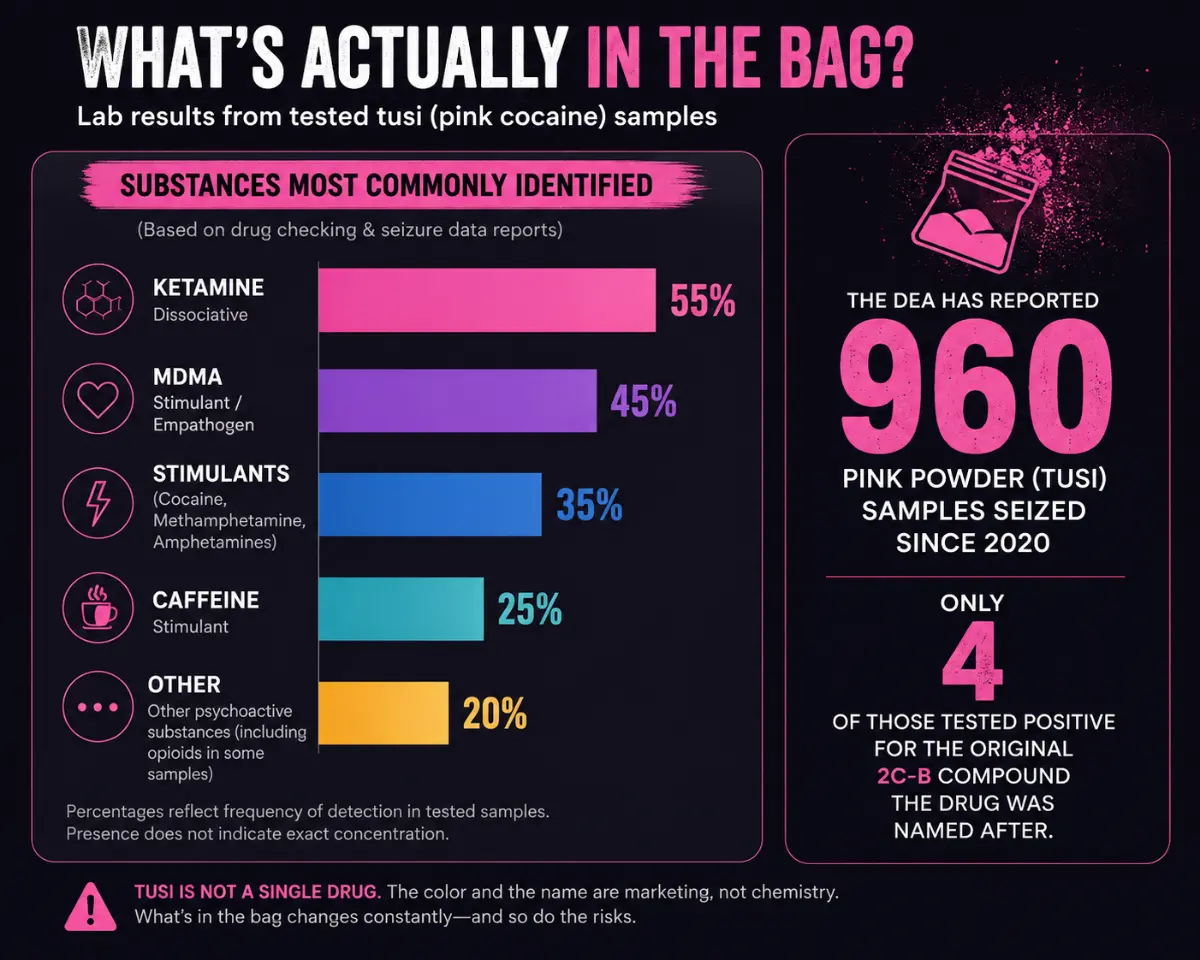
The DEA has reported seizing 960 pink powder samples since 2020, and only four of those tested positive for the original 2C-B compound the drug was named after. Ketamine and MDMA show up most consistently across tested samples, but that doesn’t mean every bag looks the same. Some contain stimulants without any dissociative at all. Others lean almost entirely sedative.
A short but important note here: tusi, cocaine, and 2C-B are not the same thing, and using the names interchangeably is exactly how people end up taking something they didn’t intend to.
Why Are the Effects So Hard to Predict?
Three things make pink cocaine’s effects genuinely unpredictable, and it’s worth sitting with each one rather than skimming past them.
- Unknown ingredients. Without lab testing, there’s no way to know what’s actually in a given batch just by looking at it, smelling it, or trusting a dealer’s word.
- Changing concentrations. Even when the same substances show up batch to batch, the ratios and potency can swing significantly, which changes how strong or how dangerous a “normal” dose turns out to be.
- Multiple drug classes in one mixture. A single dose can combine a stimulant, a dissociative, and a depressant at once, and those classes don’t just add up, they interact.
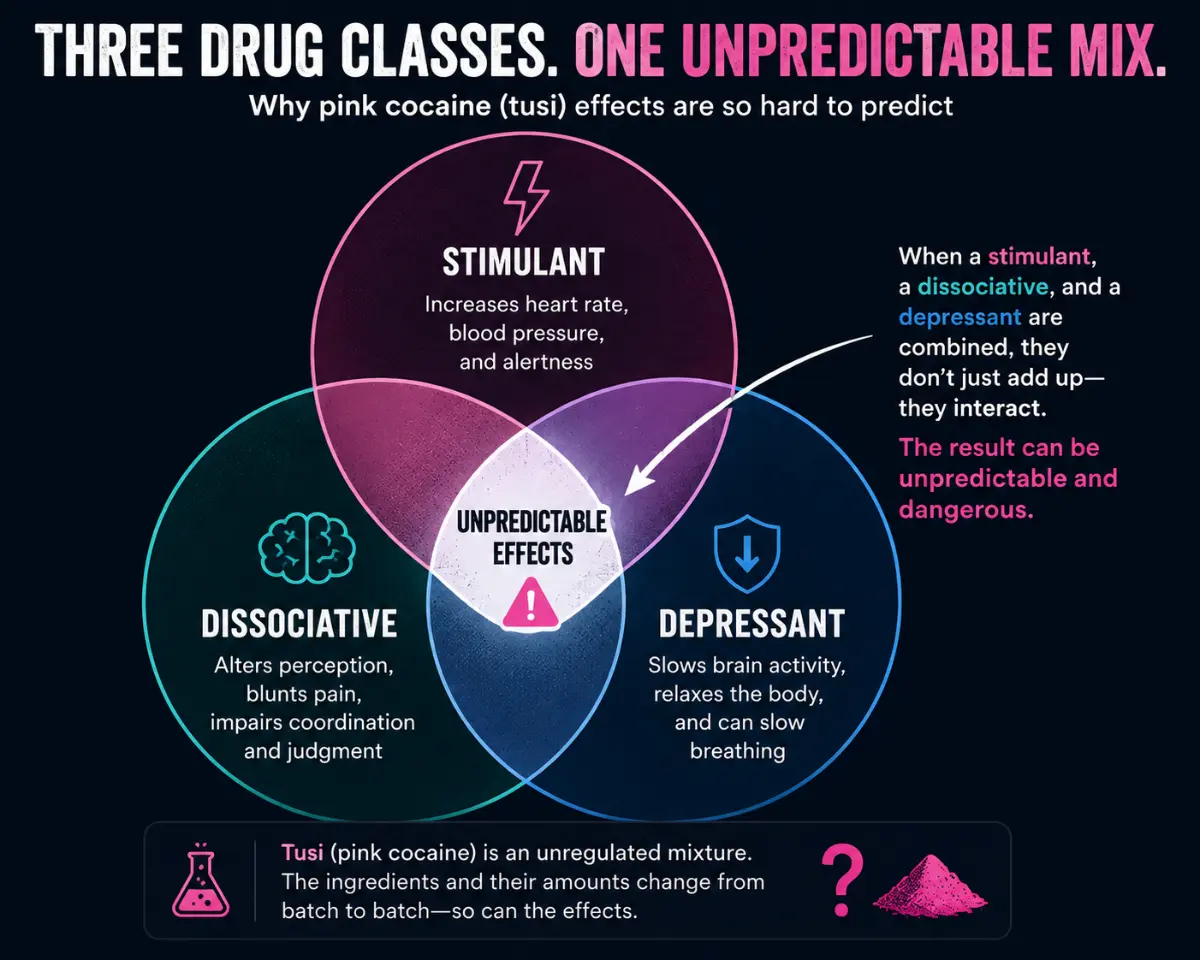
A stimulant pushes heart rate and blood pressure up. A dissociative like ketamine can blunt pain signals and impair coordination and judgment. A depressant slows breathing. Put those in the same bloodstream at the same time, and the body isn’t dealing with one drug’s effects. It’s dealing with several conflicting signals simultaneously, which is a large part of why reactions to tusi vary so much from person to person and night to night.
A clinical perspective from Dr. Ash Bhatt: I tell my patients this directly: what your body did with tusi last time isn’t a preview of what it’ll do this time. I’ve had patients describe a mellow, manageable high on one occasion and a racing heart, panic, and vomiting on what they believed was the “same” product a month later. There’s no tolerance you can build to a drug whose formula keeps changing under you.
What Can Tusi Do to the Body and Mind?
Because the ingredient list shifts, so does the range of possible effects, and it’s worth understanding why each one shows up rather than just scanning a list.
Mental and perceptual effects tend to come from whichever psychoactive component dominates a given batch. Euphoria and sociability are early signs of a positive mood boost that is usually connected to taking a combination or just MDMA as the psychoactive substance and the level of stimulation is much higher than in other cases. When the dissociative nature of ketamine begins to take effect, people may find themselves confused, their view of the surrounding environment may become distorted, or they might have a feeling of being detached from their own body. In batches that contain high doses or have unusual combinations, these side effects may go beyond normal anxiety and paranoia levels into hallucinations that are not resolve even after a relatively long time.
Physical effects follow a similar pattern of unpredictability:
- Increased heart rate and blood pressure, driven by stimulant components
- Nausea and vomiting, particularly common with ketamine
- Poor coordination and slowed reaction time, which raises injury risk in crowded venues
- Sedation or drowsiness when depressant substances are part of the mix
- Elevated body temperature, especially with prolonged dancing or physical activity
What makes this section harder to summarize than most drug-effect lists is that a single dose of tusi can produce several of these at once, sometimes in ways that don’t obviously fit together, a person might feel simultaneously wired and disoriented, or euphoric and nauseated. That combination itself is a signal that multiple substances are interacting, not that something is uniquely wrong with that person’s body.
When Can the Mixture Lead to an Overdose?
Overdose is possible with pink cocaine, and it doesn’t require a rare or unusually strong batch to happen. The risk can come from a single substance taken in a higher-than-expected dose, from multiple substances interacting in ways that strain the heart or the respiratory system, or from a substance the user never intended to take at all.
Fentanyl deserves a careful, specific mention here rather than a scare headline. Not every batch of tusi contains fentanyl, and it isn’t the dominant risk in most tested samples. But DEA reporting has confirmed fentanyl detected in some pink powder samples, and because fentanyl is active in extremely small quantities, even accidental cross-contamination during production is enough to cause a fatal opioid overdose in someone who has no opioid tolerance.
This risk isn’t unique to tusi. Nationally, CDC data shows that in 2023, nearly 47% of drug overdose deaths in a subset of reporting jurisdictions involved both opioids and stimulants together, a reminder that mixing drug classes, whether intentionally or through a contaminated supply, is a leading driver of overdose deaths across the country, not just in party-drug scenes.
Emergency Warning Signs to Know
Because tusi can combine a stimulant, a dissociative, and a depressant in one dose, an overdose doesn’t always look the way people expect. Someone might appear “too sedated to be in danger” while their breathing is actually the problem, or seem agitated and overheated rather than obviously unconscious. Knowing the specific signs matters more than judging how “bad” someone looks.
Watch for:
- Slow, irregular, or stopped breathing
- Loss of consciousness
- Inability to wake the person
- Seizure
- Severe chest pain
- Extreme agitation or confusion
- Very high body temperature
If you see any of these signs in yourself or someone else, call 911 immediately. Don’t wait to see if symptoms pass on their own, and don’t assume a small amount used means low risk, with a mixture like this, dose and danger don’t scale the way people expect.
Can Repeated Use Lead to Addiction?
There isn’t a single, standardized medical condition called “pink cocaine addiction,” because tusi isn’t a single drug. What repeated use can lead to is a polysubstance-use pattern, where the person develops dependence on the combined experience the mixture produces, or on one of its specific components, such as ketamine or MDMA.
That pattern still shows up the way substance use disorders typically do: loss of control over use, cravings between uses, using more often or in larger amounts than intended, and continuing use despite clear negative consequences.
A clinical perspective from Dr. Ash Bhatt: When I evaluate someone who’s been using tusi regularly, I’m not trying to diagnose “tusi addiction.” I’m trying to figure out which substances in their pattern their body and brain have actually adapted to, because that determines what withdrawal and treatment will look like. Two people who both say they “do tusi every weekend” can need completely different care plans.
Signs That Recreational Use Is Becoming a Larger Problem
One night of use doesn’t automatically signal addiction. What matters clinically is whether a pattern is forming and whether that pattern is expanding over time.
Some signs worth paying attention to:
- Using more often than originally intended
- Increasing the amount used to get the same effect
- Feeling like it’s needed to socialize, party, relax, or feel energized
- Regularly mixing it with alcohol or other drugs
- Falling into repeated binge-and-crash cycles
- Continuing use despite problems at work, home, or in relationships
- Trying to cut back or stop, but repeatedly returning to use
None of these on their own is proof of a substance use disorder. But if several of them are showing up together, or if the pattern is getting harder to interrupt, that’s worth taking seriously and talking to a professional about.
Why Tusi Is Relevant in Los Angeles
Tusi has become associated with nightlife and party environments across several major U.S. cities, and Los Angeles is one of the metro areas where it’s been encountered by law enforcement and reported in clinical and public health literature alongside Miami and New York City. That doesn’t mean it’s uniquely widespread here or that it’s reached epidemic levels locally, the honest picture is that LA is one of several urban markets where tusi has shown up as part of a broader national trend in party-drug culture, and local awareness is worth having as a result.
When Is Professional Treatment Worth Considering?
Choosing treatment options should not just focus on what is termed “tusi”. Instead, the decisions must be based on the particular substance-use behavior of the person, which is why a real assessment looks very different from a quick intake form.
A proper evaluation typically starts with mapping out exactly what’s been used, how often, in what combinations, and for how long, because ketamine dependence, stimulant dependence, and opioid exposure each carry different withdrawal timelines and different risks if managed incorrectly. Besides that, the clinicians will also investigate if alcohol consumption is there, any prescription drugs that may be involved and mental health issues co-occurring with substance use like anxiety, depression, or history of trauma, because in many cases they can be the driver of the behavior as much or even more than what the substance is itself.
That assessment is also what decides where someone should start:
- Medical detox becomes the starting point when the pattern includes substances carrying real withdrawal risk, certain stimulant or sedative combinations can produce complications that are safer to manage under medical supervision than at home.
- Residential treatment fits when use has become frequent, hard to control, or entangled with daily life in ways that make stepping away from that environment necessary for real progress.
- Outpatient programs work for people whose pattern is serious enough to need structured treatment but who can safely continue living at home, working, or attending school during recovery.
- Dual diagnosis care treats the mental health condition and the substance use together rather than separately, which matters because treating one without the other tends to fail.
- Aftercare and relapse-prevention planning carry the work forward after formal treatment ends — this is often where polysubstance patterns actually get tested, since triggers and party environments don’t disappear once treatment is over.
What should push someone toward reaching out sooner rather than later isn’t a specific quantity or frequency threshold, it’s whether the pattern is expanding, whether other substances are getting pulled in, and whether attempts to stop or cut back haven’t held. Those are the signals worth acting on rather than waiting out.
If that description fits you or someone you care about, Legacy Healing LA’s Street Drug Addiction Treatment program is built to assess exactly this kind of polysubstance pattern from the first conversation, rather than starting from an assumption based on a street name.
Conclusion
Pink cocaine’s biggest risk isn’t any single ingredient, it’s the not knowing. A drug sold under one name but assembled differently every time removes the one thing that lets people make even minimally informed choices: consistency. That’s true whether someone uses it occasionally at parties or has fallen into a regular pattern that’s becoming hard to control.
If tusi use, or use alongside other substances, has started to feel less like a choice and more like a habit you can’t easily step back from, that’s worth a real conversation with a professional, not just a personal resolution to “cut back next time.”