




-
 Written By:
Alex Herrera
Written By:
Alex Herrera
-
Edited By:
Phyllis Rodriguez, PMHNP-BC
-
Clinically Reviewed By:
Dr. Ash Bhatt, MD, MRO
 Written By:
 Edited By:
 Clinically Reviewed By:
Understanding the unique mental health challenges of executives, celebrities, artists, and athletes, and why discretion, expertise, and personalized care matter.
Key Takeaways
|
The Hidden Cost of High Performance
Success looks different from the inside. The corner office, the sold-out show, the championship win, the gallery opening, these moments are celebrated publicly. What the world doesn’t see is the invisible toll: sleepless nights, anxiety that peaks after major accomplishments, the weight of impossible expectations, and the loneliness that comes from being at the top.
High performers, executives, celebrities, artists, and athletes face a paradox. Their achievements define them. Their visibility constrains them. Their success isolates them. They can’t simply “take a mental health day” without it becoming tabloid news. They can’t vent to friends without worrying about confidentiality. They can’t access traditional therapy without navigating complex privacy concerns.
Yet the pressures are real. Decision fatigue. Performance anxiety. Creative burnout. The gap between public persona and private reality. Substance use as a coping mechanism. Identity loss when career peaks or roles change.
This is why private behavioral health support exists. Not as a luxury, but as a necessity, tailored care that understands the unique challenges of high-performing individuals, delivered with the discretion and expertise they require.
Clinical Takeaway from Norman Chazin, M.D.,“What I want people to understand is that high performance often comes with an invisible psychological cost. The pressure, isolation, and constant expectation create patterns that, over time, require structured clinical support.” |
What Is Private Behavioral Health Support?
Private behavioral health support refers to highly confidential, personalized care designed for individuals who require discretion alongside clinical excellence. Unlike traditional treatment environments, these programs prioritize:
- Absolute confidentiality (aligned with HIPAA and 42 CFR Part 2 standards)
- Individualized care plans tailored to lifestyle and responsibilities
- Flexible scheduling and private accommodations
- Integrated mental health and substance use treatment when needed
- Specialized expertise in high-performance psychology
Discreet mental health care allows individuals to address concerns without disrupting their professional identity or public presence.
Why High Performers Face Unique Behavioral Health Risks
Behavioral health challenges in high performers are not simply a result of “too much work.” They emerge from a combination of pressure, identity, and environment.
In Los Angeles, these factors are amplified. Success is visible. Competition is constant. And vulnerability is often perceived as risk.
This creates a pattern where individuals adapt by pushing through rather than stepping back, making behavioral health for high performers a distinct clinical need.
Executives: Leadership Pressure & Decision Fatigue
Executives are expected to operate with clarity under pressure, often making decisions that carry financial, legal, and organizational consequences. Over time, this creates a cognitive load that is rarely addressed directly.
Decision fatigue begins to show up subtly:
- Slower processing despite experience
- Increased reliance on routine decisions
- Mental exhaustion masked as productivity
What appears as “just stress” is often the early stage of burnout. Behavioral health for executives focuses on restoring cognitive clarity, improving emotional regulation, and preventing long-term decline in decision-making capacity.
Celebrities: Visibility Without Privacy
For public figures, the challenge is not just internal; it is structural. Every action exists under scrutiny. In Los Angeles, this creates a unique barrier to care. Seeking help can feel like exposure. As a result, many delay support due to:
- Fear of reputational damage
- Media attention or public speculation
- Loss of control over personal narrative
This is why confidential treatment for high performers is critical. It removes the visibility barrier and allows individuals to engage in care without risking their public identity.
Artists: Emotional Depth & Creative Strain
Creative work often requires emotional access. The ability to feel deeply, reflect, and express complex internal states is part of the craft. But without boundaries, that same depth can become overwhelming. Artists frequently experience:
- Emotional volatility tied to creative output
- Irregular routines that disrupt stability
- Pressure to remain consistently original
Discreet mental health care provides structure without suppressing creativity, helping individuals sustain both their work and their well-being.
Athletes: Performance Pressure & Identity Challenges
For athletes, performance is identity. When performance shifts due to injury, aging, or competition, the psychological impact can be significant.
This often leads to:
- Anxiety around relevance and longevity
- Loss of identity beyond performance
- Pressure to recover quickly, sometimes at the cost of mental health
Focused mental wellness for high performers helps athletes rebuild psychological resilience while maintaining competitive focus.
Clinical Takeaway from Norman Chazin, M.D.,“These challenges are not simply about workload. They are tied to identity, environment, and sustained pressure. That combination creates a distinct clinical profile that standard care models do not always address effectively.” |
Subtle Signs It May Be Time to Seek Support
One of the most important, and most overlooked, realities is that high performers rarely experience a clear breaking point. Instead, the need for private behavioral health support emerges through patterns that are easy to dismiss. These are not crises. They are shifts.
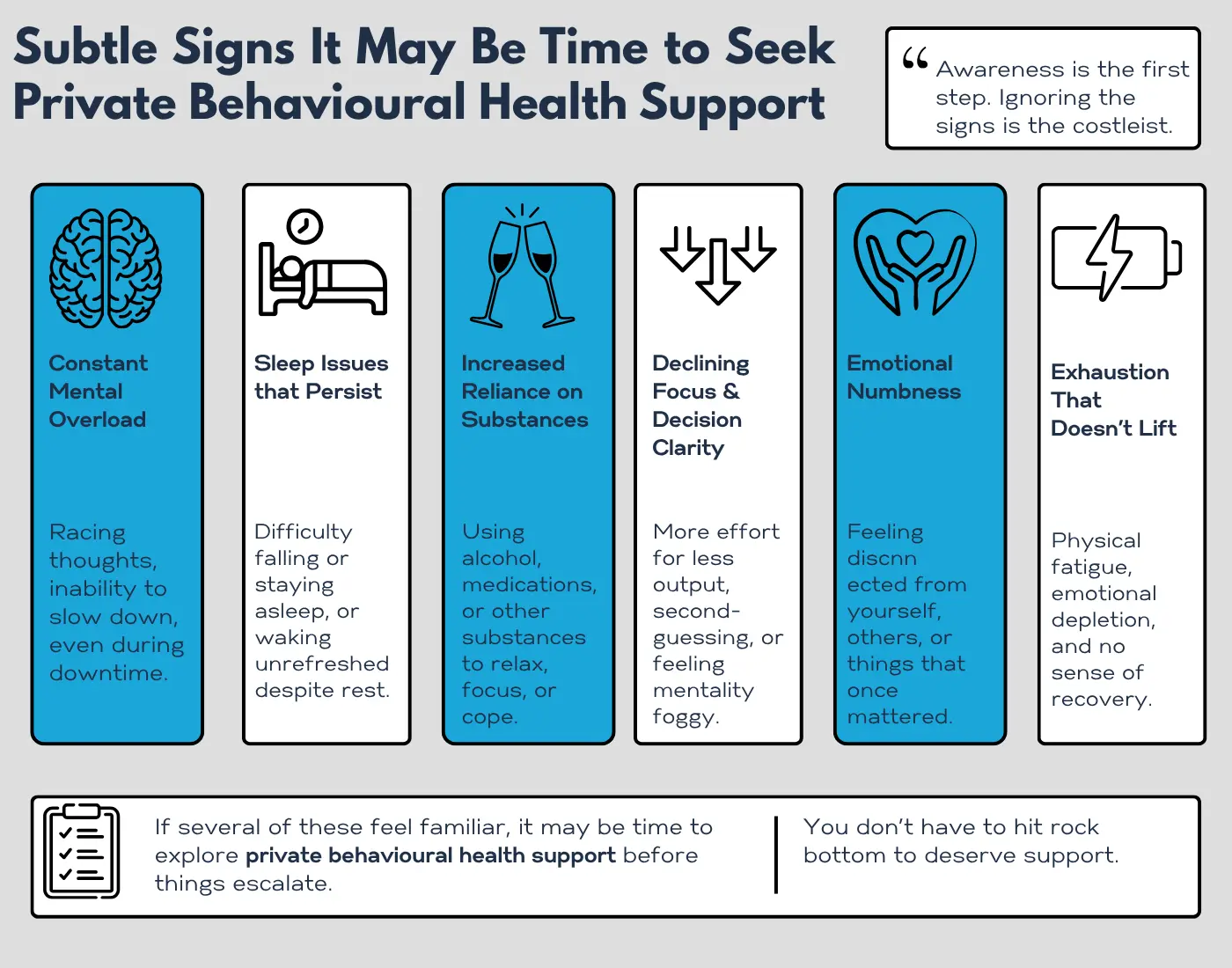
| Critical insight: The absence of a crisis doesn’t mean support isn’t warranted. Many high performers benefit most from preventive care, addressing patterns before they become acute and significantly affect performance or health. |
When Does Stress Become a Behavioral Health Concern?
Stress is expected in high-performance environments. In many cases, it is even rewarded. But stress becomes a behavioral health concern when it stops being temporary and situational, and becomes persistent and internalized. The shift is not always obvious.
It happens when:
- Rest no longer restores energy – You sleep or take time off, but you don’t feel recovered
- Work begins to feel overwhelming rather than engaging – What once energized you now drains you
- Emotional responses become harder to regulate -You’re irritable, reactive, or emotionally flat
- Mental clarity starts to decline – Decisions feel harder, focus is fragmented, creativity stalls
- Sleep becomes inconsistent or insufficient – Despite fatigue, you can’t sleep or you’re exhausted regardless
- Substance use increases – Alcohol, stimulants, or sleep aids become more frequent or necessary
At this stage, stress is no longer adaptive. It is beginning to interfere with functioning. Seeking discreet mental health care at this point is not reactive, it is preventative.
The Link Between Burnout, Substance Use & Performance Decline
Burnout and substance use are often interconnected, not coincidental, particularly for high performers. Understanding this relationship is critical for both prevention and intervention.
The Progression: How Burnout Leads to Substance Use
When performance pressure is relentless, sleep is fragmented, and recovery feels impossible, substance use becomes a management tool:
- Alcohol helps you decompress after tense meetings or long days
- Stimulants sharpen focus during crunch periods
- Sleep aids finally allow rest
- Prescription or recreational drugs manage pain, anxiety, or mood
It works, temporarily. Until tolerance builds and the substances become necessary just to maintain baseline functioning.
The cycle unfolds like this: High performance demands → Chronic stress → Sleep loss and fatigue → Substance use (to manage energy and mood) → Physical and emotional dependence → Performance decline → Increased pressure to compensate → Escalated substance use → Crisis
This cycle is common and often invisible until it’s critical.
Clinical Takeaway from Norman Chazin, M.D.,“What begins as a way to manage stress can gradually become a dependency. Addressing both the underlying burnout and the substance use pattern at the same time is essential for sustainable recovery.” |
Why High Performers Are Vulnerable
The insidious part is that initial substance use often enhances performance. A drink helps you relax after a tense meeting. Stimulants sharpen focus. But dependency develops subtly. Performance becomes contingent on the substance. Stress management becomes substance management. The brain’s natural regulation systems atrophy from disuse.
High performers have high tolerance for discomfort, physical, emotional, psychological. This same trait that enabled achievement also enables substance use to escalate significantly before recognition of it as problematic. By the time it’s acknowledged, the substance use is often affecting performance, relationships, and health measurably.
Additionally, the stigma around substance use in high-performing circles delays intervention. Executives worry about image and career consequences. Celebrities fear tabloid exposure. Athletes fear league suspension. This silence allows the problem to deepen.
| Key insight: Early identification and intervention, before substance use becomes the primary problem, is critical. Private behavioral health programs are equipped to address the root causes (burnout, stress, sleep dysregulation, performance anxiety) alongside substance use patterns, breaking the cycle before it becomes entrenched. |
The Advantages of Luxury Behavioral Health Programs
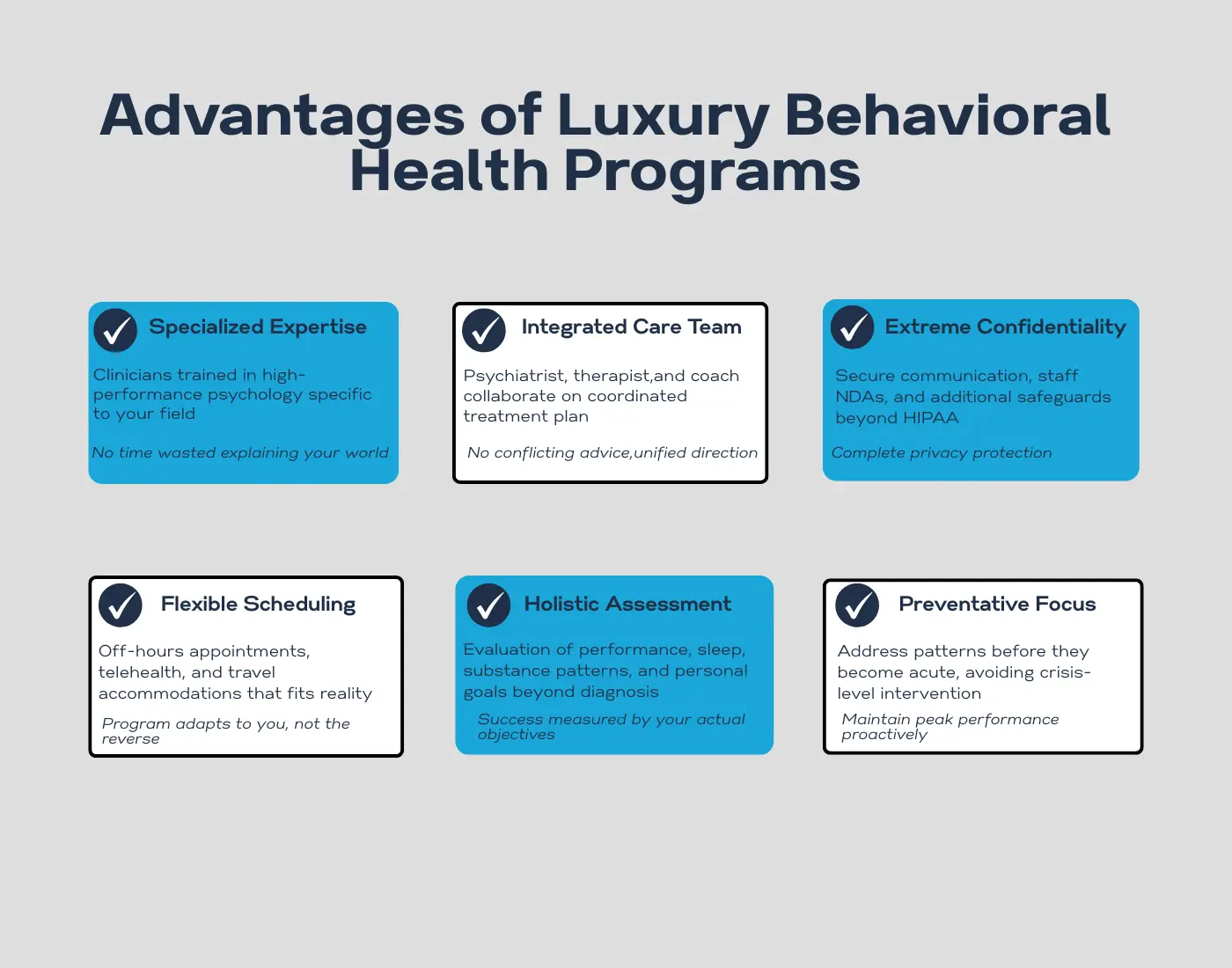
Luxury behavioral health programs aren’t about excess, they’re about removing barriers to effective care and treatment. When you’re a CEO managing a multi-billion-dollar company, a performer on a global stage, an artist with unpredictable income, or an elite athlete, standard therapy models simply don’t fit. Luxury programs bridge that gap.
What to Expect from a Private, High-End Program
Understanding the engagement process reduces anxiety and barriers to entry. Here’s what typically unfolds:
Step 1: Initial Consultation
Your first session is exploratory. A clinician or intake coordinator will ask about what brought you in, stress, sleep issues, substance use patterns, relationship strain, performance concerns, and want to understand your medical history, family dynamics, current stressors, sleep patterns, and goals. This is a conversation, not a formal diagnosis. You’re both assessing whether the program is a good fit for you.
Step 2: Comprehensive Assessment
Over the next 1-2 weeks, you’ll have in-depth conversations with multiple clinicians, a psychiatrist, a therapist, and sometimes a health coach. You’ll review your detailed history: childhood experiences, relationship patterns, career trajectory, substance use timeline, and physical health. Psychological evaluations assess depression, anxiety, and personality patterns. Lab work often helps rule out medical factors (thyroid dysfunction, nutrient deficiencies, hormonal imbalances) that can mimic mental health symptoms.
Step 3: Treatment Planning
Based on assessment findings, the clinical team recommends a personalized treatment plan. This typically includes therapy modality (cognitive-behavioral, psychodynamic, somatic, etc.), psychiatric consultation and potential medication, performance coaching, lifestyle modifications (sleep, exercise, nutrition), and a customized frequency of care. You’re not locked into a rigid protocol—the plan evolves as you progress.
Step 4: Ongoing Care
Regular sessions occur at your agreed frequency (weekly, twice weekly, monthly, or another cadence). Between sessions, you have check-in options: secure messaging with your clinician, phone consultations for urgent concerns, and direct access to your clinical team. Progress is monitored against your specific goals, and the approach is adjusted if something isn’t working.
Step 5: Integration & Progress Measurement
Good programs help you implement changes within your real constraints. If you travel frequently, telehealth and sleep optimization are prioritized. If you have a high-pressure job, stress management and performance psychology are emphasized. If substance use is a concern, specific protocols address it. Progress is measured through symptom reduction, performance metrics, relationship quality, and your own sense of well-being. Regular check-ins ensure you’re seeing meaningful change.
How to Choose the Right Program for Your Lifestyle
Not all private behavioral health programs are equal. Some excel with executive burnout but lack celebrity expertise. Others specialize in substance use but aren’t equipped for performance anxiety. Here’s how to evaluate them:
| What to Evaluate | What to Look For |
| Clinician Expertise | Do they specialize in your specific challenges (executive burnout, creative blocks, athlete psychology)? What’s their background in high-performance psychology? Do they have experience in your industry? |
| Flexibility & Accessibility | Can they accommodate your travel and schedule? Do they offer telehealth, in-person, or hybrid options? What’s their response time for urgent concerns? |
| Team Composition | Is there an integrated team (psychiatrist, therapist, coach) or individual providers? How do they collaborate? Will you have a primary point of contact? |
| Confidentiality Protocols | What specific safeguards do they use? Do they employ secure messaging, encrypted communication, and NDA agreements with staff? How do they handle media inquiries? |
| Substance Use Expertise | Do they have specialized training in addressing substance use alongside performance pressure? Can they distinguish between recreational use, coping mechanisms, and dependency? |
| Clinical Philosophy | Are they aligned with your approach? Do they emphasize medication or therapy/lifestyle? Do they focus on root causes or symptom management? |
| Outcomes & Results | How do they measure success? By symptom reduction, performance metrics, or your defined goals? Can they provide examples of outcomes with similar clients? |
A good fit means you trust the clinician, feel genuinely understood, see progress toward your objectives, and feel comfortable being fully transparent.
Taking the First Step, On Your Terms
High performance is an achievement and a choice with consequences, professional demands, relentless pressure, and often, an invisible struggle that the world never sees.
Whether you’re an executive managing millions, a performer on a global stage, a creator pushing artistic boundaries, or an athlete at the peak of your abilities, the challenges are real. So is the solution. Private behavioral health support exists specifically to meet your needs: with discretion, expertise, and a genuine understanding of what high performance demands.
If you recognize yourself in these pages, if stress, burnout, substance use patterns, or simply the gap between professional success and personal well-being feels significant, consider reaching out. A confidential conversation with a specialist costs nothing but time, and often changes everything.
Your success is real. Your struggles are valid. Support is available.