



-
 Written By:
Alex Herrera
Written By:
Alex Herrera
-
Edited By:
Phyllis Rodriguez, PMHNP-BC
-
Clinically Reviewed By:
Dr. Ash Bhatt, MD, MRO
 Written By:
 Edited By:
 Clinically Reviewed By:
Prescription drug addiction does not begin with a decision to become dependent; it begins with a diagnosis, a period of sustained stress that comes from managing chronic pain for months on end. The medications are legitimate. The prescriptions are filled at a pharmacy. And then, gradually, the relationship with those medications changes.
For many of the people who find their way to Legacy Healing LA, prescription drug dependence developed alongside it. High-performing professionals and individuals carrying significant personal and professional responsibility often encounter prescription medications as tools for managing demanding lives.
This is not a rare story. It is one of the most common pathways into substance dependence today. This article is a clear, honest account of how prescription drug addiction develops, what it looks like from the inside, and why specialized, private, luxury treatment is often the most appropriate and most effective response for individuals who have built lives they need to protect.
Key Takeaways
|
When Helpful Medications Quietly Become Harmful
The clinical term is iatrogenic dependence, medication dependence that develops as an unintended consequence of legitimate medical treatment. It accounts for a significant proportion of opioid prescription addiction cases, and it is important precisely because it strips away the narrative of recklessness that surrounds addiction in the public imagination.
A board-certified surgeon prescribed opioids after a spinal procedure. A senior partner was given benzodiazepines to manage presentation anxiety before a high-stakes pitch. In each case, the medication serves a real purpose, but the tolerance develops. The dose that worked three months ago no longer does. The idea of stopping becomes quiet and then unthinkable.
“Prescription drug dependence does not discriminate by income, education, or achievement. It follows the biology, and the biology follows sustained use, regardless of how the use began.”
Unlike the more visible presentations of substance use disorder, prescription drug dependence often coexists with professional achievement and social normalcy. The person performing at the highest level may be managing a dependence that no one around them can see. And the very competence that sustains that performance often delays the recognition that help is needed.
Quick Answers from Dr. Ash Bhatt
“What I want people to understand is that prescription drug dependence often begins without intention. It develops gradually as the brain adapts to continued exposure. This is not a failure of judgment, it is a predictable biological response that requires clinical care.”
Prescription Medications Most Often Linked to Addiction
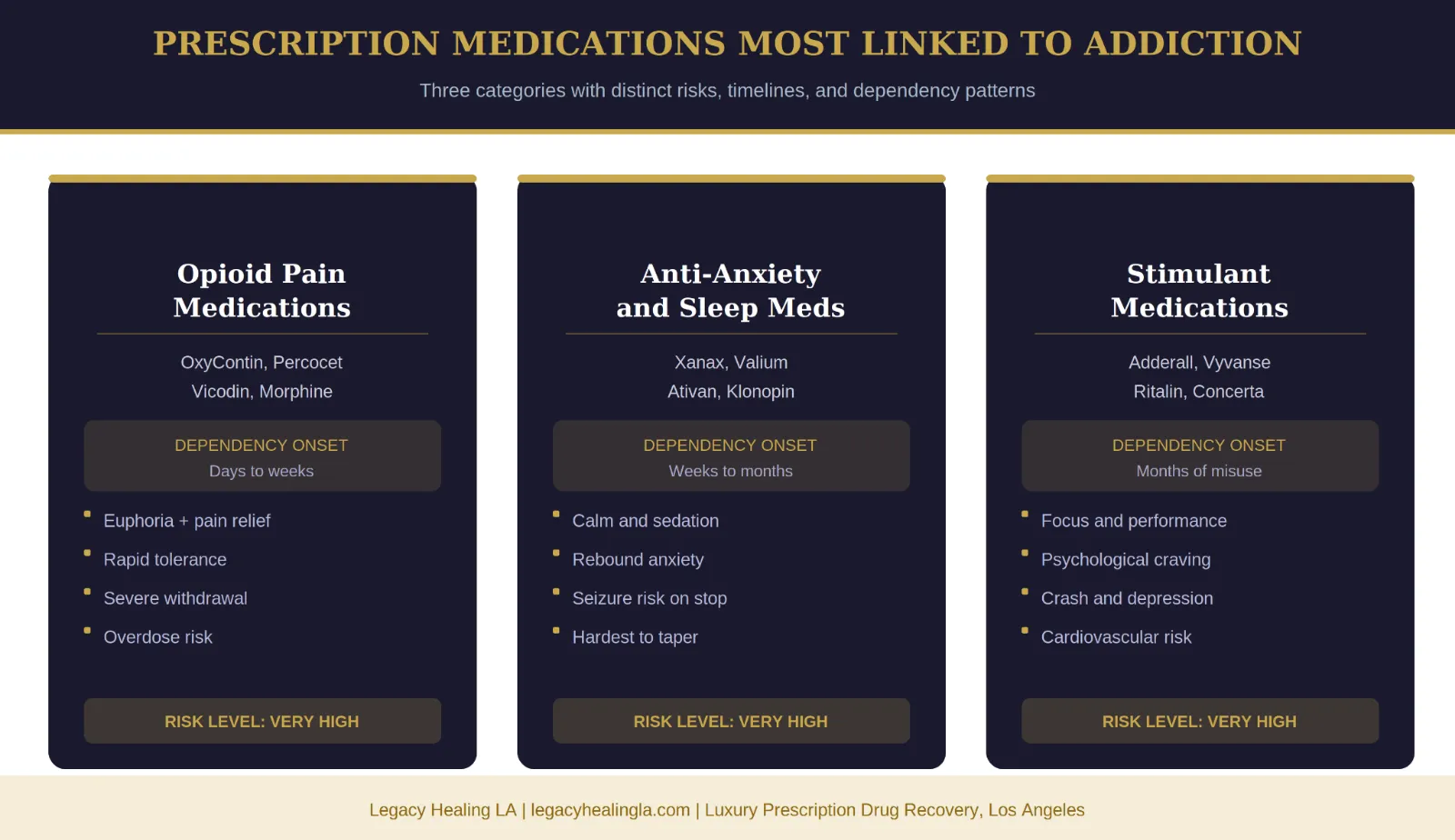
Not all prescription medications carry equal addiction risk, but three categories account for the overwhelming majority of prescription drug dependence cases presenting for treatment. Understanding how each category works and why dependence develops is the first step toward recognizing when a prescription has crossed a line.
Opioid Pain Medications
Opioid pain medications, including oxycodone (OxyContin, Percocet), hydrocodone (Vicodin), morphine, and codeine, are commonly prescribed for injury recovery, post-surgical pain, or chronic pain conditions. They are highly effective for short-term pain relief and also among the most dependency-producing substances in modern medicine.
Prescription opioid abuse often begins with a legitimate script where opioids bind to receptors in the brain, suppressing pain while simultaneously producing a sense of calm, and tolerance develops quickly. For successful professionals managing demanding lives, opioids can also quietly become a tool for managing stress, pressure, and emotional discomfort, not just physical pain. That secondary function is where painkiller addiction most commonly takes root.
Anti-Anxiety and Sleep Medications
Benzodiazepines, the class of drugs that includes alprazolam (Xanax), diazepam (Valium), and clonazepam (Klonopin), are prescribed for anxiety disorders and related conditions. They work by enhancing the effect of GABA, the brain’s primary inhibitory neurotransmitter, producing a calming, sedating effect.
The benzodiazepine addiction can develop within weeks of regular use, even at prescribed doses. For high-achieving individuals who rely on prescribed benzodiazepines to manage the anxiety that accompanies high-pressure roles, anxiety medication dependence addiction often develops slowly and invisibly.
Stimulant Medications for Focus
Stimulant medications, including amphetamine-based drugs such as Adderall and Vyvanse, are prescribed primarily for ADHD. In high-performance professional environments, however, prescription stimulant misuse has become increasingly common among people who may or may not have a legitimate diagnosis, using these medications to sustain productivity and maintain a competitive edge.
Stimulant medication addiction develops because these drugs produce significant dopamine activity, the brain’s reward signal, which makes the enhanced cognitive state feel necessary.
ADHD medication abuse that begins as a performance optimization strategy can evolve into a dependence that produces severe anxiety, sleep disruption, and paranoia.
Subtle Signs of Prescription Drug Dependence
One of the defining characteristics of high-functioning addiction is how effectively it maintains the appearance of normalcy. Many individuals carry a developing prescription drug dependence while continuing to meet their professional responsibilities, maintain relationships, and present a composed exterior to the world.
The following three patterns are among the most clinically significant indicators of medication misuse signs, and the ones most commonly present in high-functioning professionals.
1. Increasing Dosage to Maintain the Same Effect
Tolerance is the earliest and most reliable clinical indicator of developing physical dependence. When the dose that managed pain last month is no longer adequate, now requires twice the amount to get through the morning, tolerance has set in.
For successful professionals, this pattern often manifests as self-adjustment. These small accommodations feel like practical management of a medical need. They are, clinically, prescription drug addiction symptoms that mark the transition from therapeutic use to dependence.
2. Feeling Unable to Function Without Medication
There is a meaningful clinical distinction between taking a medication and not taking it. When a person reaches the point where starting the day without their prescription feels unthinkable, where the medication is no longer managing a symptom but preventing a withdrawal state, the nature of the dependency has fundamentally shifted.
This is one of the most commonly reported medication misuse signs in high-functioning individuals. The fear of losing access to the medication is, at this stage, inseparable from the fear of losing the life they have built. That fear keeps people using long after they have recognized the problem, and it is one of the most important things private addiction treatment must address directly.
3. Seeking Multiple Prescriptions or Refills
When the prescribed dose is no longer sufficient, and the prescription runs out before the scheduled refill date, the behavioral response often involves seeking additional sources: requesting early refills from a primary physician, or consulting multiple providers. This is among the clearest behavioral markers of prescription drug misuse, and one that carries significant legal and professional risk that many individuals are acutely aware of but feel unable to stop.
Quick Answers from Dr. Ash Bhatt
“The most important signs are often the least visible. Increasing tolerance, reliance on medication to function, and changes in behavior are clinical indicators I look for. Recognizing them early can make a significant difference in recovery outcomes.”
Why Discreet Treatment Matters for Many Individuals
For many people struggling with prescription drug dependence, the barriers to seeking help are about what seeking help might cost them, professionally, socially, and personally.
Understanding these barriers is essential to understanding why private addiction treatment is not merely a preference for a certain demographic.
1. Privacy Concerns
The fear that entering treatment will leave a discoverable record, in insurance claims, in electronic health records, or in the simple fact of an absence from professional life, is real and reasonable for individuals in high-visibility roles. Discreet rehab programs designed specifically for this population address this fear structurally, not merely as a promise. Our residential model operates within private facilities that are not identifiable as treatment centers, with communications handled with complete confidentiality and insurance processes managed to minimize disclosure.
2. Professional Reputation
In many industries, the perception of addiction carries consequences that feel disproportionate to the reality of a treatable medical condition. The stigma is unfair. It is also real. And for individuals whose livelihood and sense of self are bound to their professional standing, the calculation of what disclosure might cost can override the calculation of what continuing without help will cost.
Our private addiction treatment programs are built around the understanding that the people we serve have made significant professional investments that deserve to be protected. Our admissions team can also advise on professional license considerations and, where appropriate, connect clients with specialist legal guidance before treatment begins.
3. Family Responsibilities
Many individuals delaying private addiction treatment are also primary caretakers of children, of aging parents, of relationships, and households that depend on their presence. The idea of stepping away, even temporarily, can feel like a form of abandonment.
What this calculation almost always underweights is the long-term cost of untreated prescription drug addiction to those same relationships. The most effective thing most parents, partners, and providers can do for the people who depend on them is get well. Our clinical and logistical support is designed to make that possible without unnecessary disruption to the lives of the people our clients love.
“The decision to seek confidential addiction treatment is not an admission of failure. It is an act of professional and personal judgment, the same kind of judgment that has driven every other significant decision in your life.”
Recovery Through Personalized and Private Care
Effective prescription drug recovery is not a single intervention or a standard protocol applied uniformly. It is a carefully individualized sequence of clinical steps, within an environment that actively supports the process.
Our private rehab programs are built around one foundational principle: the treatment should meet the person, not the other way around. Every element of care, from the clinical team’s expertise to the nature of the residential setting, is selected and maintained with that principle as the operating standard for luxury addiction treatment.
1. Medically Supervised Detox in a Comfortable Setting
The first clinical step in prescription drug detox is medically supervised withdrawal management. For opioid prescription addiction, this involves carefully managed tapering protocols or medication-assisted approaches using buprenorphine or methadone to ease the transition out of physical dependence. For benzodiazepine addiction, a physician-supervised taper is medically required, given the seizure risk of abrupt discontinuation. For stimulant dependence, detox focuses on managing the withdrawal crash, while supporting physical restoration.

The environment in which detox occurs matters clinically. A calm, beautiful, private setting does not just feel better than a clinical ward. It produces measurably different physiological and psychological conditions that support recovery.
2. Individualized Therapy and Wellness Programs
Prescription drug detox addresses the body. Individualized therapy addresses everything that remains, which, in most cases, is the more complex and more consequential part of prescription drug recovery. At our Legacy Healing LA center, therapy is a personalized clinical program built around each individual’s history, psychological profile, professional context, and recovery goals.

- Evidence-based modalities, including Cognitive Behavioral Therapy (CBT) and Dialectical Behavior Therapy (DBT) address the thought patterns, emotional triggers, and behavioral responses that drive and sustain prescription drug misuse.
- Trauma-focused therapy addresses the unresolved experiences that the medication has been managing.
- Executive wellness programming addresses the specific pressures and identity dynamics of high-performing professionals whose addiction treatment programs must account for the particular demand.
- Dual diagnosis treatment is integrated throughout, because anxiety, depression, PTSD, and other co-occurring conditions are clinically present in a significant proportion of individuals with prescription drug dependence. Treating addiction without treating what drives it is incomplete care, and long term addiction recovery depends on addressing both.
3. Peaceful Environments That Support Healing
The environment in which addiction treatment programs are delivered is integral to it. Neurological research is consistent: calm, safe, restorative environments reduce cortisol, support neural plasticity, and create the physiological and psychological conditions under which deep therapeutic work is possible. An environment that compounds stress does not support recovery. An environment that reduces it does.

| What the Legacy Healing LA treatment experience includes: • Medically supervised detox with physician oversight 24 hours a day • Individualized treatment plans built around each client’s specific clinical picture • Individual therapy: CBT, DBT, EMDR, trauma-focused modalities • Group therapy in a private, peer-appropriate setting • Dual diagnosis treatment for co-occurring anxiety, depression, PTSD • Wellness programming: nutrition, mindfulness, movement, sleep restoration • Absolute confidentiality – from first contact through discharge and aftercare • Aftercare planning and alumni support for long-term recovery continuity |
Quick Answers from Dr. Ash Bhatt
“Effective recovery is never one-size-fits-all. What works is a structured, individualized approach that addresses both the physical dependence and the underlying psychological drivers, all within an environment that supports focus and stability.”
A New Chapter Beyond Prescription Drug Addiction
Long-term addiction recovery from prescription drug dependence is built on a foundation that extends well beyond the detox and residential phases of treatment. It requires ongoing therapy, relapse prevention planning, accountability structures, and the sustained support of a clinical team that remains available after the residential chapter closes. At our Legacy Healing LA’s addiction treatment programs are designed with the full arc of recovery in mind, not just the acute phase, but the months and years that follow it.
If the pattern described in this article is familiar, in your own life or in the life of someone close to you, the most important thing to know is this: the window for early, effective intervention is always open. And the conversation you are hesitant to have is shorter, safer, and more consequential than you may yet believe.
“Long term addiction recovery is not a destination at the end of a difficult road. It is the road itself, and at Legacy Healing LA, no one walks it alone.”