


-
 Written By:
Amber Asher, MSW, LSW
Written By:
Amber Asher, MSW, LSW -
 Edited By:
Phyllis Rodriguez, PMHNP-BC
Edited By:
Phyllis Rodriguez, PMHNP-BC
-
 Clinically Reviewed By:
Dr. Ash Bhatt, MD, MRO
Clinically Reviewed By:
Dr. Ash Bhatt, MD, MRO
Key Takeaways
- While previous antidepressants like tricyclic antidepressants may cause a life-threatening effect on the patient if taken alone, trazodone is not related to such effects. Yet, if trazodone is taken together with alcohol or another sedative medication, the danger of it causing an overdose is quite high.
- A documented emergency medicine case involved a patient who ingested 2,500 mg of trazodone and developed severe blood pressure collapse requiring ICU care, proving a “safer” prescription antidepressant may still become clinical emergency.
- If trazodone is used in combinations of other drugs that influence the action of the brain neurotransmitter serotonin, then there is a possibility that serotonin syndrome could happen even at a prescribed dose with no need for high dose or overdose.
Yes, you can overdose on trazodone. Whether it turns dangerous depends on how much was taken, your age, your other medications, and whether alcohol was involved. Some trazodone overdoses resolve with monitoring alone. Others require intensive care.
In this article, we’ll break down what actually happens in the body during a trazodone overdose, what separates a mild case from a dangerous one, what you should do in the moments after it happens, and how to tell whether an overdose is an isolated accident or a sign of something that needs deeper attention.
Can You Overdose on Trazodone?
Trazodone is an FDA-approved antidepressant, and it’s also widely prescribed off-label for insomnia because of its sedating effect. In fact, a substance overdose implies that an individual consumes more of a substance than their body can metabolize safely and it may occur either unintentionally or deliberately in anyone having access to the drug.
There’s no single milligram threshold that marks the line between “safe” and “dangerous” for every person. The severity of a trazodone overdose depends on several individual factors, including how much was ingested and the person’s overall health status. A dose that causes drowsiness in one person can cause dangerously low blood pressure in another, depending on liver function, kidney function, age, and body weight.
This is precisely why a medication your doctor prescribed can still become dangerous under the wrong circumstances. Two people can be prescribed the exact same dose of trazodone, and their bodies can respond in completely different ways if one of them has reduced kidney function, is elderly, or takes another sedating medication alongside it.
What Happens During a Trazodone Overdose?
Overdose symptoms don’t all show up at once, and they don’t all look serious. Initial side effects like drowsiness, sedation, and lightheadedness typically emerge within one to four hours, while more serious symptoms like irregular heartbeat, low blood pressure, and severe sedation can develop rapidly afterward. That window is exactly why waiting to “see how it goes” is risky.
1. Mild symptoms are usually the body’s first response to excess trazodone in the bloodstream.
- Drowsiness
- Dizziness
- Nausea
2. Moderate Symptoms indicate the medication is starting to affect the cardiovascular and neurological systems more directly.
- Confusion
- Vomiting
- Low blood pressure
- Rapid or irregular heartbeat
3. Severe Symptoms represent a genuine medical emergency and can develop quickly once moderate symptoms are underway.
- Seizures
- Difficulty breathing
- Cardiac arrhythmias
- Loss of consciousness
- Coma
The most severe reactions reported with trazodone overdose have included priapism, respiratory arrest, seizures, ECG changes such as QT prolongation, and a hormone-related condition called SIADH, while drowsiness and vomiting are the most commonly reported reactions overall.
| Severity | Common Symptoms | Action Needed |
| Mild | Drowsiness, dizziness, nausea | Contact poison control (1-800-222-1222), monitor closely |
| Moderate | Confusion, vomiting, low blood pressure, rapid heartbeat | Seek medical evaluation |
| Severe | Seizures, breathing trouble, arrhythmias, loss of consciousness | Call 911 immediately |
How Much Trazodone Is Considered Too Much?
Prescribed doses vary widely depending on what trazodone is treating and how a person’s body responds to it. Standard prescribing typically starts at 150 mg daily in divided doses, with a maximum of 400 mg per day for depression treatment. But “too much” isn’t a fixed number that applies to everyone.
Someone with liver disease, kidney impairment, or another medication that interacts with trazodone can experience toxicity at a dose that would barely affect someone else. That’s why overdose risk is never just about the milligrams on the label; it’s about the person taking them.
We’re not going to walk through specific dosage thresholds here, because that number genuinely isn’t safe or useful information to act on outside a doctor’s care. If you’ve taken more than prescribed, or aren’t sure how much is too much for you, that question belongs to a poison control specialist or your physician.
Factors That Increase the Risk of a Trazodone Overdose
Overdose risk with trazodone is rarely about the medication in isolation, it’s almost always shaped by what else is happening in the body or what else was taken alongside it. Understanding these factors matters because most of them are preventable once you know they exist.
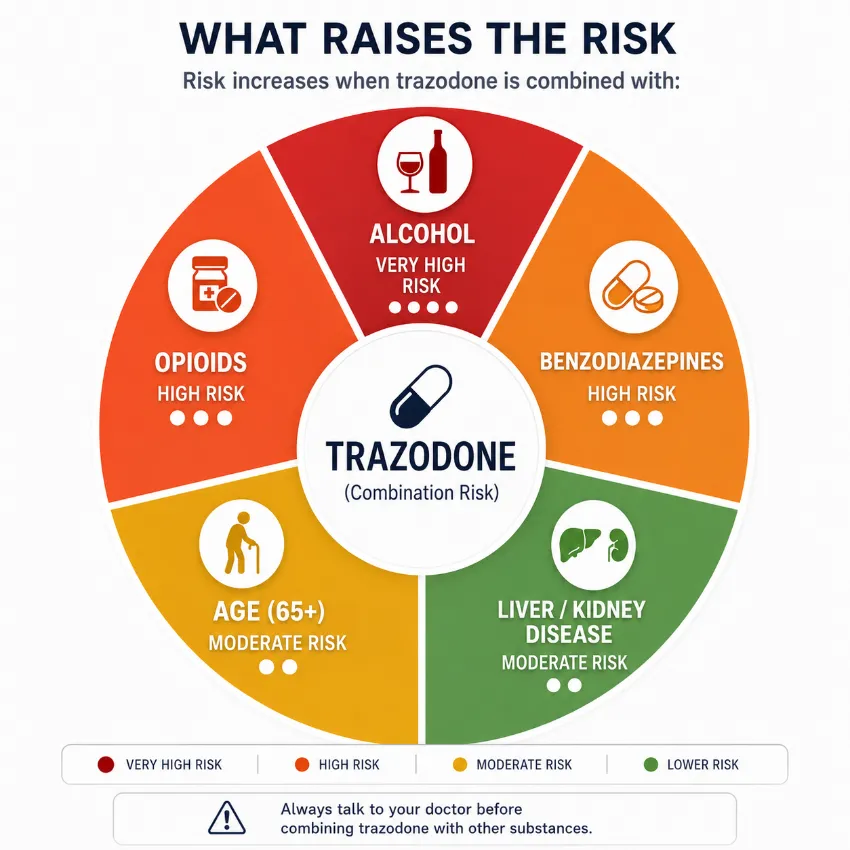
- Alcohol is one of the most common contributors to serious trazodone overdoses. Alcohol intensifies trazodone’s sedative effect and further depresses breathing, which is exactly the combination that shows up in the most severe documented cases. Even a moderate amount of alcohol on top of a normal trazodone dose can push someone into dangerous territory.
- Opioids compound the respiratory depression risk that trazodone can already cause on its own. When both drugs slow breathing simultaneously, the combined effect can be far more dangerous than either medication alone. This interaction is particularly concerning for patients managing both pain and insomnia with separate prescriptions.
- Benzodiazepines add to trazodone’s sedative and blood-pressure-lowering effects, increasing the likelihood of the moderate-to-severe symptoms described earlier. This combination is common in patients being treated for both anxiety and sleep difficulties, which makes careful medical oversight essential rather than optional.
- Other antidepressants, especially those that also affect serotonin, raise the risk of serotonin syndrome on top of standard overdose symptoms. This risk exists even when both medications are taken at prescribed doses. Patients switching between antidepressants should always do so under medical supervision with an appropriate transition period.
- Advanced age slows the body’s ability to metabolize and clear trazodone, which means the drug stays active in the system longer and at higher concentrations. Older adults are also more likely to be taking multiple medications, which compounds the risk further. This is why dosing in elderly patients typically starts lower and increases more cautiously.
- Liver disease directly impairs the body’s ability to break down trazodone, since the liver is the primary organ responsible for metabolizing the drug. Reduced liver function means the medication can build up to toxic levels even at a standard prescribed dose. Patients with any history of liver impairment should have their trazodone dosing individually assessed rather than following standard guidelines.
- Kidney disease result in decreased clearance of the active metabolites. So metabolites accumulation may result in prolonged effects or toxicity, particularly in those who are taking long term therapy in the treatment of chronic insomnia.
- Mixing multiple medications can cause some unanticipated interactions with trazodone. There have been cases of trazodone overdose resulting in death and these cases all involved co-administration of the drug with other depressant medications such as alcohol, chloral hydrate, diazepam and sedatives.
What Should You Do If Someone Overdoses on Trazodone?
If you suspect a trazodone overdose, don’t wait to see how symptoms progress. Acting in the first few minutes matters more than most people realize.
- Call 911 immediately.
- Do not induce vomiting unless Poison Control or a medical provider specifically instructs you to do so.
- Stay with the person the entire time.
- Gather the medication information while you wait.
- Follow the emergency dispatcher’s instructions exactly.
- Call Poison Control at 1-800-222-1222 if the situation feels uncertain rather than clearly an emergency.
Clinical Perspective from Dr. Ash Bhatt:
I always tell families the same thing, don’t try to “wait it out” at home. I’ve seen a mild overdose turn into a breathing emergency within an hour, and by then, minutes matter more than they did when it started. Call first, ask questions after.
How Is a Trazodone Overdose Treated?
There is no medication that reverses a trazodone overdose the way naloxone reverses an opioid overdose. That is why hospital treatment centers on supportive care, and physicians are advised to consider contacting a Poison Help line or medical toxicologist for guidance. Treatment in the hospital is built around stabilizing the body’s systems while the medication clears naturally, and it typically includes the following:
- Continuous cardiac monitoring – Doctors track heart rhythm closely throughout treatment to catch arrhythmias early, since irregular heartbeat is one of the more dangerous complications of trazodone overdose.
- IV fluids – Fluids are administered to counteract the dangerously low blood pressure that often accompanies moderate-to-severe overdose cases, helping stabilize circulation.
- Oxygen support – If breathing has become compromised, supplemental oxygen or ventilator support is provided to keep oxygen levels stable until the medication clears the system.
- Activated charcoal – This may be given if the patient arrives soon enough after ingestion, since it can reduce how much of the drug is still absorbed from the digestive tract.
- Seizure management – If seizures occur, they are controlled with anti-seizure medication under close observation until the risk has passed.
- Extended observation – Even patients who look stable are typically monitored for several hours, since symptoms in trazodone overdose can escalate after the initial presentation.
The seriousness of what hospital teams prepare for is best illustrated by a documented case. A 40-year-old man who ingested approximately 2.2 grams of trazodone became unconscious with difficulty breathing, developed dangerously low blood pressure and an irregular heart rate, and required a ventilator along with admission to a cardiac intensive care unit before he stabilized.
Can You Recover From a Trazodone Overdose?
Most people who receive prompt medical attention recover fully. Death from a trazodone overdose is unlikely if medical attention is sought right away, though slowed or stopped breathing for a prolonged time can cause permanent brain damage.
Recovery timelines vary depending on how much was taken and how quickly treatment started. Some people are monitored for a few hours and discharged. Others, especially those who mixed substances or delayed care, may need a longer hospital stay and follow-up cardiac evaluation.
Complications are more likely when treatment is delayed, when other substances were involved, or when the person has an underlying heart, liver, or kidney condition. Early intervention consistently produces better outcomes than a wait-and-see approach.
When an Overdose May Signal a Bigger Problem
A trazodone overdose isn’t always an isolated accident, and pretending otherwise does patients a disservice. It can point to several underlying issues, and figuring out which one is at play is what actually determines the right next step.
- Medication misuse – Taking more trazodone than prescribed specifically to chase a stronger sedative effect is one of the most common reasons an overdose happens outside of a true accident.
- Self-medicating an untreated condition – Some patients increase their own dose because their anxiety, depression, or insomnia isn’t adequately controlled by the current treatment plan, and they’re trying to solve that gap on their own.
- Prescription dependence – An overdose can be the first visible sign of a dependence that developed gradually over months, often without the patient or their family recognizing it until a medical event forced the issue.
- Suicide risk – In more serious situations, an overdose can be a direct marker of suicide risk, which requires immediate psychiatric evaluation rather than simply adjusting the medication and sending the patient home.
- Dual diagnosis – Overlapping mental health conditions occurring alongside prescription misuse are common in these cases and frequently go unaddressed until an overdose brings them into the open.
Clinical Perspective from Dr. Ash Bhatt:
Every case that we see as an overdose does not mean someone went deliberately through that path. And that is something I do not ever take for granted. Still, if a patient comes with signs of a trazodone overdose, then my initial inquiries are about the sleeping pattern of the patient, their emotional state, and the events that led up to this point in their life, because such information reveals a lot more than the lab test results of drugs.
Treatment for Prescription Medication Misuse
Recovering from prescription medication misuse is significantly more effective with structured, professional support than with an attempt to self-correct after an overdose has already occurred. Treatment generally draws on several components working together, not any single one in isolation.
- Medical detox – Provides supervised support for anyone with physical dependence, allowing withdrawal to be managed safely under clinical observation rather than attempted at home.
- Residential treatment – Offers a structured environment away from daily triggers and unsupervised access to medication, giving someone the space to focus fully on recovery.
- Cognitive Behavioral Therapy (CBT) – Addresses the thought patterns that drive compulsive or escalating medication use, helping patients recognize and interrupt those patterns before they repeat.
- Individual therapy – Works through whatever is underneath the misuse itself, whether that’s untreated anxiety, chronic insomnia, or unresolved trauma driving the behavior.
- Psychiatric support – Ensures that any ongoing medication needs are reassessed with proper clinical oversight rather than left to guesswork or self-adjustment.
- Family therapy – Helps rebuild the trust and communication that medication misuse often strains within a household, involving loved ones directly in the recovery process.
- Aftercare – Provides continued support once residential treatment ends, which is frequently the period where relapse risk is highest without a structured plan in place.
How Legacy Healing LA Helps Individuals Recover
At Legacy Healing LA, we treat prescription medication misuse as a clinical issue, not a personal failing. Our approach combines evidence-based care with individualized treatment planning, because no two people end up here the same way.
Our clinical team has specific expertise in dual diagnosis care, addressing co-occurring depression, anxiety, or trauma alongside prescription medication dependence. Treatment happens within a private, luxury healing environment designed to support real recovery without added stress.
If a trazodone overdose, yours or someone you love’s has raised questions you haven’t had answered yet, our prescription medication addiction program is built to help you find those answers with real clinical support behind you.
Resources Used:
- FDA Prescribing Information – Trazodone Hydrochloride: https://www.accessdata.fda.gov/drugsatfda_docs/label
- MedlinePlus (National Library of Medicine) – Trazodone Overdose: https://medlineplus.gov/ency/article/007529.htm
- National Poison Control (National Capital Poison Center) – Trazodone: Side Effects, Interactions, and Overdose: https://www.poison.org/articles/trazodone
- PubMed – Recognition and Management of Antidepressant Overdoses: Tricyclics and Trazodone: https://pubmed.ncbi.nlm.nih.gov/3725005/
- PubMed – Fatal Overdose with Trazodone: Case Report and Literature Review: https://pubmed.ncbi.nlm.nih.gov/11603256/