




-
 Written By:
Alex Herrera
Written By:
Alex Herrera
-
 Edited By:
Phyllis Rodriguez, PMHNP-BC
Edited By:
Phyllis Rodriguez, PMHNP-BC
-
 Clinically Reviewed By:
Dr. Ash Bhatt, MD, MRO
Clinically Reviewed By:
Dr. Ash Bhatt, MD, MRO
Key Takeaways
|
Discreet Addiction Treatment for High Performers
You’ve just closed a seven-figure deal, and your team is celebrating. You reach for a drink, then another, and by the third glass, you’re confident, articulate, more ‘yourself.’ You wonder when the two drinks became three, and three became a nightly ritual.
You’re not alone. High-stress environments, constant decision-making, social drinking embedded in professional culture, and the relentless pressure to ‘handle everything’ create a perfect storm for substance dependence. The CDC reports that executives have higher rates of alcohol dependence than the general population, yet they’re the least likely to seek treatment.
Why? Because traditional rehab wasn’t built for people like you. The thought of checking into a facility feels like a career-ending move. Your reputation is everything. Your competitors are waiting. Your board would question your stability. So you don’t get help. You tell yourself you’ll cut back. And meanwhile, the problem quietly grows.
“That’s why discreet addiction treatment for executives exists. Its recovery is designed by executives, for executives, where privacy isn’t negotiable. And most importantly: recovery is possible without derailing your career. This guide explains what discreet addiction treatment looks like, why it works differently for executives, and how to navigate the path to recovery while keeping your professional life intact.
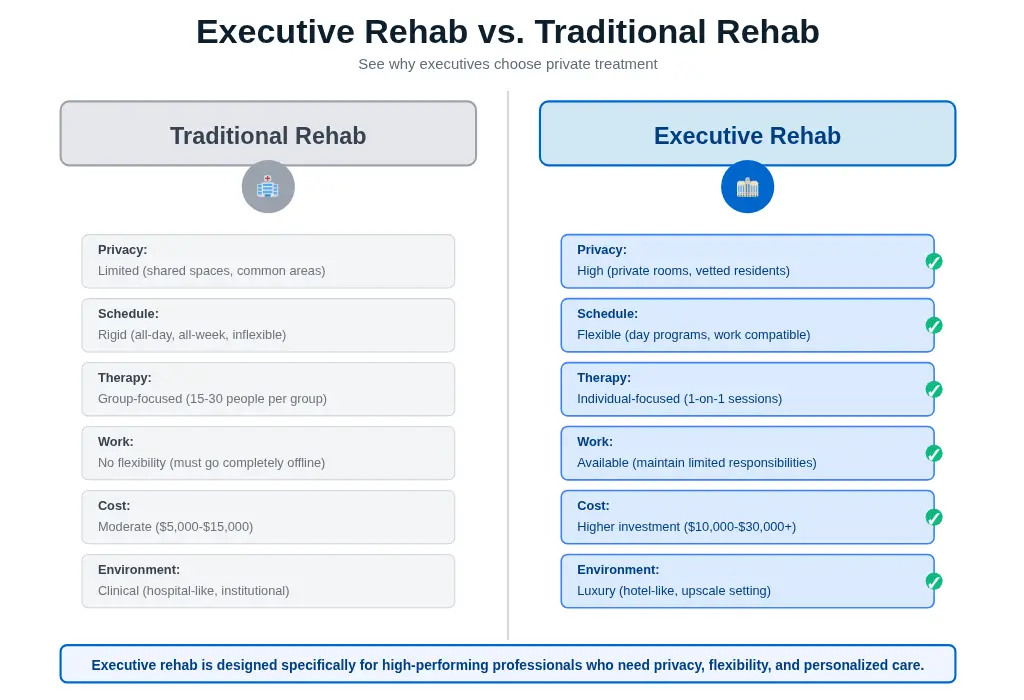
Why Executives Avoid Traditional Rehab Programs
The lack of privacy in rehab is the primary barrier keeping executives from seeking help. Here’s what makes standard programs incompatible with executive life:
Recognition Risk: Standard rehab facilities mix all demographics in shared spaces. You share waiting rooms, dining areas, and group sessions with people from your industry. The fear of being recognized by a competitor, a business partner, or even a client is paralyzing. Some executives have reported being seen by people they’ve negotiated with, worked alongside, or competed against. That exposure destroys the point of seeking treatment.
Rigid Schedule, Inflexible Structure: Traditional programs demand full-time, continuous presence. You’re expected to be offline for weeks or months. For executives, this is impossible. The cognitive dissonance of ‘surrender control’ while your organization needs you creates unbearable pressure and often triggers early program exits.
Group Therapy as the Primary Modality: Sitting in a circle with strangers discussing emotions feels fundamentally incompatible with the leadership identity that got you here. Many executives have spent decades building an image of control, authority, and competence. Group therapy directly challenges that. Some find it healing. Most find it humiliating, and they leave.
Career Destruction: An extended rehab absence is a red flag. Your board questions stability. Your largest clients call. Investors lose confidence. For executives who’ve built decades of success, the risk of being ‘that person who went to rehab’ feels worse than the addiction itself.
Traditional rehab assumes everyone has the same constraints: time, privacy, identity, and career risk. Executives don’t. That’s why they don’t go, and why they need something different.
Clinical Insight From Dr. Ash Bhatt“Many executives I work with are not resistant to treatment itself; they’re resistant to losing control, privacy, and professional identity. Traditional rehab environments often feel incompatible with the responsibilities they carry, which is why executive-focused care must be built differently from the start.” |
What “Discreet Addiction Treatment” Actually Means
Confidential addiction treatment is not simply about keeping your stay quiet. For executives, it’s about protecting identity, reputation, professional relationships, and long-term career stability throughout the recovery process.
True discreet treatment is built around systems that minimize exposure at every level, from admissions and communication to clinical documentation and daily operations.
Confidential Admissions and Identity Protection
Executives often avoid treatment because they fear being recognized before recovery even begins. Discreet rehab programs solve this by offering private admissions processes, direct-entry enrollment, restricted staff access, and optional anonymous registration.
In many programs, only essential clinical staff know a client’s identity. Communication is tightly controlled, and no information is shared externally without explicit consent.
Privacy Beyond Standard HIPAA Protection
While HIPAA compliance is required everywhere, executive-focused treatment centers typically go further. Additional confidentiality agreements, encrypted records, restricted access systems, and highly controlled communication protocols help protect sensitive personal and professional information.
This matters for executives managing public visibility, investor relationships, leadership responsibilities, or high-profile careers.
Controlled Communication and Reputation Protection
Discreet treatment also means controlling how, when, and with whom communication happens. Calls, emails, and approved work communication are handled privately. Staff are trained specifically in executive confidentiality expectations, including media sensitivity and reputation protection.
For many professionals, this level of discretion is what finally makes treatment feel possible.

How Executive Rehab Programs Are Structured Differently
The structural differences between traditional and executive programs are fundamental. Unlike standard programs, discreet addiction treatment for executives is designed around privacy, flexibility, and professional responsibility. Here’s how the structure differs:
- Privacy-First Environment
A private rehab environment looks nothing like traditional treatment. You’re in a secure, luxury setting designed to feel welcoming rather than institutional.
Private rooms with ensuite bathrooms. Limited client volume (often 5-8 residents maximum) means you’ll rarely encounter other people in common areas. When you do, they’re carefully screened for professionalism and discretion, often other high-performing professionals from non-competing industries.
The message is clear: recovery happens here, but your private executive life is protected.
Personalized, One-on-One Care
Individualized addiction treatment for executives means your therapy is tailored to your specific situation, not a one-size-fits-all curriculum.
You work with your dedicated therapist daily. Sessions address your specific triggers. Your therapist understands executive psychology, the perfectionism, the imposter syndrome masked by confidence, the isolation of the top role.
Treatment includes cognitive behavioral therapy (CBT), trauma-focused care if needed, executive coaching alongside addiction counseling, and relapse prevention tailored to your specific pressures. If you’re managing depression or anxiety, medication is integrated. If you have specific work-related trauma, that’s addressed directly.
Group sessions (if you attend) are small and peer-level. This is where shared experience actually helps, because everyone in the room gets the stakes.
Flexibility for Ongoing Responsibilities
Unlike traditional rehab, flexible rehab for professionals recognizes that you may need to maintain limited responsibilities while in treatment. This is sometimes called ‘intensive outpatient’ (IOP) or ‘executive partial hospitalization.’
Here’s how it works: You’re in treatment 8-12 hours daily, five to six days a week. But you’re not required to be present 24/7. You may attend morning and afternoon therapy sessions and return for evening sessions.
Residential options exist, too. You stay on-site overnight (in your private room), but daytime flexibility allows for limited work. A quick visit to the office, all with therapeutic processing built in.
This hybrid approach prevents the ‘I have to choose: my company or my recovery’ dilemma. You don’t have to choose. You do both, safely, with professional oversight.
Controlled, Secure Setting
Secure addiction treatment means your environment is controlled in ways that support recovery.
Communication is private. Phone calls are conducted in your private room or a designated confidential space. Your therapist isn’t listening. Your privacy is protected. Email access is available (critical for executives), but with safeguards, you’re encouraged (not forced) to limit work communication during treatment.
Your laptop is available for necessary work, but gaming, excessive social media, and other escape behaviors are gently monitored.
Medical monitoring includes urine drug screens (random, for your safety and accountability), physical health assessments, and psychiatric evaluation. You’re medically safe, and your therapist knows exactly where you are clinically.
The Unique Pressures That Drive Substance Use in Executives
Executive stress and addiction are directly connected. Understanding the specific pressures executives face is crucial to treating the addiction effectively.
Decision Fatigue and Constant High-Stakes Choices: By 5 PM, you’ve made hundreds of decisions. Firing someone. Closing a division. Betting the company on a new direction. Your brain is exhausted. Alcohol quiets that noise. It turns off the constant evaluation, the weight of consequences, and the responsibility. One drink becomes your decompression. Then two. Then a dependency.
Burnout Without Permission to Rest: You can’t take a ‘mental health week’ without market interpretation. You can’t say ‘I’m overwhelmed.’ You’re expected to handle it all. So you medicate the overwhelm. Alcohol becomes time off. Stimulants become a way to push through. Benzodiazepines become the only sleep aid you trust.
Social Drinking as Professional Requirement: Networking events, client dinners, board celebrations—alcohol is embedded in executive culture. Not drinking is suspicious. Light drinking looks like weakness. Heavy drinking is normalized. ‘Leaders drink.’ So you drink. And the boundary between social drinking and self-medication blurs.
Isolation of the Top Role: There’s no one to talk to. Your peers are competitors. Your subordinates see you as an authority. Your board judges you. You can’t be vulnerable. So you internalize the stress, the pressure, the loneliness. And you self-soothe with substances.
Perfectionism and Fear of Exposure: You’ve built an image of infallibility. One crack threatens everything. The thought of needing help is terrifying. So instead of getting help, you hide the problem. You drink alone. You take pills. You tell yourself you have it under control. Until you don’t.
Clinical Insight From Dr. Ash Bhatt“I often see executives normalize exhaustion, chronic stress, and alcohol use because it has become deeply integrated into leadership culture. Over time, substances stop being recreational and start becoming coping mechanisms for performance, pressure, and emotional isolation.” |
What a Day in Discreet Executive Treatment Looks Like
Here’s a real walkthrough of an executive rehab experience, structured, private, and designed to feel like recovery, not incarceration:
6:30 AM: Wake naturally in your private room with natural light, a private bathroom, and a comfortable bed.
7:00 AM: Optional yoga or morning meditation. Attended by you and maybe one or two other residents in a peaceful setting.
7:45 AM: Breakfast in your room or in the dining area. Chef-prepared meals, customized to your dietary preferences, that support recovery.
9:00 AM: One-on-one therapy with your dedicated therapist. Therapy is evidence-based (CBT, trauma-focused, or other modalities tailored to you).
10:30 AM: Psychiatric evaluation or medication management. If you’re managing depression, anxiety, or ADHD, medication is refined. If withdrawal symptoms exist, they’re medically managed.
11:30 AM: Executive coaching or specialized workshops by specialists on topics like stress management for leaders, addiction recovery for high performers, rebuilding executive identity in recovery, or relationship repair.
1:00 PM: Lunch and personal time. You might work for an hour (if on a flexible schedule), read, call someone approved, or sit quietly.
2:30 PM: Group therapy (optional, small, peer-level), with 3-5 other high-performing professionals. You can also skip group and do additional individual therapy instead.
4:00 PM: Recreation and wellness. Gym access, walking trails, massage, or spa treatment.
6:00 PM: Dinner. Again, chef-prepared and customized. Shared or private, your choice.
7:00 PM: Evening group (optional) or personal therapy continuation. Some executives do additional individual work. Some attend peer discussion. Some rest.
9:00 PM: Personal time in your room. Phone access to pre-approved contacts. Relaxation. Journaling. Preparing for tomorrow. Bedtime when you choose.
| What’s absent: humiliation, forced group sharing, rigid wake-up times, loss of autonomy. What’s present: structure, privacy, professional care, respect for your intelligence and needs. This is why executives actually engage in treatment. |
How Discreet Treatment Protects Your Career
The greatest fear executives have about seeking treatment is career destruction. Confidential rehab for professionals is specifically designed to protect your reputation and career trajectory.
Legal Confidentiality: Your treatment is protected by HIPAA and confidentiality laws. Confidential enrollment means your presence at a facility is legally protected and shares no public footprint.
Flexible Timeline: You might take two to four weeks of ‘personal time’ while doing intensive treatment, then transition to outpatient care. Your absence is minimal and explainable (‘personal matters’ is enough).
Return-to-Work Support: Your therapist doesn’t just discharge you. There’s a structured transition plan. Continued outpatient therapy (often via telehealth from your office). Relapse prevention specific to your work environment.
Executive Coaching Continuation: Many executives benefit from ongoing executive coaching post-treatment. This normalizes your continued support (everyone gets a coach) while providing the accountability structure that prevents relapse.
Reputation Management: Private rehab facilities understand that your reputation is your asset. They help you understand what to disclose and how to move forward authentically without oversharing.
Clinical Insight From Dr. Norman Chazin“One concern I hear repeatedly is, ‘Will treatment ruin everything I’ve built?’ In reality, untreated addiction is far more damaging to long-term leadership, decision-making, and reputation than seeking confidential professional help early.” |
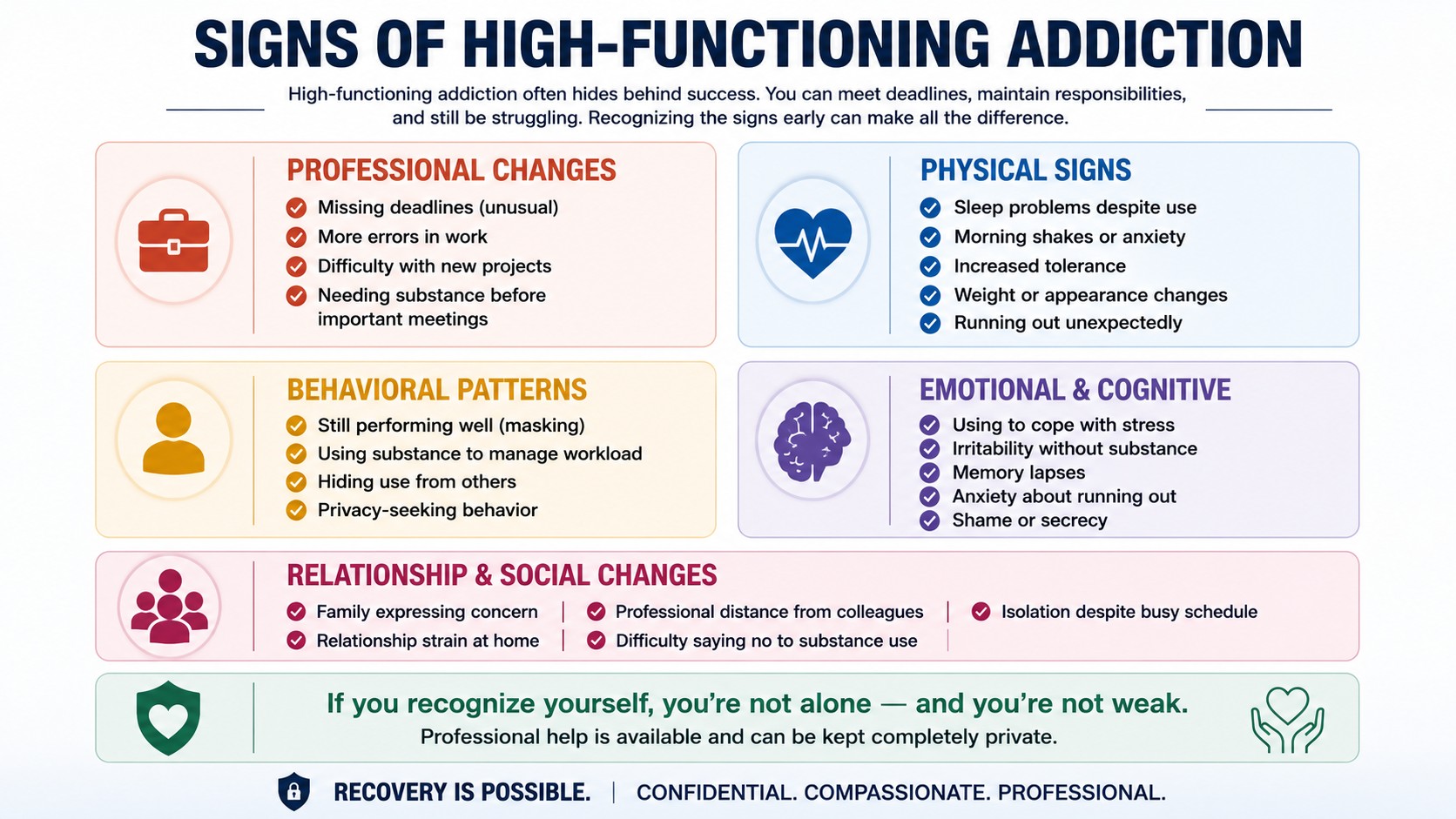
Signs You May Need a More Private Approach to Treatment
High-functioning addiction signs are often invisible to others and to yourself. You’re succeeding at work. You’re paying your bills. You’re maintaining relationships (mostly). But internally, something is wrong. Here are the subtle, executive-specific warning signs:
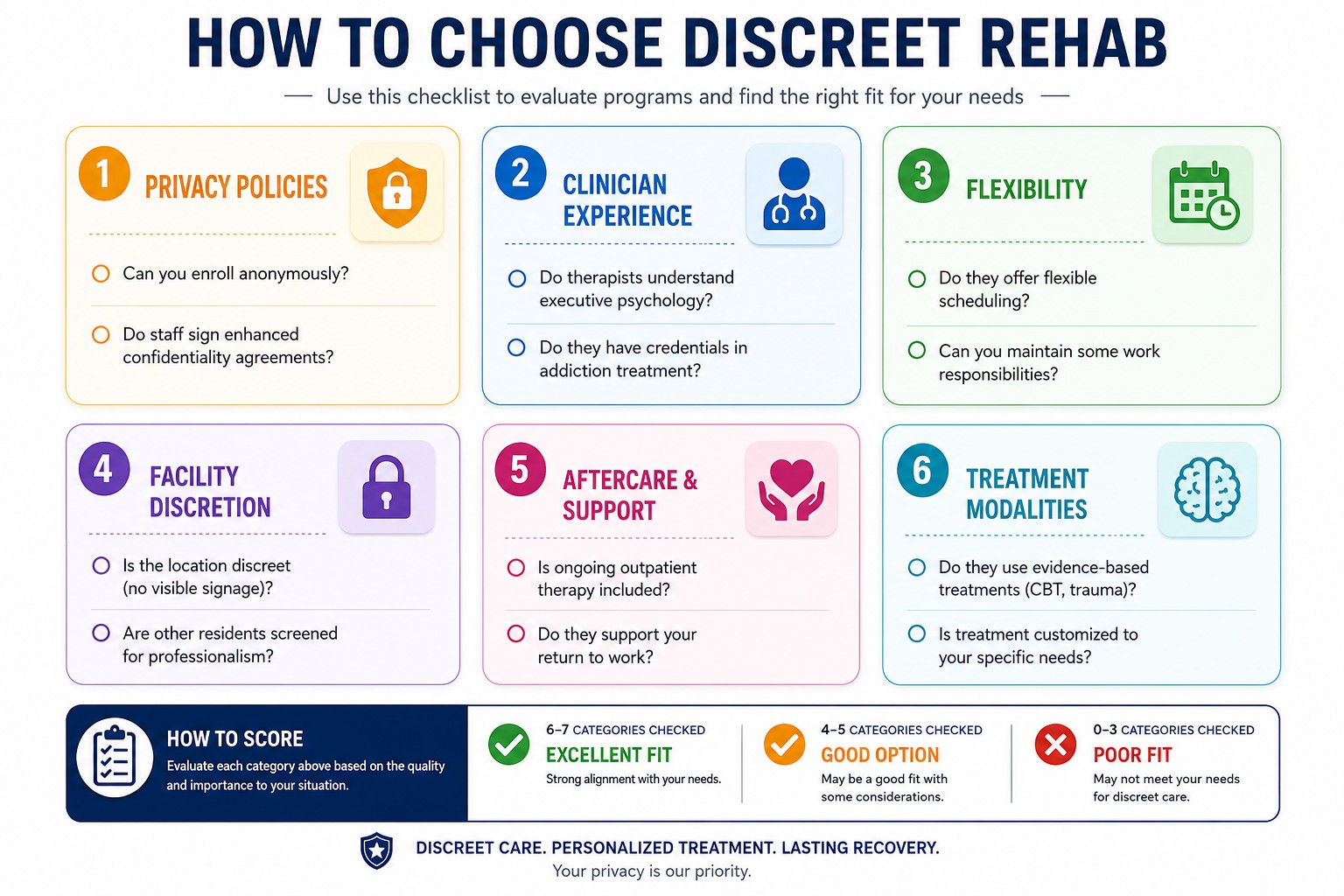
How to Choose a Truly Discreet Rehab Program
Not all private rehab programs are the same. Here’s how to choose discreet rehab that actually serves your needs:
Conclusion: Recovery Without Public Exposure
You didn’t become an executive by taking shortcuts or accepting mediocrity. Why would you accept mediocre treatment for something this important?
Private addiction treatment for executives is the difference between recovery that works and recovery that fails. It’s the difference between rebuilding your life in private and destroying your reputation in public.
You can continue building, leading, and succeeding, but only if you get the right help. Not standard rehab. Not a six-month absence that triggers career catastrophe.
You need discreet addiction treatment for executives. Designed by executives, for executives. Confidential, flexible, professional, and effective.
Begin Confidential Treatment at Legacy Healing Center Los Angeles
For executives and high-performing professionals, choosing the right treatment environment is as important as the treatment itself. At Legacy Healing Center Los Angeles, our executive addiction treatment program is designed around the specific pressures, schedules, and privacy requirements of leadership-level clients.
Our intake process is fully confidential. You can begin with a private phone consultation that never appears on public records. Our hillside residential facilities offer private suites, separate entrances, and staff trained in enhanced confidentiality protocols — going well beyond standard HIPAA compliance.
Our clinical team, including our board-certified addiction specialists, has extensive experience treating high-functioning addiction in executives, entrepreneurs, and public figures. Treatment is individualized, discreet, and built to protect both your recovery and your reputation. Explore the full scope of our luxury amenities and private accommodations to understand what your care environment looks like.
Ready to Take the Next Step?Legacy Healing Center Los Angeles specializes in private addiction treatment for executives. A confidential consultation with one of our executive specialists takes 15 minutes. No judgment. No pressure. Just an honest conversation about your situation and whether discreet rehab is right for you. |