



-
 Written By:
Alex Herrera
Written By:
Alex Herrera
-
 Edited By:
Phyllis Rodriguez, PMHNP-BC
Edited By:
Phyllis Rodriguez, PMHNP-BC
-
 Clinically Reviewed By:
Dr. Ash Bhatt, MD, MRO
Clinically Reviewed By:
Dr. Ash Bhatt, MD, MRO
Alcohol poisoning is not simply “being too drunk.” It is a serious and potentially fatal medical emergency caused by consuming a dangerous amount of alcohol in a short period of time. As blood alcohol concentration (BAC) rises, the body gradually loses its ability to regulate critical functions such as breathing, heart rate, body temperature, and consciousness.
At Legacy Healing LA, we regularly work with individuals and families who underestimate how quickly alcohol poisoning can escalate. Many people assume a person can simply “sleep it off,” when in reality, delaying medical attention can lead to respiratory failure, brain injury, coma, or death. Understanding the warning signs and knowing when immediate intervention is necessary can save lives.
Key Takeaways1. Alcohol poisoning is a medical emergency. Excessive alcohol consumption can dangerously suppress breathing, consciousness, and other vital body functions. 2. Symptoms can become life-threatening quickly. Slow breathing, seizures, blue skin, vomiting while unconscious, and inability to wake someone are all emergency warning signs. 3. Immediate medical attention is critical. Alcohol poisoning should never be managed alone or ignored overnight. Prompt emergency care can prevent fatal complications. |
What Is Alcohol Poisoning?
Alcohol poisoning is a serious, potentially life-threatening condition that occurs when someone consumes alcohol faster than their body can metabolize it, leading to dangerously high blood alcohol concentration (BAC). This is not simply being drunk. It’s a medical emergency where the central nervous system becomes severely depressed, and the body’s vital functions, breathing, heart rate, temperature regulation, and consciousness begin to fail.
Unlike mild intoxication, which people often manage or even ignore, alcohol poisoning demands immediate medical intervention. The condition can develop rapidly, sometimes in someone who has never experienced severe intoxication before. Understanding the signs and knowing how to respond can be the difference between recovery and tragedy.
How Alcohol Poisoning Happens
Alcohol is a depressant. It slows the central nervous system, affecting the parts of the brain that control breathing, heart rate, and consciousness. When consumed in small to moderate amounts, the body metabolizes it efficiently, and these effects are manageable. But when someone drinks faster than their liver can process the alcohol, typically through rapid consumption or binge drinking, alcohol accumulates in the bloodstream to toxic levels.
Blood alcohol concentration (BAC) is measured as a percentage of alcohol in the blood. For context:
| BAC Level | Effect |
| 0.08% BAC | Legal driving limit in most U.S. states |
| 0.20% BAC | Dangerous; significant impairment is severe |
| 0.30% BAC | Life-threatening; loss of consciousness likely |
| 0.40% BAC and above | Can be fatal; respiratory depression and seizures imminent |
The critical issue is how quickly they drank it. A person can consume a large amount of alcohol over several hours and remain functional. The same amount consumed in 30 minutes can cause poisoning. This is why “drinking games,” rapid-fire shots, and pre-drinking before going out are particularly dangerous.
The body cannot speed up alcohol metabolism. The liver processes alcohol at a fixed rate, approximately one standard drink per hour for most adults. Once BAC reaches dangerous levels, the only solution is time, medical support, and sometimes emergency intervention.
Signs and Symptoms of Alcohol Poisoning
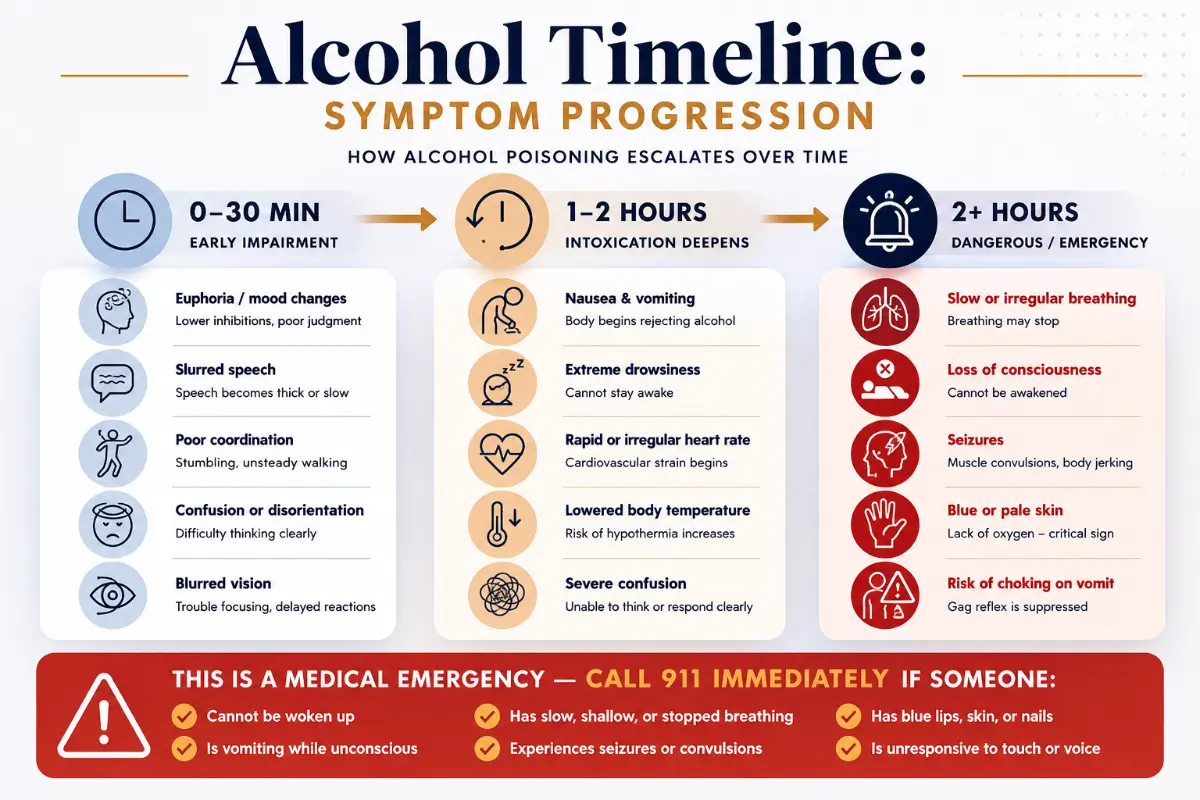
Alcohol poisoning symptoms don’t always develop in the same order or at the same speed. However, understanding the typical progression helps you recognize when someone needs immediate help.
When Alcohol Poisoning Becomes Fatal
Alcohol poisoning becomes especially dangerous when the brain can no longer regulate breathing and oxygen delivery properly. As respiration slows, oxygen levels in the body drop, increasing the risk of brain injury, cardiac arrest, and death.
Another major danger is aspiration. When someone loses consciousness and vomits, they can choke because the gag reflex becomes suppressed. This is one of the primary reasons individuals die from alcohol poisoning while asleep or unconscious.
Severe alcohol poisoning may also lead to:
- coma
- dehydration and electrolyte imbalance
- hypothermia
- permanent neurological damage
- respiratory arrest
At our facility, we emphasize that alcohol poisoning is never something to “monitor overnight” without medical involvement. The progression can be unpredictable, and waiting too long to seek help can have irreversible consequences.
What To Do If Someone Has Alcohol Poisoning
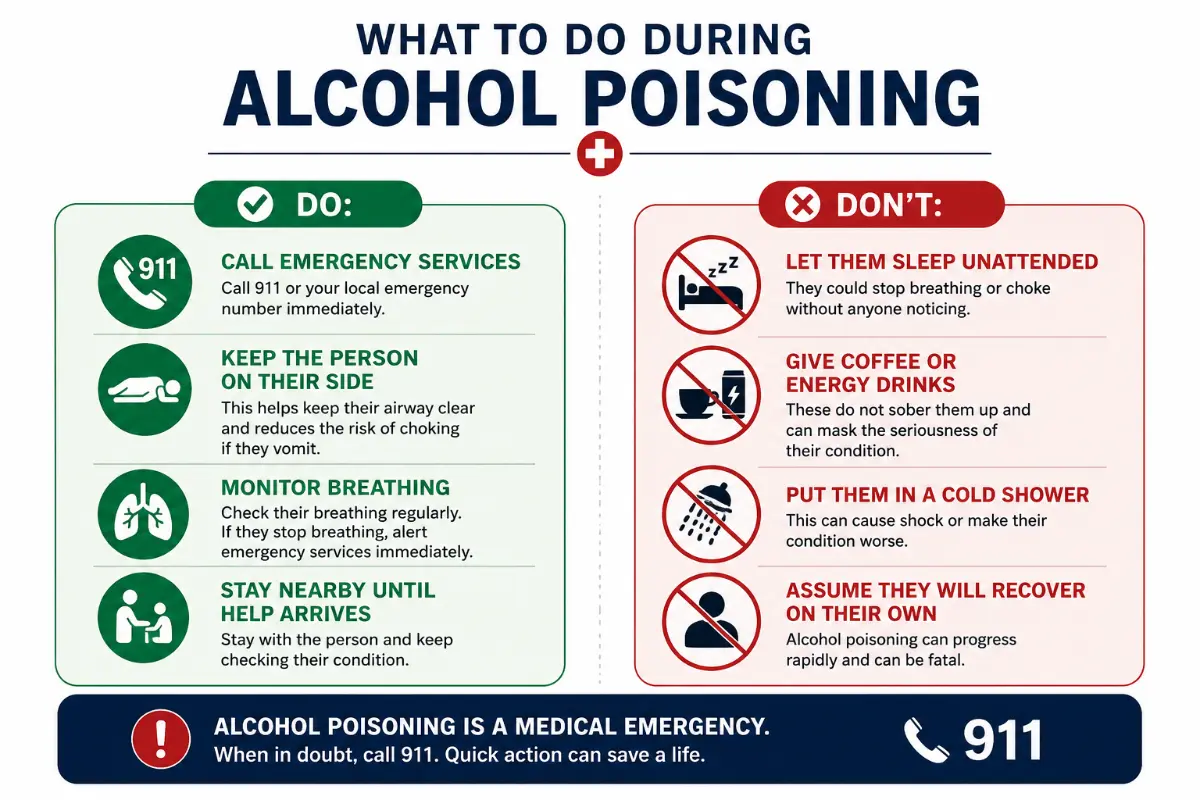
Call 911 immediately. Do not wait. Do not assume they’ll recover on their own. Do not worry about legal consequences. Emergency services exist for exactly this situation.
While waiting for paramedics:
- Position the person on their side in the recovery position (on their side, one leg bent to stabilize them). This prevents them from aspirating vomit if they become sick.
- Never leave them alone. Monitor their breathing. If breathing becomes shallow, irregular, or stops, be ready to describe this to emergency responders.
- Stay calm and monitor their responsiveness. Try to keep them awake by talking to them. If they cannot be roused or their condition worsens, this information is critical for paramedics.
- Gather information for paramedics: How much did they drink, and how quickly? When was the last drink consumed? Have they taken any medications or other substances? Any medical conditions they have? Has this happened before?
| Good Samaritan Laws: Many states and jurisdictions have Good Samaritan laws that protect people who call for emergency help on behalf of someone experiencing alcohol poisoning. These laws exist because lawmakers recognize that fear of legal consequences should never delay a life-saving call. Check your local laws, but in general, calling 911 for a medical emergency is the right decision legally and morally. |
Emergency Treatment for Alcohol Poisoning
When you or someone else arrives at the hospital with suspected alcohol poisoning, the medical team’s first priority is stabilization.
And it begins with an initial assessment, which includes:
- Blood alcohol level test (breathalyzer or blood test)
- Blood glucose check (low blood sugar is common and dangerous)
- Vital signs: heart rate, blood pressure, temperature, respiratory rate
- Neurological assessment: Can they follow commands? Are they conscious?
Once the initial assessment has been done, the medical practitioners perform the treatment, which may include:
- Supportive care: Intravenous fluids to prevent dehydration and support kidney function
- Thiamine (Vitamin B1) supplementation: Heavy alcohol use depletes thiamine, which can cause serious neurological damage (Wernicke’s encephalopathy). This is given preventively.
- Glucose administration: If blood sugar is low, glucose is given immediately
- Respiratory support: If breathing is dangerously slow, oxygen may be given through a mask or, in severe cases, mechanical ventilation
- Medication management: Medications may be given to manage seizures, stabilize blood pressure, or prevent further deterioration
- Continuous monitoring: Heart rate, oxygen saturation, and other vital signs are monitored continuously
Hospital stay duration typically ranges from a few hours to overnight, depending on severity. Most people with alcohol poisoning recover fully with medical care, though the experience is uncomfortable and the risks are real.
Discharge and follow-up: Before leaving the hospital, patients usually receive information about alcohol use and are offered referrals to substance use treatment or counseling. Taking these seriously, not as judgment, but as an opportunity, significantly improves outcomes.
Alcohol Poisoning as a Turning Point
A single episode of alcohol poisoning raises important questions. It signals that drinking patterns, whether occasional but heavy, or regular heavy use, have reached a dangerous level. This is not a judgment. It is clinical reality.
Research shows that people who experience alcohol poisoning are at risk for recurrence without intervention. More importantly, alcohol poisoning often occurs in the context of problematic alcohol use patterns that benefit tremendously from professional assessment and treatment.
For many people, an emergency like this becomes a turning point. It shatters the illusion of control and creates an opportunity to reassess. The question shifts from “How did this happen?” to “What now?”
Confidential Alcohol Treatment at Legacy Healing LA
An episode of alcohol poisoning is frightening and serious. It is also survivable, and it is treatable.
If you or someone you care about has experienced alcohol poisoning and is ready to understand what happened and prevent it from happening again, professional help is available. At Legacy Healing LA, we provide confidential assessments and treatment for individuals concerned about their alcohol use, whether they’re seeking help after an acute crisis or recognizing a broader pattern they want to address.
Our approach is straightforward: medical evaluation, honest conversation, and a plan that reflects your needs and your life. No judgment. No pressure. Only clinical expertise and the privacy you expect.