



-
 Written By:
Alex Herrera
Written By:
Alex Herrera
-
 Edited By:
Phyllis Rodriguez, PMHNP-BC
Edited By:
Phyllis Rodriguez, PMHNP-BC
-
 Clinically Reviewed By:
Dr. Ash Bhatt, MD, MRO
Clinically Reviewed By:
Dr. Ash Bhatt, MD, MRO
For many people, the decision to stop drinking is not the hardest part. What follows is. Alcohol withdrawal is a physiological process that begins within hours of the last drink, and for individuals with significant physical dependence, it can escalate into a medical emergency. Understanding what withdrawal involves, and why attempting to manage it alone is a serious risk, is essential for anyone considering stopping alcohol use.
At Legacy Healing LA, our medically supervised alcohol detox program provides the clinical oversight, comfort-focused care, and privacy that high-functioning individuals expect when making one of the most important decisions of their lives.
Key Takeaways1. Alcohol withdrawal is a serious medical condition. It begins within hours of the last drink and can quickly escalate from mild symptoms like anxiety and tremors to life-threatening complications such as seizures and delirium tremens. 2. Detoxing without medical supervision can be dangerous and unpredictable. Withdrawal severity cannot be accurately predicted, and attempting to quit alcohol alone carries real risks, including fatal outcomes, making professional, medically supervised detox the safest approach. 3. Detox is only the first step toward recovery. While medical detox stabilizes the body, long-term recovery requires continued treatment that addresses the psychological and behavioral aspects of alcohol dependence to reduce the risk of relapse. |
Why Alcohol Withdrawal Happens
Alcohol is a central nervous system depressant. Over time, with sustained heavy use, the brain compensates by downregulating its inhibitory systems, primarily GABA, and upregulating excitatory activity through glutamate. The brain essentially recalibrates itself around the presence of alcohol to maintain equilibrium.
When alcohol is removed suddenly, that compensation is left unopposed. The nervous system becomes hyperexcitable, driving every symptom of withdrawal, from mild anxiety and tremors to, in severe cases, life-threatening seizures and delirium tremens. This is not a lack of willpower. It is a neurological rebound that demands medical attention proportional to its severity.
The Alcohol Withdrawal Timeline
Withdrawal does not follow a single fixed schedule, its course depends on drinking history, individual physiology, and prior withdrawal episodes. That said, a general timeline applies to most cases of significant alcohol dependence.
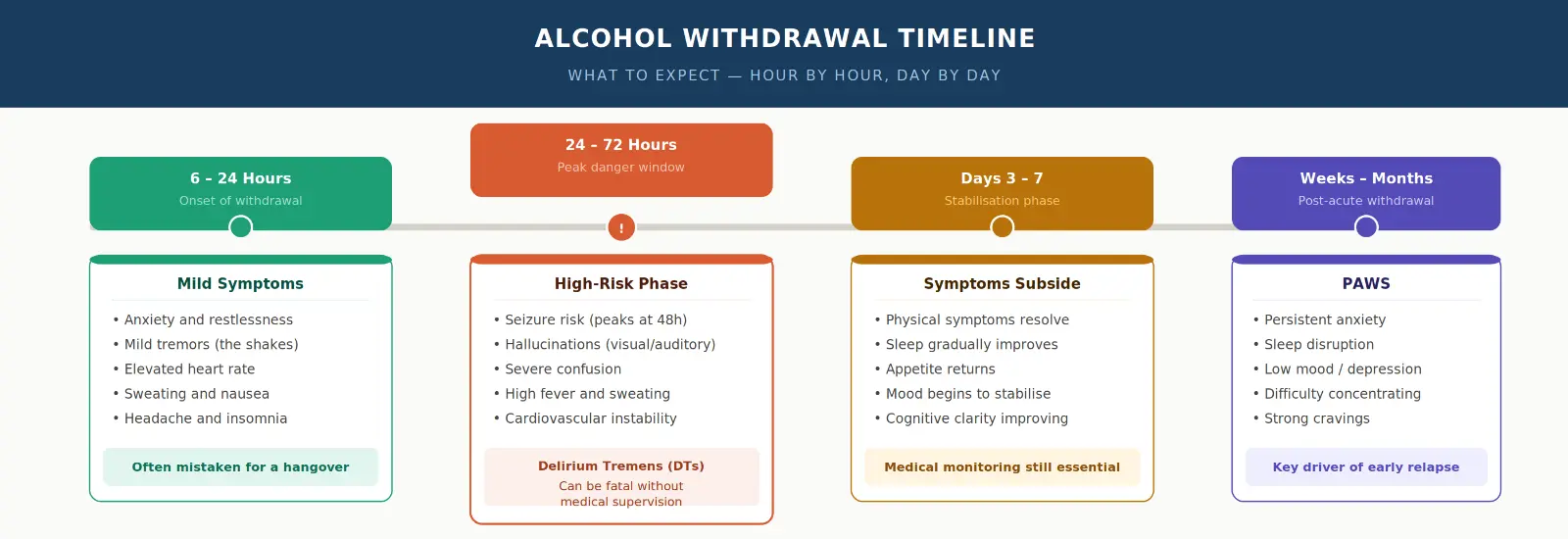
In the first 6 to 24 hours, initial symptoms emerge: anxiety, restlessness, mild tremors, elevated heart rate, sweating, and difficulty sleeping. These early signs are often mistaken for a bad hangover, which is precisely what makes them easy to dismiss, and dangerous to ignore.
Between 24 and 72 hours, withdrawal reaches its most critical phase. This window carries the highest risk of seizures and delirium tremens (DTs). Delirium tremens is characterised by severe confusion, hallucinations, profound autonomic instability, and can be fatal without medical intervention. The risk is highest in individuals with a long history of heavy drinking or prior withdrawal episodes.
From day three to seven, symptoms typically begin to stabilise and gradually resolve for most individuals. However, psychological symptoms, anxiety, depression, and sleep disturbance can persist for weeks as part of post-acute withdrawal syndrome (PAWS). This extended phase is one of the most significant drivers of early relapse without professional support.
Alcohol Withdrawal Symptoms: Mild, Moderate, and Severe
Alcohol withdrawal symptoms exist on a spectrum, and determining where an individual falls is one of the first clinical assessments made during supervised detox, it directly shapes the treatment plan.
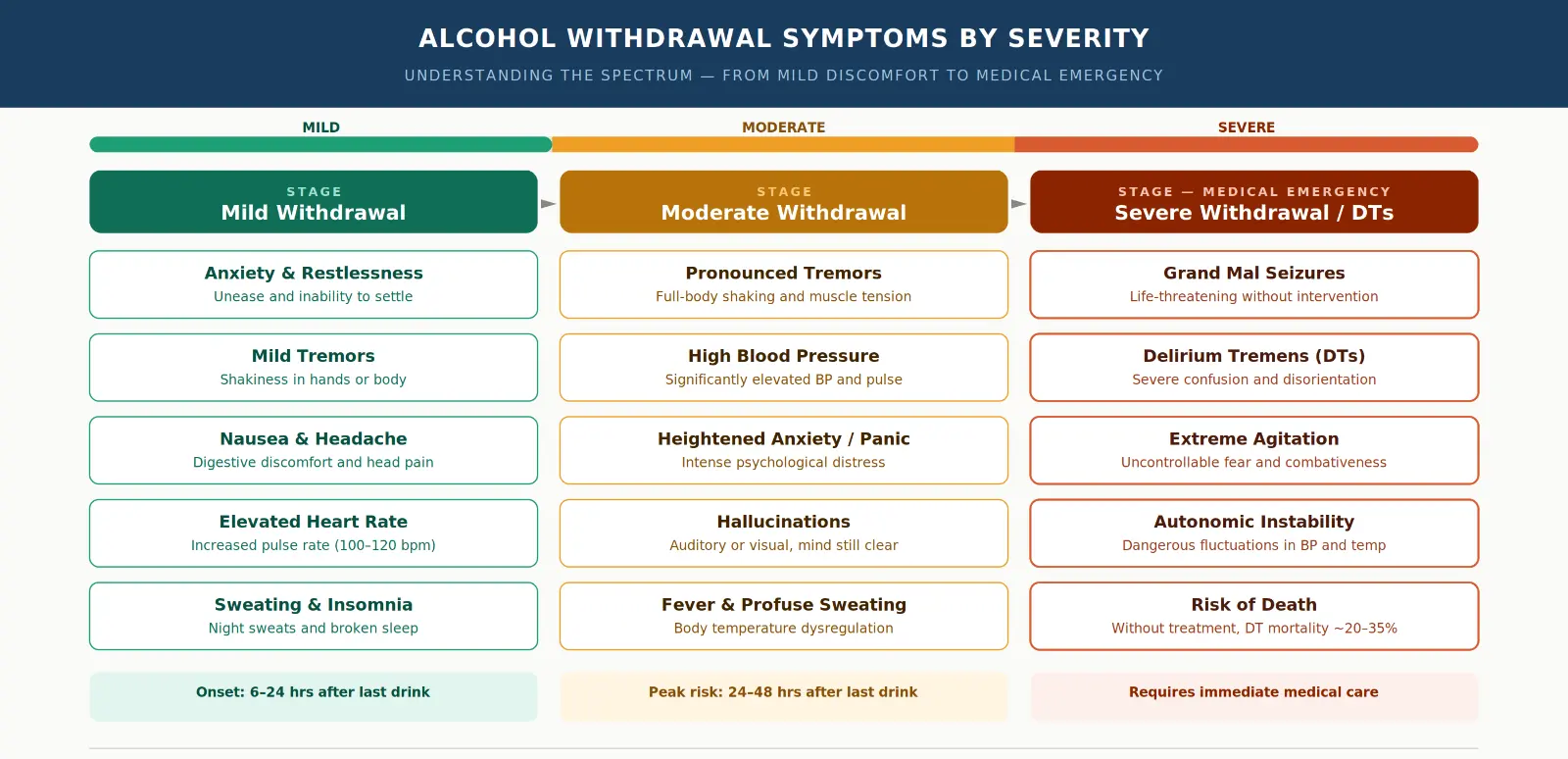
Critically, an individual cannot predict in advance which category they will fall into. Age, overall health, drinking history, and prior withdrawal episodes all influence severity, and the transition from moderate to severe can occur rapidly.
Why You Should Never Attempt to Detox from Alcohol Alone
This is perhaps the most important section of this page. A significant number of high-functioning individuals, accustomed to managing challenges independently and privately, consider stopping drinking on their own. It is understandable. It is also genuinely dangerous.
Alcohol withdrawal is one of the only substance withdrawal syndromes that can be directly fatal. Unlike opioid withdrawal, which is agonising but rarely life-threatening in otherwise healthy individuals, alcohol withdrawal carries a real risk of death through seizures and delirium tremens. Historically, before modern medical detox protocols, DT mortality rates were as high as 20 to 35 percent. With appropriate medical management, that figure drops to under 1 percent.
Withdrawal seizures can occur without warning, in someone who has never seized before, in a car, at work, in the shower. The risk is not theoretical.
Choosing medically supervised detox is not an admission of incapacity. It is the decision any physician or executive would make when confronted with a genuine medical risk, and in every sense, the intelligent one.
What Medically Supervised Alcohol Detox Involves
Our medically supervised alcohol detox program is a structured, comfort-focused process carried out in a private, resort-calibre environment. Every protocol is built around both clinical safety and the discretion our clients expect.
Upon admission, a comprehensive medical assessment establishes baseline health status, drinking history, and withdrawal risk. This assessment guides the treatment plan and determines appropriate medication protocols.
Medication-assisted treatment (MAT) is central to safe alcohol detox. Benzodiazepines, most commonly diazepam or lorazepam, are the clinical standard for preventing seizures and managing neurological hyperexcitability. Supportive medications address blood pressure, nausea, sleep, and nutritional deficiencies, particularly thiamine supplementation to prevent Wernicke’s encephalopathy.
Throughout detox, clients are monitored continuously by our clinical team using validated tools to assess symptom severity and neurological status. The environment is private, calm, and designed to support physical recovery, not to feel institutional.
The typical detox process takes between five and seven days for most individuals, though this varies based on individual factors. Clients are supported medically and emotionally throughout, with transition planning beginning from the first day.
Detox Is the Beginning, Not the Destination
Medical detox addresses the physiological component of alcohol dependence. It does not address the psychological, behavioural, and relational dimensions that sustain the cycle of addiction. Research consistently shows that detox alone, without subsequent treatment, is associated with very high rates of relapse, often within days or weeks.
At Legacy Healing LA, detox transitions seamlessly into our continuum of care, residential treatment, a partial hospitalisation program (PHP), or intensive outpatient care, each delivered with the same commitment to privacy and clinical rigour.
For our clients, the end of detox is the beginning of a carefully structured recovery process. That transition is planned, supported, and never abrupt.
Confidential Alcohol Detox at Legacy Healing LA, Los Angeles
Legacy Healing LA offers one of the most comprehensive and discreet luxury alcohol detox programs in Los Angeles. Our facility provides medical-grade withdrawal management within an environment that reflects the standards our clients hold in every other area of their lives, private rooms, an expert clinical team, and a level of confidentiality that never wavers.
We work with executives, physicians, attorneys, and other high-functioning professionals. Our admissions process is confidential from the first inquiry, no obligation, only information handled with complete discretion.
If you or someone you care about is ready to stop drinking and wants to do so safely, we invite you to reach out for a private consultation at a time that suits you.