




-
 Written By:
Alex Herrera
Written By:
Alex Herrera
-
 Edited By:
Phyllis Rodriguez, PMHNP-BC
Edited By:
Phyllis Rodriguez, PMHNP-BC
-
 Clinically Reviewed By:
Dr. Ash Bhatt, MD, MRO
Clinically Reviewed By:
Dr. Ash Bhatt, MD, MRO
From the outside, they have it all. The corner office. The enviable portfolio and the impressive titles. They meet deadlines, deliver results, and maintain the facade of complete control. Yet behind closed doors, a different story unfolds, sleepless nights, and a growing dependence on substances to manage the weight of their own success.
This is the reality for many high-achieving individuals: the coexistence of professional excellence and personal struggle. Addiction and mental health are not opposing forces in their lives, they are intricately linked, often feeding each other in ways that are invisible to colleagues, family, and sometimes even to themselves.
Key TakeawaysThe Connection is Real: Addiction and mental health aren’t separate problems, they’re clinically linked. 50% of people with addiction have a co-occurring mental health condition. Treating one without the other guarantees incomplete recovery. High-Functioning Doesn’t Mean Healthy: You can be successful and struggling simultaneously. Compartmentalization allows high-achievers to perform excellently while privately dependent on substances. This isn’t sustainable, it costs your relationships, health, and peace of mind. Recovery Requires Both/Both Approach: Real recovery addresses both addiction AND mental health simultaneously. Integrated dual diagnosis treatment provides the mental clarity and emotional stability to sustain success, not sacrifice it. |
The most important insight? This link between addiction and mental health in high achievers is not a moral failing or a sign of weakness. It is a clinical reality that requires a sophisticated, integrated approach to treatment.
The Overlooked Connection Between Mental Health and Substance Use
Mental health and substance abuse are not separate issues, they are deeply intertwined, particularly for high-functioning individuals. Research demonstrates that approximately 50% of people with addiction disorders also experience a mental health condition, and vice versa. For high achievers, this connection is even more pronounced, driven by the unique stressors of their professional and personal lives.
For many professionals, substance use begins innocently enough: a glass of wine to unwind after a grueling presentation, a prescription sleeping pill for insomnia caused by stress, or occasional stimulants to enhance focus during critical projects. But for those with underlying anxiety, depression, or trauma, these substances quickly become tools for self-medication.
They provide temporary relief from unbearable internal states, the racing thoughts, the crushing self-doubt, the fear of failure that haunts even the most accomplished individuals.
What begins as self-medication becomes a cycle: temporary relief leads to increased use, which leads to dependence, which masks deeper mental health symptoms, which drives further use. The substance provides escape, but it also prevents the individual from developing healthy coping strategies or seeking help for the underlying condition.
Why High-Functioning Individuals Often Go Undiagnosed
One of the most dangerous aspects of addiction and mental health issues in high-achievers is their invisibility. These individuals have mastered the art of compartmentalization. They can maintain their careers and appear completely functional, even while struggling significantly.
They Maintain Professional Functioning
- Meet deadlines and deliver results consistently
- Keep up appearances of complete control
- Continue advancing in their careers and taking on more responsibility
The Signs Are Subtle and Easily Dismissed
- Emotional withdrawal and detachment from relationships
- Insomnia or chronic fatigue rationalized as work demands
- Irritability and occasional outbursts dismissed as perfectionism
- Increased substance use at social events blending into executive culture
- Occasional unexplained absences or cancellations
The Real Barrier: Fear and Stigma
- Fear of employer discovery and potential job loss
- Concern about professional reputation damage
- Worry about losing client, investor, or colleague confidence
- Identity built entirely on success makes admitting struggle feel impossible
- Professional and financial stakes feel too high to risk seeking help
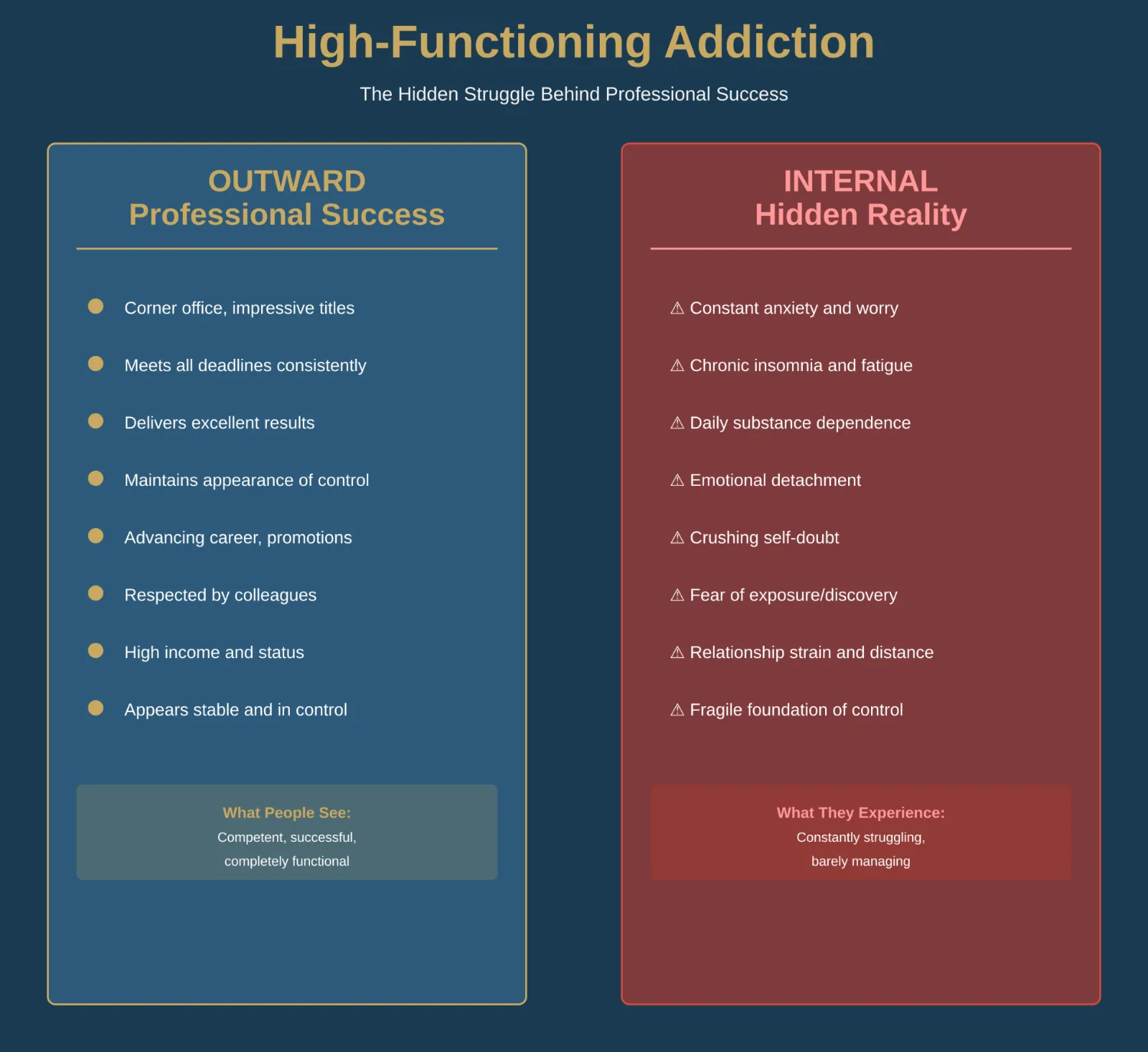
As a result, high-functioning addiction often progresses unchecked until a critical event, a health crisis, a relationship breakdown, a work incident, or a moment of acute despair, forces them to acknowledge the problem.
The Risk of Treating Only One Side of the Problem
This is where many well-intentioned treatment approaches fail. When only addiction is treated, removing the substance while ignoring the underlying mental health condition, the individual is left with no coping mechanisms for the anxiety, depression, or trauma that originally drove the substance use. They enter recovery emotionally vulnerable, with unresolved pain still demanding attention.
Similarly, treating only the mental health condition, prescribing medication for anxiety or depression while ignoring the addiction, often fails because the substance use has become so intertwined with daily functioning that the individual continues using despite psychiatric treatment. The medication may help mood, but it doesn’t address the compulsive behavior, the tolerance building, or the psychological dependence that has developed.
The result is predictable: recurring cycles of relapse, plateaus in recovery, and a deepening sense of hopelessness. The individual feels trapped, unable to maintain sobriety without addressing their mental health, and unable to genuinely heal their mental health while substances are still in the picture. They may complete one or even multiple treatment programs, only to find themselves back in old patterns within months.
The solution is not treating one side better. It is treating both sides simultaneously, with equal sophistication and depth.
What Integrated, High-End Treatment Actually Looks Like
For high-achieving individuals, integrated dual diagnosis treatment requires a sophisticated approach that honors their intelligence, respects their time, and acknowledges their unique pressures.
Medical Detoxification with Complete Discretion
The foundation of treatment often begins with medical detoxification, conducted with the highest level of privacy and clinical expertise. For high-achieving individuals, this means hospitalization-grade medical monitoring in a discrete, professional setting, away from public view and the demands of work and personal life. Medical professionals monitor vital signs, manage withdrawal symptoms, and ensure the physical body can safely adapt while therapeutic support addresses the psychological experience.
- Hospitalization-grade medical monitoring if needed
- Safe withdrawal from substances with minimal physical distress
- Private, professional setting away from public view
- Simultaneous mental health support during the detoxification process
Therapy Tailored to High-Achievers
Beyond medical management, the therapeutic work is where genuine healing occurs. High-achieving individuals require therapy that honors their complexity, addresses the root causes of their addiction, and helps them maintain the excellence and drive that define them, but in healthier ways. It is sophisticated psychological work that explores how perfectionism and the need for control have shaped both their success and their struggle.
- Trauma-informed care exploring roots of perfectionism and anxiety
- Performance-focused therapy addressing drive for excellence and achievement
- Cognitive-behavioral therapy tailored to executive challenges and pressures
- Exploration of how addiction served them (managing emotions, maintaining high output) and healthier alternatives
Psychiatric Care and Medication Management
Many high-achievers have genuine mental health conditions, anxiety, depression, PTSD, that predate their substance use and will persist after addiction is addressed. The question is how to treat these conditions carefully, with precision. A psychiatrist specializing in addiction medicine evaluates whether medication is genuinely needed, which medications are appropriate, and how to manage prescriptions in a way that supports recovery rather than enabling continued dependence. This is clinical discernment, providing real relief from real mental health conditions while avoiding the trap of substituting one dependency for another.
Personalized Care Planning
The final critical component is planning that reflects the individual’s actual life. High-achievers often need to maintain at least some professional engagement during treatment, board calls, client relationships, or other commitments that cannot simply be abandoned. Some may need to completely step back; others benefit from limited, structured involvement. The recovery plan should reflect their specific situation, timeline, and goals. It should address how to return to a demanding career from a place of genuine wellness. This level of customization requires one-on-one attention with experienced professionals who understand both addiction and the high-pressure environments these individuals navigate.
This is private, executive-level addiction treatment. It acknowledges the real constraints and pressures in the lives of high-achievers while providing the clinical rigor necessary for lasting recovery.
Equally important is the medication management component. A psychiatrist experienced in addiction medicine carefully considers what psychiatric medications might genuinely help, addressing the depression, anxiety, or sleep issues, versus what might enable continued substance reliance or create new dependencies. This is clinical precision at its finest.
Why a Private, Personalized Approach Leads to Better Outcomes
Privacy transforms the treatment experience. When high-achievers know their information will be protected, when they don’t fear their employer finding out, their board learning of their struggle, or their professional reputation being damaged, they become genuinely open in therapy. They stop managing their image and start addressing their reality. This openness is essential for meaningful therapeutic work.
Customized care versus generic programs is a clinical necessity. A high-powered executive has different triggers, different coping mechanisms, and different recovery goals than someone in a different life circumstance. A program designed for one-size-fits-all recovery will not address the specific high-pressure environments these individuals return to, the perfectionism driving their behavior, or the fear of vulnerability that prevents them from seeking help in the first place.
The outcomes speak clearly. High-achievers in private, personalized and luxury dual diagnosis programs show significantly better long-term recovery rates. They achieve mental clarity, the ability to think and plan without the fog of substances or untreated mental illness. They experience emotional stability, no longer cycling through crises or extreme mood states. And they sustain their professional performance, but now from a place of genuine wellness rather than fragile control. They perform better, feel better, and live better.
This is not recovery that demands sacrifice of success. It is recovery that reclaims success alongside genuine well-being.
Regaining Control: Recovery as a Strategic Investment in Your Future
Recovery is about regaining control, control over your mind, your choices, and your future. For high-achievers, this reframing is essential.
Consider what addiction and untreated mental health cost you. The mental energy spent managing your substance use or fighting through depression. The relationships strained by your emotional distance or irritability. Now consider what genuine recovery offers: the ability to think clearly, to make decisions from wisdom rather than desperation, to build relationships based on authenticity rather than image management. It offers the mental clarity and emotional stability to actually enjoy your success, to feel secure in your professional standing, and to pursue the next chapter of your ambitions from a place of genuine strength.
You do not have to choose between success and well-being. That false choice is part of what created this situation in the first place.
Legacy Healing LA provides confidential, integrated treatment for high-achieving professionals. We understand the pressures you face, the stakes you perceive, and the sophistication you require. Your recovery is our commitment, and your success is our measure of excellence.
Take the First Step
If you recognize yourself in this article, the outward success masking internal struggle, the belief that seeking help would somehow diminish you, the hope that things will improve on their own, we encourage you to reach out.
A confidential consultation with one of our specialists costs nothing and reveals everything you need to know about whether integrated treatment is right for you. We offer:
- Complete privacy and confidentiality
- Dual diagnosis expertise (addiction + mental health)
- Personalized treatment planning
- Medical detoxification with premium care
- Therapy tailored to executive challenges
- Psychiatry specializing in addiction medicine
- Insurance verification and flexible options
Your recovery starts with a single conversation. Contact us today at 8008084570 for a confidential assessment.